







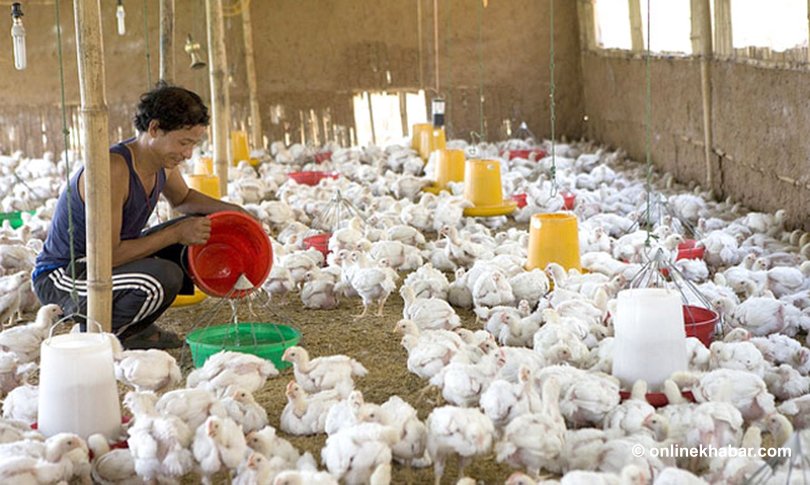
Kathmandu, March 22: Nepal’s poultry industry is pulling in serious money, around Rs 58 billion a year just from broiler chicken sales. Not bad for something that used to sit quietly in backyard coops.
Data from the National Statistics Office shows roughly 117 million broilers are raised annually, out of about 127.6 million total chickens. More than 100 million broilers are sold each year, generating close to Rs 57.9 billion. Farmers typically raise them for about 44 days before selling them at an average weight of 2.6 kg.
The sector has shifted fast from subsistence farming to full-on business. Chief Statistician Madhusudan Burlakoti points out that short production cycles and low land requirements make poultry attractive for small investors. In plain terms, quick turnover and modest startup costs are pulling people in.
Commercial poultry farming now operates in 75 districts, missing only Manang and Mustang. Around 22,928 farms are involved, with 92 per cent focused on meat, 7.4 per cent on eggs, and a tiny fraction on chick production.
Bagmati Province leads in output and earnings. Karnali records the highest broiler price at Rs 278 per kg, while Madhesh sits at the bottom with Rs 192.
The business still leans heavily male, with men running nearly 80 per cent of farms. Women manage about 20 per cent. Most farms are individually owned, and the largest group of farmers falls between the ages of 35 and 44. Altogether, nearly 64,000 people work in the sector.
Running these farms is not cheap. Total spending reaches about Rs 78.4 billion, with feed alone swallowing nearly Rs 54 billion. Chick purchases take another Rs 11.6 billion, and medicines and vaccines cost about Rs 2.5 billion.
Bagmati again tops spending, followed by Gandaki and Lumbini. Karnali trails far behind.
On the production side, 243 million eggs were incubated nationwide last fiscal year, producing 204 million chicks, an 82 per cent success rate. Of these, 194 million chicks were sold, earning around Rs 10 billion, with each chick priced at about Rs 59.
People’s News Monitoring Service

Login to add a comment