








National/Regional/International Affairs

By N. P. Upadhyaya (Aryal)
Biratnagar: The fresh visit of French President Emanuel Macron to China surely has political connotations which well speak of the increasing diplomatic acumen of the Chinese regime. The visit has just concluded.
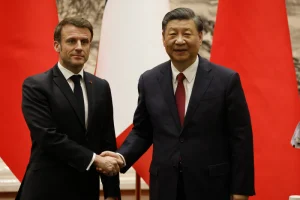 Needless to say, Beijing has of late increased its political and diplomatic contacts with the countries that are or were “excessively” close to the lone Super Power-the USA. Let’s take it this way: China is penetrating deep into the space occupied by the US in the previous decades inside Europe more so after the Ukraine crisis. The European nations are allies of the US housed in the NATO block.
Whether one likes it or not, the foreign policy of President Joe Biden’s administration has not worked to the extent it was supposed or expected to as compared to the rival regime of China. Thus the US need to review its foreign policy to match China’s pro-active diplomacy, say informed Nepali analysts.
For sure, the US and China are not on good terms on some political counts and the fresh one that has irked China is Taiwanese President Tsai Ing-wen’s sounding sort of warning that “democracy was under threat” as the lady president met with the US House Speaker Kevin McCarthy on last week in California, US, – a highly anticipated event that marked a show of democratic solidarity in defiance of threats from China, so write Clare Doren and Simone McCarthy for the CNN, April 06.
“The friendship between the people of Taiwan and America is a matter of profound importance to the free world. It is critical to maintaining economic freedom, peace and regional stability,” McCarthy, host in CA, said to CNN reporters. Perhaps it is this visit that has scratched the already strained ties in between China and the USA.
Taiwan is an integral part of China, the authorities in Beijing claim. Conversely, Taiwan claims itself as a sovereign nation.
Reacting sharply to Tsai’s visit, the Chinese response was, as reported by Chris Buckley and Amy Chang Chien for the New York Times, April 6, “Do not go down this dark path of ‘riding on the back of the U.S. to seek independence”.
The Communist Party of China (CPC) office for Taiwan policy further said, “Any bid for ‘independence’ will be smashed to pieces by the power of the sons and daughters of China opposed to ‘independence’ and advancing unification.”
In our opinion, this visit of Tsai to California has brought yet another high voltage fresh controversy in the already wrecked ties between the US and China. The US-China ties are on the edge.
Tsai Ing-wen said of the US, “Yet what binds the two countries together is the “colossal trade turnover” in between the two that, say high-placed economists run in billions and billions. However, like the trade turnover, the politics of the two countries sharply differ from each other.
Nepali observers say that the altercation between China and the US is that the latter thinks that China should follow the US lines on some key international issues, however, China claims that the world must not run under the whims of the US. China talks of the prevalence of a multipolar world. These conflicting issues have shaped the relations between the two countries of late.
The Ukraine-Russian Federation conflict too has distanced China from the US for obvious reasons. If the European nations are the declared natural allies of the US then with the Russian Federation-Ukraine war of the year 2022 February lingering, China too apparently has added its strength to the Russian Federation. Say a sort of undeclared Russia-China alliance exists.
At least this is perceived by the US and its allies in Europe and hence the rush of European leaders to Beijing. And with the fresh visit of Chinese President Xi Jinping to Moscow, international observers/commentators opine that the two countries have come even closer much to the chagrin of the US and its allies.
If Xi’s visit to Moscow has further cemented Moscow-Beijing ties and given a new height to their bilateral relations then the 12-point peace plan which President Xi forwarded before he visited Moscow aiming the end of the overly stretched Russia-Ukraine war too may have, let’s presume for the sake of convenience, morally pressed Moscow to think that the plan pushed by Beijing to end the war was an important gesture from Beijing to Moscow. Moscow has praised the Chinese peace plan.
Informed sources say that the 12-point peace plan of Beijing has in many more ways than one forced even Ukrainian President Voldomyr Zelensky to study the inner content of the plan as such.
A BBC news story made by George Wright & Jaroslav Lukiv on 25 February reported that Ukrainian President Volodymyr Zelensky said that he plans to meet China’s leader Xi Jinping to discuss Beijing’s proposals on ending the war in Ukraine.
George Wright and Jaroslav Lukiv had given further details that Zelensky speaking on the first anniversary of Russia’s full-scale invasion also said that the proposal forwarded by Beijing signalled that China was involved in the search for peace.
“I really want to believe that China will not supply weapons to Russia,” Zelensky told the BBC.
China’s plan calls for peace talks and respect for national sovereignty, added Zelensky.
However, Antony Blinken suspects the Chinese peace plan and hints that the plan as such favors the Russians in full.
The 12-point document does not specifically say that Russia must withdraw its troops from Ukraine, and it also condemns the usage of “unilateral sanctions”, in what is seen as a veiled criticism of Ukraine’s allies in the West, reports BBC.
The peace plan that doesn’t call Russia for withdrawal raises several questions on the intent of China and commentators thus hasten to opine that the Chinese plan is aimed at keeping Russian interests supreme.
Others say that it may not be true as a mediator of the stature of China must not have done so which summarily ignores the Ukrainian prestige involved and by implication also of the entire NATO world.
Jo Inge Bekkevold, however, looks at China’s peace plan with suspicion and says that China has several ulterior motives behind the peace plan in his article “China’s ‘Peace Plan’ for Ukraine Isn’t About Peace’” and that Beijing’s diplomatic overture has ulterior motives. Jo Inge is a senior China fellow at the Norwegian Institute for Defence Studies.
His article published in the Foreign Policy (FP), April 4, says in part, “The Chinese initiative should be viewed as a piece in China’s intensified informational and diplomatic rivalry with the United States. After running its diplomatic activity at reduced speed for almost three years due to the COVID-19 pandemic, Beijing has recently launched several foreign policy initiatives. The most prominent of these is the so-called peace proposal on Ukraine, with which China aims to strengthen its position vis-à-vis the United States among three specific audiences: the global south, Europe, and postwar Ukraine.
Inge’s version may be correct in his own and his country’s perspective, yet what is for sure and equally true is that China wants to establish itself as an internationally recognized peacemaker.
China’s objective is to stand high vis-à-vis the rival USA. This fact remains not a secret and China too has not kept it guarded secret so is the rival USA.
The present “excessive” hobnob of President Xi Jinping with the visiting French President Emanuel Macron too seemingly possesses underneath a motive and that being to lure France — a powerful country in Europe and also a trusted ally of the USA to signal the US that China could, if need be, enter into the heart of the US power-base such as in Europe.
On 6 April the two Presidents, Xi and Macron agreed that China and France, as permanent members of the UN Security Council and major countries with a tradition of independence, should keep to the overall direction of a comprehensive strategic partnership that is stable, mutually beneficial, enterprising and dynamic, inject new vitality into China-Europe relations.
France and China also agreed to support each other and promote the improvement of global governance and that China and France will continue to support a multi-polar world and greater democracy in international relations, oppose Cold War mentality and bloc confrontation, and jointly tackle all types of global challenges. China supports France in hosting a successful UN Ocean Conference in 2025 and welcomes France’s participation at the third Belt and Road Forum for International Cooperation.
The use of the word “multipolar and greater democracy” in the conduct of international relations is what China has been advocating since its ties with the US began deteriorating. And this is what is being contested by the USA. France this time has okayed the Chinese line much to the chagrin of the USA perhaps.
Yet President Macron during his bilateral talks with his Chinese counterpart said or hoped, “I know I can count on you to bring Russia to its senses and everyone to the negotiating table”, writes Tom Burges WATSON for France 24, April 6.
In response President Xi said that he “stood ready to issue a joint call with France” for the resumption of “peace talks as soon as possible”, according to Chinese state media Xinhua.
Diplomatic sources in Europe say quoting a French diplomat that President Xi has expressed willingness to speak with Zelensky, but only when the time is right. Notably, President Zelensky too, media agencies claim, wants to meet President Xi. But will the US and its allies allow Zelensky to meet President Xi?
Some international media agencies claim that President Macron “pressed Xi Jinping not to deliver anything to Russia that would be used for its war against Ukraine”. This news comes in the wake of Western claims that Beijing could be mulling arms shipments to support Russia’s war.
While the French President was already in Beijing, yet another European dignitary, Ursula von der Level, European Commission Chief, too accompanied the President also had high praises for Xi Jinping on his statement that he would wish to meet President Zelensky. However, Ursula warned that arms shipments to Russia would “significantly harm” relations.
In the process, China’s deep penetration of late in the Gulf/Middle with the successful mediation between Riyadh and Tehran has to a greater extent enhanced China’s prestige globally. The Chinese peace plan for the Russian Federation-Ukraine may not work yet with some additions a new peace plan that takes care of both the conflicting countries could be devised.
Let’s hope the US and its allies take the lead. The Russia-Ukraine war continues and has already entered its second year unfortunately.
To recall, the German Chancellor on November 5 last year requested the Chinese President Xi Jinping in Beijing, to exert its influence on Russia and the latter has made several calls for the commencement of a bilateral dialogue.
The fact is also that, Nepali observers claim that China so far has not criticized Russia for what the Russians call a “military operation” on Ukraine. What does it mean then?
Yet things have not moved for the better. Both have taken it as a matter of esteem. The United Nations remains a mere onlooker thereby giving the impression that the UN Body needs to be dissolved if it can’t function.
The UN has a track record of non-functioning bodies as it has summarily failed to take its own “resolutions” made in the past to bring into execution on matters of India Occupied Kashmir.
Notably, the Kashmir dispute needs early settlement or else Kashmir in itself is more or less a “bombshell” that if not handled with care may be the “origin” of a possible full-scale war between the two declared rivals — Pakistan and India.
India’s engagement in the US-designed Quad too has in many more ways than one diminished the prospect of the early resolution of the Kashmir dispute as the Western nations for several political reasons have been nourishing the Indian regime.
It is this reason, as could be concluded, that has affected the UN body to act in an “impartial manner” for the execution of its “resolutions” made on disputed Kashmir beginning as early as 1949.
Back to the South Asian region:
As if the continued competition were not enough, India has once again taken the initiative to tease Pakistan by making the approaching G20 venue in Sri Nagar this May third week, say international and Indian media sources.
The countries housed in the G20 include almost 70 per cent of the world’s population.
Indian officials say that the event will promote tourism in this part of India. However, Nazia Sheikh writing for the Modern Diplomacy, March 12, says that “as Delhi plans to host G20 members in Srinagar, the world should remember that Jammu and Kashmir is an internationally recognized “disputed” territory between Pakistan and India. Kashmiris are being killed and evicted from their homes and lands under a brutal plan to change IOS JK’s demography. As per international law, Modi’s actions in Kashmir can describe genocide as a war crime against humanity”.
In her article, she also adds, “Pakistan also strongly urges the international community to call upon India to end its gross and systematic violations of human rights in J&K, revoke its illegal and unilateral actions of 5 August 2019, and free all political prisoners including the true Kashmiri leaders”.
With all this Indian highhandedness in this part of the world, let’s presume that South Asia once again is the venue of a likely disorder manufactured by India.
Nepali observers ask how the well-informed and powerful international community could ignore such an erratic act of the Indian government and allow the G20 event to happen in disputed Kashmir which is legally not even a part of India.
The event that is being forcibly planned in the disputed territory speaks well to how the developed West and the UN Body possess a clear bias for the Indian regime, the regional policeman deputed by the USA. The USA is being used and overused by India to its benefit. That’s all.

Login to add a comment