







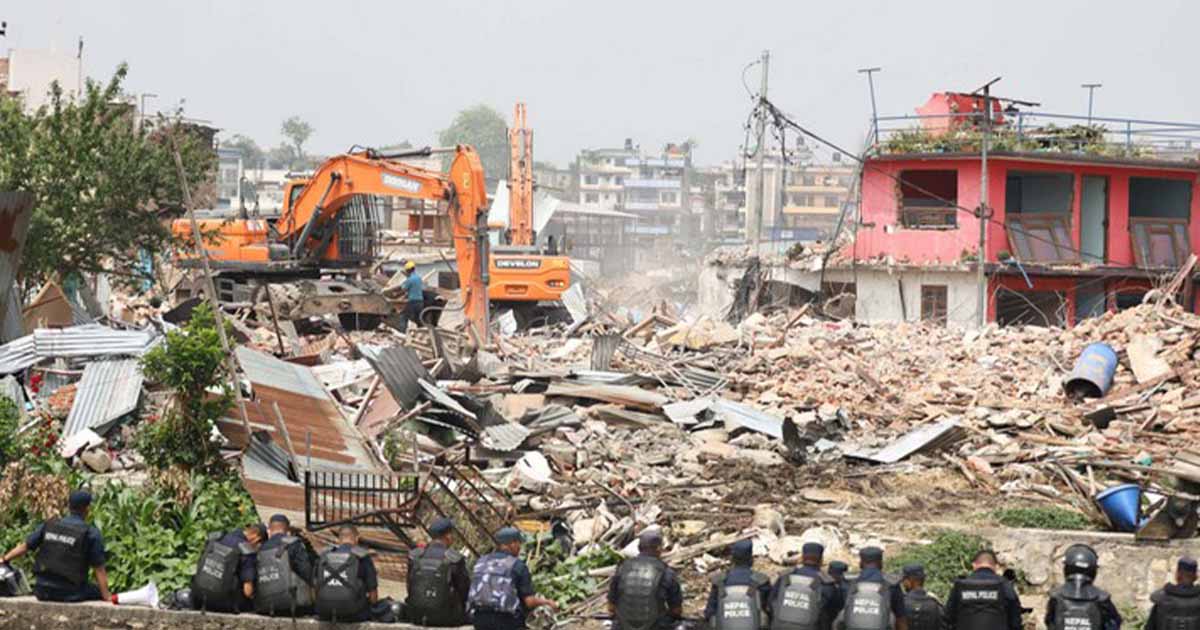
Kathmandu, May 1: Authorities have already displaced 1,800 families, and starting Friday, bulldozers will move into the homes of another 1,700 families.
Over the weekend, the government cleared informal settlements in Thapathali, Sinamangal, Gairigaun, Shantinagar, and Manohara areas of the Kathmandu Valley, evicting nearly 10,000 landless and unplanned settlers.
Even before completing arrangements for those already displaced, the District Administration Office, Kathmandu, has issued a notice to begin further demolitions. The office said eviction drives will start simultaneously across the district from 7 am on Friday.
A report published by the Ministry of Urban Development in Falgun 2079 BS estimates around 3,500 informal households living across the Valley. Of these, about 1,800 families were residing in settlements already demolished.
As per the administration’s plan, another 1,700 families will be displaced in the next phase, affecting around 7,000 people and leaving them in fear and uncertainty.
Following the notice, residents of informal settlements in Khadipakha, Ranibari, and Narayantol areas of Kathmandu Metropolitan City-3 have begun vacating their homes.
Government records show 3,459 informal households across the Valley, including 90 in Kageshwori Manohara Municipality, 138 in Budhanilkantha, 17 in Lalitpur Metropolitan City, 215 in Godawari, 773 in Madhyapur Thimi, and 2,226 within Kathmandu Metropolitan City.
The number of landless, Dalit, and informal settlers is even higher. According to the Land Problem Resolution Commission, more than 125,236 individuals in Kathmandu district have registered as landless or informal settlers.
Of those displaced over the weekend, more than 1,200 families, representing around 5,000 people, had contacted authorities by Wednesday. They registered their details at a screening center set up at Dasharath Stadium in Tripureshwor. Separate desks were operated by the Bagmati Civilization Integrated Development Project and the Kathmandu Valley Development Authority to collect data.
Most of those who reached out have taken shelter with relatives, neighbors, or in rented rooms. Around 150 families, with nowhere to go, are currently relying on government support. More than 60 families are staying at a temporary holding center set up in an open hall at Radhaswami Satsang in Kirtipur, while nearly 150 families are living in hotels in Balaju, New Bus Park, and Machhapokhari.
Kumar Sinkhada, a social mobilizer with the Bagmati Civilization Development Project, said screening of displaced families is ongoing. Data was collected at the stadium from Saturday to Tuesday, and is now being recorded at respective offices.
Authorities will verify the collected data and cross-check it with earlier surveys conducted in 2079 BS. After identification, officials will coordinate with the Ministry of Land Management to determine whether the families own land elsewhere.
Under current government criteria, those classified as landless squatters may be relocated to apartments in Nagarjun Municipality. But those facilities can accommodate only around 45 families.
Officials say the entire process could take about two weeks. The government has also pledged to manage the landless within 15 days.
Even as rehabilitation remains incomplete, preparations are already underway to clear additional settlements along riverbanks and public land in the next phase.
People’s News Monitoring Service

Login to add a comment