








By Deepak Joshi Pokhrel
Last Thursday Nepal got its third President amidst a bitter crisis in the ruling coalition since the Himalayan nation ended its centuries-old monarchy. A social democrat and seasoned politician, Ram Chandra Paudel, replaces Bidya Devi Bhandari. Here is how Paudal rose to power.
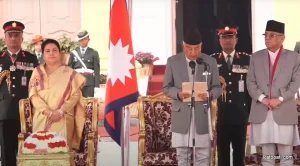 Born in a middle-class farmers’ family, Paudel was very interested in politics right from his childhood. He was born on October 14, 1944, in Bahunpokhari of the Tanahun district. He holds a Master’s Degree in Arts with the Nepali language as the major subject. As reported by the media, Paudel joined politics at the age of 16. Soon after joining politics, he became the founding central member of the Nepal Students’ Union, the student wing of the Nepali Congress, in 1970. This was a huge platform for Paudel to showcase his strength and make a space within the party.
With his gaining popularity, Paudel soon became the talk of the town. He was appointed vice president of the Nepali Congress Tanahun district committee in 1980 which led him to the foundation upon which his political career was built and strengthened. In 2005, he became general secretary and vice president in 2007 and acting president of the party in 2015.
He has been a tall figure in political movements in defending and strengthening democracy in the country. He played an active role in the Satyagraha of 1985, the People’s Movement of 1990 and the People’s Movement of 2006. He spent 12 years in jail fighting against the Panchayat regime, which was in place from 1961 to 1990 and concentrated all powers in the hands of the King. He has authored over a dozen books about democracy, socialism and agriculture. Paudel is married to Sabita, and they have four daughters and a son.
Paudel was elected to the House of Representatives from the Tanahun district for the first time in 1991. Thereafter, he represented Tanahun for six consecutive terms. He was appointed minister for local development in May 1991 and became agriculture minister in 1992. Paudel served as a speaker from December 1994 to March 1999. He served as deputy prime minister and minister for home and minister for information and communication from 1999 to 2002. Paudel also served as deputy prime minister and minister for peace and reconstruction from 2007 to 2008. He was elected parliamentary party leader of the Nepali Congress and leader of the main opposition in Parliament from 2008 to 2013.
In 2020, he was honoured with the Grand Cordon of the Order of the Rising Sun from Japan, for his role in strengthening Nepal-Japan ties.
With the vote of 214 lawmakers of Parliament and 352 provincial assembly members, Paudel, 78, secured a comfortable victory over rival Subas Chandra Nebmang. The total number of voters for the election of the President is 882, consisting of 332 members of the parliament and 550 members of the provincial assemblies of the seven provinces.
Paudel has assumed his office at a time when political confrontation has become the norm and values of every party in the country. Their only intention is to remain in power — no matter how it comes. Amidst this political uncertainty, the newly elected President will have to make a cautious move to save himself from dragging into controversy.
This is the third presidential election in Nepal after we ended the monarchy in 2008. The term of office of the President is five years from the date of election and one can be elected to the post for only two terms. Although the post of President is largely ceremonial, they hold some discretionary powers accorded by the constitution.
Paudel will have to authenticate many bills while he is in office. It is also crystal clear that the parties will table many bills that will threaten our sovereignty and nationality. The outgoing President was heavily criticized by some leaders of the parties regarding some decisions which according to her were against the broader national interest.
A political analyst says that the President is required to play a largely ceremonial role, though it can play a key function during political crises. They also argue that the biggest challenge for the new president is to maintain an impartial constitutional role. Furthermore, the president is not supposed to independently act, nor be a separate power centre. In most cases, the president is supposed to act on the recommendation and with the consent of the prime minister.
As our politicians can embrace any measures to put even the head of the state under pressure, we hope that our newly elected president will not succumb to their pressure and sign any bill that threatens our sovereignty and nationality. We also believe that the newly elected president, endowed with decade’s political experience, will be able to decide what is right and what is not for the country.
We wish him good luck for his successful tenure. We also extend our support and collaboration that will help us to establish a prosperous Nepal.

Login to add a comment