







The right to People’s Freedom of Expression is fundamental
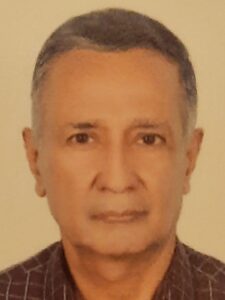
Dr Upendra Gautam is the secretary general of the China Study Center Nepal. Gautam is known as a scholar and expert on institutional building in water/irrigation resource development and management. Dr Gautam is the junior brother of a senior journalist late Devendra Gautam, editor-in-chief of Nepal Post fame.
We requested Dr Gautam to share insight and experience about the late Gautam who passed away on 18 September 2022. Dr Gautam’s recollection of the late Gautam and Nepal Post is given below:
Q.: The People’s Review Weekly: We know, you are the junior brother of senior journalist, the late Devendra Gautam. It has been about four and half months since he passed away (Asoj 2, 2079 B.S/18 September 2022). How does his role in the Fourth State continue hereon?
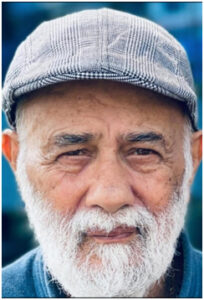
The late Devendra Gautam
Ans: Upendra Gautam: Daajee (Devendra Gautam) was an apostle of the people’s fundamental right to freedom of expression. He always struggled for independence and correctness in information dissemination and knowledge sharing. Even many noted journalists could not be correctly critical of the late Devendra Gautam and his Nepal Post for the people’s right to freedom of expression and took his long struggle for this right as resentment and dissent against a particular political regime of the King. An example is the obituary of Devendra by a renowned journalist Dr Kundan Aryal (Naya Patrika, 29 Asoja, 079 B.S). For Devendra and the believers in him, the struggle needs to continue with more vitality and united strength as domestic and foreign politicians in consort are playing out a game to appease journalists and media elites with their ever-intensified promises of “press freedom” at the high cost of the people’s fundamental right to freedom of expression. The big question is: how genuine is press freedom when the people’s basic right to freedom of expression is subjugated and becomes a part of a commercial deal?
In the present context of Nepal, the working “fundamental right” of the people has become the people’s “right to get killed or suicide.” The late Devendra Gautam perpetually loved to assert sustained vital ties with China and Israel, the other asset in his tradition. Talking of diplomacy in Nepal, we were grateful to have the high-quality services of the late Shammy Laor and Zhang Jiuhuan, ambassadors of Israel and China to Nepal, who always took care to strengthen Nepal’s self-pride and honor. In my modest way, I have been effortful to carry on the two values.
His younger son Kiran Gautam fully subscribes to his father’s basic values. As a young boy, he had deeply felt the repression his father suffered through at the hands of, in the words of renowned lawyer late Krishna Prasad Pant, ‘state-sponsored terrorism.” His “fatherly value nurturing works” include publications in the realm of social, cultural, philosophical, architectural and inter-generational works. He, representing the Current Media and Research Center Pvt. Ltd signed additional agreements the other day in Beijing with the Chinese publishers including FLTRP to publish the Nepali edition of “Key Concepts in Traditional Chinese Rule of Law Culture.” He likes to extend a helping hand to the organizations related to the right to freedom of expression like the Federation of Nepal Journalists and the Editors’ Society of Nepal, and the sustenance of the vital ties with China through deeper creative exchanges in publication and translation works, joint civilizational level seminars and candid delegation level dialogues.
Q.: The late Gautam edited and published the Nepal Post and Current carving an originally distinct space for him in the annals of modern journalism in Nepal. You were a part of the editorial team. Nepal Post made its first appearance in the media market on 14 December 1973. How do you view the beginning and then afterwards?
A: We published “Rasayan” (literarily meaning “catalyst “), a three-monthly journal of science literature, before Nepal Post and Current. We had “science” in the bye-line of the journal name to impress the authoritarian office of the Zonal Commissioner (Anchaladhish of the Bagmati Zone) with our scientific outlook for this was the office that had the authority to register or not to register a journal. Rochak Ghimire, the editor-in-chief of bimonthly Rachana fame, had very appropriately suggested this title name. Rasayan got registered and published in the last quarter of 1970 (Push, 2027 B.S). In its registration, we received the blessings of the late Harihar Nath Regmi, our brother-in-law. The late Regmi, a teacher of the English language and literature par excellence, for a short period was in an official position in the Commissioner’s office.
In one of the numbers of the journal, we had offered a toast to His Majesty King Birendra on his birthday. The toast was symbolized by a filled glass within the graphic outline of the Nepali number Shri-Paanch (five), the formal entitlement representing His Majesty the King in Nepal.
Rasayan was our communication tool to get into Nepal’s most conscious and articulate people’s community, the knowledgeable institutions, their colors and shades if any and have a sense of the difficulties, challenges and prospects the society faced in the exercise of the fundamental right to freedom of expression. With it, we were able to establish our reach individually to a distinct group of writers and analysts that with progressing time included Manas and National Star group members led by Durga Poharel along with Shrish Rana and Upendra Shamsher; Mahesh Raj Pant, Bishweshwor
Man Shrestha (Biman), Siddheshwor Man Shrestha, Shakti Lamsal, Raju Sayami (Rasa), Bidhyadhar Gotame, Guna Raj Shandilya Kafle, Mahendra Chalise, Pushkar Lohani, and writers associated with Rachana including Ramesh Bikal (Rabi Babu), Bhairab Aryal, Som Nath Byas Ghimire and his sons Keshab, Raghu, Govinda, Madhav; and Padam Paudel (Padmanav). Gehendra Man Amatya, who was also the block maker for photo printing, and Balaram Thapa regularly contributed sketches for the cartoon column “this side.” All these writers, analysts and cartoonists were highly educated, and many excelled in the creative arts of public communication. Without such human assets, Nepal Post/Current could not have gained the class we are proud of.
Journalism has never been a comfort enterprise for journalists advocating the right to freedom of expression with a basic angle of promoting vital outside ties that supported Nepal’s independent development and security. We felt we could do it substantially if we do not become a part of any conspiracies-so endemic in the “free” journalist world.
A couple of years in Rasayan we prepared for and overlapped ourselves with journalism the society called “mainstream.” We did not like this branding and would not like it all to be a part of it. So right from the beginning and afterwards, Nepal Post, a name, inspired by the Washington Post, the adversary role of the Fourth State was an essential permanent value for us. This value we felt our society required not only to safeguard but also to nurture the fundamental people’s right to freedom of expression. Then the leaders of Nepalese journalism like the late Gopal Das Shrestha of the Commoner Daily and Maniraj Upadhyay of Samaj Daily would not agree with us. Their disagreement did not swerve us from our basic values. Another famous name in the press circle Manindra Raj Shrestha, the ever-immaculately dressed editor of the Motherland daily would just give us a sweet smile on any discussion on press values.
Devendra Gautam was the editor-in-chief and publisher of the two journals. He was determined on the journalistic course he chose to lead. I supported him as the foreign affairs editor. He performed the lead role in the journals during all adverse situations — financial, political-administrative; a personalized vendetta, and interfering foreign pressure even on the Nepal Council of Ministers to take punitive measures against Nepal Post stories. Dr Prakash Chandra Lohani, an acknowledged name in Nepal’s intellectual circle, and then a member of the Council of Ministers, once had referred to such an interfering foreign case relating to Nepal Post, asking us to take care.
The late Gautam consistently provided guardianship to the basic principle that we cherished to practice in Nepal Post in the adversary role, more so, during times of vendetta and repression. The autonomous operation and management of the highly engaging journalist affairs were adapted to the extent of our ability with the cherished basic principle.
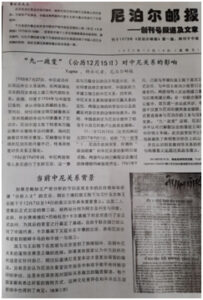 You have rightly mentioned the date the first number of the Nepal Post reached the newsstand. This was the day King Birendra returned to Nepal after completing his first state visit to China. The first issue featured the Nepal-China bilateral relations and their international dimension. Israel has been the other country we kept in very high esteem. Our transparent external policy on these two countries was inspired by their firm and consistent stand on their independent development and indomitable sense of national security.
Nepal’s late prime ministers TP Acharya and BP Koirala’s foresight and courage to establish full-fledged diplomatic ties with China in 1955 and Israel in 1960 respectively under King Mahindra’s reign had perpetually impressed us. For Dr (H.C.) Chiran S. Thapa, then royal palace principal secretary on press and foreign affairs to King Birendra, Nepal Post policy on foreign ties was a reflection of a willingness and ability which though looked ideologically contradictory was in fact an astute one to realistically safeguard Nepal from geopolitical as well as a geo-strategic whirlwind.
Q.: Could you highlight some events that illustrate his journalistic acumen?
Ans: I will try my best to recollect a few. I beg pardon of the readers and the late and living Nepal Post team members for my inability to mention several important lesson-giving episodes in the long struggle-bound trajectory of modern journalism in Nepal.
At one point, Indian Embassy in Kathmandu invited him to undertake a visit to the Republic of India.
- The visit was lavish, organized well and took him to different cities in India. The Embassy looked to test his nerves and socialize with him to an extent. He felt the Indians really tried him. I felt he enjoyed the visit to the cultural and urban places. A rare awesome moment for him seemed to be his meeting with Nepal’s Communist father figure Pushpa Lal Shrestha in Calcutta. On issues he felt serious enough; he would not hesitate to visit Indian Embassy at the Launcher where he would politely insist to have a translator as he felt it was easier for him to talk in the Nepali language. He did not see anything wrong in his behavior. He considered the Indian Embassy here to serve the Nepali people as the Nepal Embassy in Delhi was to serve the Indians.
- Royal Nepal Army was strongly feeling troubled at the hand of a section of the Nepal Police. Nepal Police has started publicizing the incident of a contractor who died inside the Baglung Army Camp. Police were portraying the event as a case of murder inside the camp. On a fine day, I got a call from Shrish. He wanted me to meet his uncle Satchit Shamsher JBR who was then C-in-C of the Nepal Army on the case in his Fohora Darbar residence. Before going to meet him, I briefed the matter to my brother. Our conclusion was we should cooperate with the Army in the best possible way, and we should not expect some favor from them. Any persons or institutions wrongly implicated in a crime without independent and fair investigation should be protected. The following evening, I saw the C-in-C. After some time, Gadul Shamshera Rana, director of military operations, joined. The Army was seeking some help from us. Under the rule, they could not go public formally with the press. Even for our informal meeting, they had got the prior consent of the King. They had prepared a three-page news story on the Banglung Army camp incident. After listening to them, I said we would indeed be happy to help them with the incident as it was a part of our public duty. But we would not use the story the way they prepared. We would prepare it in our way with the key message they want us to deliver to the Nepali public. Finally, we would not like to see a deterioration in our link with the Police because of the story that we definitely publish. Accordingly, all of us played our respective roles as agreed.
- Before the sequel of authoritarian repression of the Nepal Post in the pretext of its alleged link with the “Ram Raja Prasad Singh’s terrorist group,” it was banned repeatedly before too.
Such a case was made on the final day of Dr Tulasi Giri’s Council of Ministers chairmanship. Dr Giri’s guru Pandit Som Nath Ghimire Byas wrote an article in the Post describing the true features of a democracy. Among others, he commented, “the government run by the representatives elected by the people is democracy.” Such a comment was not acceptable to the panchayat regime. Dr Giri advised his guru to go underground to escape arrest. It was the same day when Dr Giri had agreed to address a public meeting on Albania National Day organized by Nepal-Albania Friendship Association. The late Devendra Gautam was the president of the Association. The late Gautam was cool and fully engaged to mark the event successfully. We requested Kedar Man Byathit, a veteran poet and politician, to address the meeting. The following day, the Nepal Post was banned. It was banned also on the issue it published on Gaijatra festival week held every year in the Kathmandu Valley. Traditionally this was the festival when the administration was culturally forced to be tolerant of very creative public expressions packed with acerbic satire. Even on such traditionally recognized festival week celebrating the cultural right to freedom of expression, the zonal commissioner’s office used its draconian power to silence Nepal Post. It was banned twice — once for the satire by Rabi Babu and the second time by Bimal Niva.
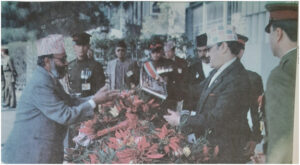
- On December 29, 1994, A.D. (14 Poush, 2051 B.S.), King Birendra released Devendra Gautam’s book entitled “Anushandhan Bhitrako Anushandhan” (published as “Counter Investigation” in English in May 2000). Gautam presented a copy of the book to the King for release amidst a birthday felicitations program at the Royal Palace. Shrish Rana writing an “Editor’s Note” to the English version of the book hailed the book as a “masterpiece on Nepali society as a whole” which “becomes an eye-opener on its own.” The police raj in the panchayat years was justified “in the name of law and order in the interest of preserving the sacrosanct panchayat regime, often using the palace as a convenient shield,” to borrow the words of MRJ from his review of the book that appeared in the People’s Review of 19 January 1995. I heartily appreciated the late Gautam for the courage and humility in openly approaching the King to release a book he penned exposing the brutal highhandedness of a regime the King headed. I am as well-liked to read in this illustration a deeper, sincere symbolic return message of the King to the editor-in-chief of the Nepal Post: Now I am a constitutional king; sorry for the incarceration and excruciation.
- I would not like to leave knowledgeable readers to go with the impression that the late Devendra Gautam and his Nepal Post team were something above the society where personal vested interest and greed are more intensified in the Iron Age. The Nepal Post Libyan story may highlight this side. Libyan Arab Jamahiriya opened its Embassy at the Charge d’ affairs level in Kathmandu in the late 1970s. This north-African country was very oil-wealthy. In April 1979 Moshe Dayan, foreign minister of Israel, a country Nepal Post always held in high esteem, was scheduled to visit Nepal. Considering the strategic significance of the visit, we decided to have another view of it. I approached the lavishly furnished Libyan Charge d’ affairs office located in a Putali Sadak house of Mohan Bahadur Shahi. After the exchange of pleasantry, I started my conversation with the scheduled Nepal visit of Moshe Dayan. The diplomat probably in his mid-20s had counter-questions, ”Why Dayan should visit Nepal; what he can give you? Instead, why do you not ask us for oil that we can provide you at a political price?” His proposal to me was he would like me to have a news commentary in Nepal Post on the visit which should be titled “the destruction of Israel.” Then he offered me a chequebook and asked me to mention any amount I wanted, adding that he is only willing to sign the book. I was momentarily thoughtful before responding, “I noted your generosity. Perhaps we shall not be living just for today. We will prepare the news story in our way and will reflect your views as well. We cannot give the title to the story you suggested.”
Nepal Post Libyan story was simply an example of the international informal diplomacy-media trade that has flourished by leaps and bounds in recent times in Nepal in the given geo-strategic environment. In Nepal Post, we strongly shared a feeling that if we depart from our basic public journalist values and joined a partisan activity, we were doomed the next moment. Indeed, we needed money and at times we also received it for the translation and printing of materials on terrorism, development and project works from government agencies and foreign embassies. We did not bother if still someone had doubts about us.
Late Gautam took the Nepal Post value of people’s right to freedom of expression to China and India too. He invited
- three GAPP (General Administration of Press and Publication, China)/Editor’s Society of China delegations led by Vice-minister level officials Gui Xiaofeng, 2008, Zhou Baiyi, 2009 and Wu Shuling, 2011 to Nepal. These delegations started opening the links, maintaining good and open exchanges between the Editor’s Society of China and the Editors’ Society of Nepal, Nepali media and the communication sector in general. From the Nepal side, he led delegations that visited China and also Hubei province in 2009 and 2010. He supported Hubei media and entrepreneurial teams to visit Nepal in 2010 and 2011 to mutually start creative and cooperative investment initiatives. In all these exchanges with the Chinese counterparts, the late Gautam consistently emphasized Nepal’s independence, sovereignty and economic development by asserting on freedom of right to expression of the people; not limiting this right exclusively to the media and press as it is fashionable in recent times. He reasserted the same basic right to the freedom of expression of the people at the Nepal-India Journalist Conference organized by the Nepal Editors’ Society in May 2011 at Dhulikhel in Nepal.
Q.: How do you describe the late Gautam’s attribute as a person that inspired and guided his self-behavior?
Ans.: He perpetually held the highest regard to the ancestors, father in particular. Out of the fatherly inheritances, he loved most and regularly paid reverence to the late father’s walking stick made out of a single stem of a kush (scientific name Desmostachya bipinnta). This stem grows only once in the life cycle of Kush. Each time he felt bad, he held the stick against his forehead and received joy and inspiration for the moment and the time ahead. He usually blessed us with the stick.
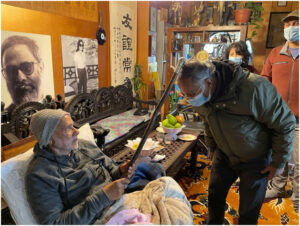
He could discern a news angle even out of a conversation with people of all sorts of color, shades and creeds. His contacts were diverse, with almost all types of people — journalists, politicians, bureaucrats, diplomats, high-end aristocrats — he considered any person was potentially newsworthy only requiring a bit of investigation, fairness in treatment and understanding.
Fear and intimidation were not in the dictionary of the late Gautam. He would feel reenergized when got unfairly challenged. He felt his openness and transparency with everyone at times was sometimes a headache for him for bad people also lived in the society and used him to cover their ill-intention. In such a situation, the larger and better cause would be taken over by his anxiety — here the family members have precisely and affectionately remained infinitely helpful — a safeguard as valuable as the Nepal Post values were for him.

Login to add a comment