







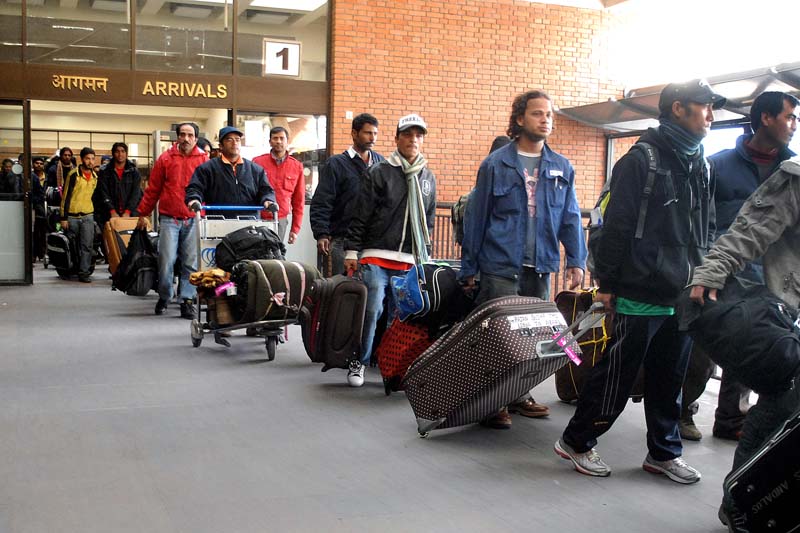
Kathmandu, June 24: Nepal’s foreign employment sector, a major pillar of the national economy, has become increasingly mired in policy distortions, regulatory uncertainty and vested interests. Industry stakeholders argue that outdated laws, inconsistent government policies and bureaucratic hurdles have shifted much of the financial burden onto migrant workers.
With the formation of a strong government, both workers and recruitment agencies had hoped for reforms. The government has announced plans to dismantle syndicates and overhaul the sector. Labour, Employment and Social Security Minister Ramji Yadav recently told Parliament that many of the problems stem from the existing Foreign Employment Act itself, describing it as a “horse without reins.”
Yadav said the government has finalized a draft amendment to the law and plans to send it to the Ministry of Law soon. He stressed that the revised legislation would strengthen worker protection and address longstanding weaknesses in the system.
According to Nepal Association of Foreign Employment Agencies President Dik Bahadur Khatri, provisions in Sections 15 to 19 of the Foreign Employment Act, 2007, need urgent revision. He said unrealistic legal requirements and cumbersome procedures have trapped the sector in what policymakers themselves now call a “policy trap.”
Recruitment agencies argue that increased security deposits and mandatory quotas requiring agencies to send at least 100 workers abroad annually have encouraged unhealthy competition. Ultimately, they say, the added costs are passed on to migrant workers.
Free visa, free ticket remains largely on paper
The government’s much publicized “Free Visa, Free Ticket” policy, introduced in 2015, was intended to ensure employers bear recruitment costs for workers heading to Saudi Arabia, Qatar, Kuwait, Bahrain, Oman, the UAE and Malaysia.
More than a decade later, the policy remains only partially implemented. The current government has acknowledged its shortcomings and pledged reforms. Minister Yadav said a high level task force has been formed to make the policy practical.
Although the policy envisioned an employer pays model, only about 5 to 7 percent of Nepali workers currently migrate under such arrangements. Nearly half still pay visa and airfare costs from their own pockets. While manpower agencies are allowed to charge a service fee of Rs 10,000, industry representatives argue that amount does not even cover administrative expenses, creating room for policy driven corruption and distortions.
New saudi rule adds financial burden
Saudi Arabia, one of the largest destinations for Nepali workers, has introduced mandatory skills certification requirements. Workers who fail skills tests will no longer receive labour approval for Saudi jobs.
The certification process carries a fee of Rs 15,000, adding another financial burden on migrant workers already struggling with rising costs. While stakeholders agree that skills verification is beneficial, many have questioned the fee structure and implementation process.
UAE visa procedures become costlier
The United Arab Emirates has also tightened visa procedures following recent security concerns. Nepali workers must now have police clearance reports authenticated by the UAE Embassy.
The process, conducted through a VFS center, costs workers an additional Rs 14,005 (353 dirhams). Workers also face extra charges to obtain and process police reports, further increasing migration costs.
Health testing syndicate
For years, foreign employment health checks were dominated by a limited group of 171 authorized medical institutions. Workers often paid up to Rs 9,500 for tests that could be conducted in government hospitals for around Rs 3,000.
The government has now opened health examinations to all listed medical institutions and public hospitals. If fully implemented, the reform could save workers billions of rupees. However, similar efforts in the past were reversed under pressure from vested interests.
More than 2,000 Nepalis leave for foreign employment every day, and Nepali workers are employed in over 178 countries. Industry leaders say meaningful legal reform, transparent cost structures and the removal of policy ambiguities could eliminate most distortions and restore credibility to the sector.
People’s News Monitoring Service

Login to add a comment