







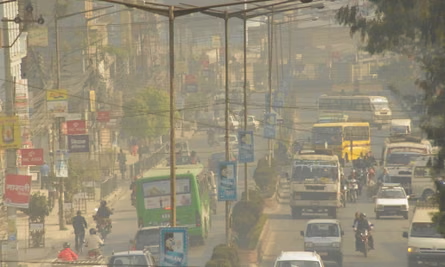
Kathmandu, June 13: The government is preparing to launch a Rs 8.71 billion ($57 million) clean air mega project aimed at reducing air pollution, modernising industries and improving air quality across Nepal.
The Nepal Clean Air and Prosperity Project (NCAPP) is set to begin in the 2026-27 fiscal year after securing $52 million in concessional financing and a $5 million grant from the World Bank.
According to the Department of Environment, the project seeks to overhaul Nepal’s air quality management system while accelerating the shift of industries from fossil fuels and coal to cleaner energy sources.
Department Director General Gyan Raj Subedi said the initiative would strengthen air quality monitoring, support evidence-based policymaking and help industries adopt cleaner technologies.
The project will expand the number of air quality monitoring stations, upgrade existing facilities, add modern laboratory equipment and strengthen the technical and institutional capacity of environmental agencies.
Subedi noted that air pollution imposes heavy economic costs worldwide, with studies estimating losses equivalent to about six percent of global GDP. The project will also assess pollution sources in Nepal and measure their economic and social impacts.
Deputy Director General Saroj Kumar Chaudhary said reducing emissions of fine particulate matter (PM2.5) is the project’s central goal. PM2.5 levels in Kathmandu Valley and the Tarai often exceed World Health Organization guidelines by eight to nine times, posing serious health risks.
Under the programme, industries using coal and other fossil fuels in boilers and furnaces will be encouraged to switch to electric or biomass-based technologies.
Industries converting to electric furnaces will receive capital grants covering up to 20 percent of investment costs. Those adopting biomass technologies, including bio briquettes and bio pellets, will be eligible for grants of up to 10 percent of capital costs. Long term loans of up to 15 years will also be available. Other pollution control equipment will qualify for concessional financing but not direct grants.
The government expects around 400 industries to gain access to affordable financing under the programme. At least 300 industries are targeted for installation of cleaner boilers or furnaces.
The project aims to mobilise $30 million in concessional loans and attract an additional $18 million in private sector investment.
Four air quality monitoring stations will be upgraded into “supersites” capable of identifying pollution sources, analysing emissions data and tracking transboundary pollution.
Once fully implemented, the project is expected to reduce PM2.5 emissions by 500 metric tonnes annually and cut greenhouse gas emissions by 110,000 tonnes each year.
Officials estimate the initiative will directly or indirectly benefit 400 industrial enterprises, about 60,000 workers and nearly 18 million people living in Kathmandu Valley and the Tarai. It is also expected to help Nepal meet its international climate commitments under its Nationally Determined Contributions (NDCs).
People’s News Monitoring Service

Login to add a comment