







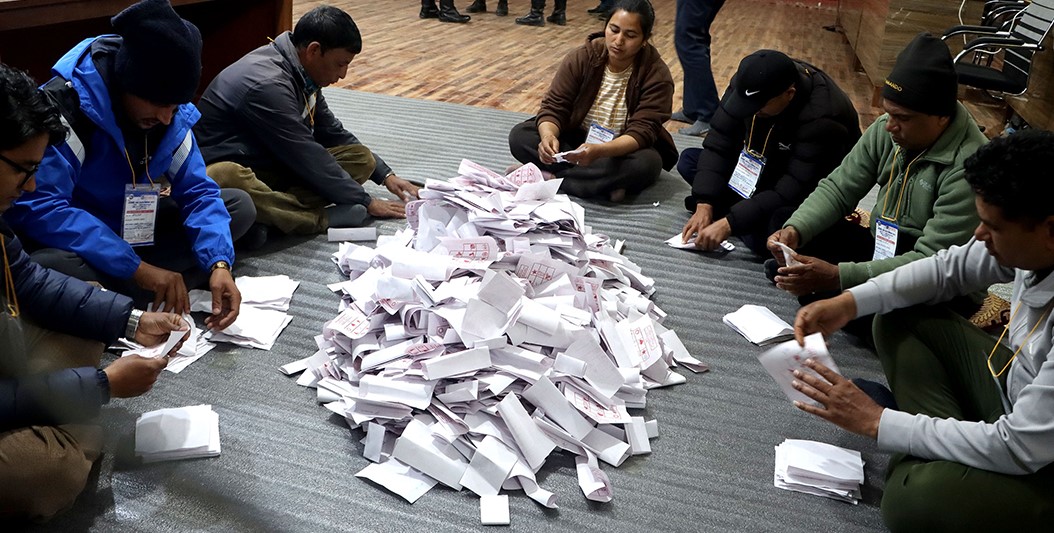
Kathmandu, March 8: Vote counting for Nepal’s House of Representatives election is still underway as results already point to a dramatic political shift. The Rastriya Swatantra Party (RSP) has emerged as the strongest force in the election so far, winning a huge number of constituencies and leading in many others. Traditional political parties that dominated Nepali politics for decades have suffered major setbacks.
According to the Election Commission, results from many constituencies have already been announced. Among those declared winners so far, candidates from the Rastriya Swatantra Party account for the overwhelming majority. Nepali Congress, CPN UML, and the Nepali Communist Party have secured far fewer seats in comparison. A few seats have also gone to smaller parties and independent candidates.
The results suggest a massive shift in voter mood. Many voters appear to have rejected established political parties and turned toward newer political figures and alternative political forces.
One of the most talked about victories came in Jhapa 5. RSP’s prime ministerial candidate Balendra Shah defeated former prime minister and CPN UML chair KP Sharma Oli by a huge margin. Shah received more than 68,000 votes, while Oli remained far behind. The scale of the defeat surprised many observers and signaled growing dissatisfaction with traditional leadership.
RSP candidates have also recorded major victories in several districts across the country. In Rupandehi 3, Dr Lekh Jung Thapa secured a massive win against a Nepali Congress candidate. In Bhaktapur 2, RSP candidate Rajib Khatry defeated UML leader Mahesh Basnet by a large margin.
In Dang 2, Bipin Kumar Acharya defeated UML leader Shankar Pokhrel. The defeat marked Pokhrel’s second consecutive loss in the constituency. In Lalitpur 3, medical doctor Toshima Karki won again as a member of the House of Representatives. She had earlier represented the same constituency and maintained strong support among voters.
The party continued to secure strong victories across other districts. In Rupandehi 2, Sulav Kharel defeated UML leader Bishnu Prasad Paudel by a wide margin. In Morang 6, Rubina Acharya defeated Nepali Congress leader Shekhar Koirala. In Morang 4, Santosh Rajbanshi secured another win for the party.
In the Madhesh region, the party also performed strongly. Manish Jha won in Dhanusha 3. Pramod Kumar Mahato secured victory in Mahottari 1. Arbinda Sah and Rahabar Ansari won in Bara 3 and Bara 4. Buddhi Prasad Pant won in Parsa 1.
In Kathmandu valley, the party dominated several constituencies. Ranju Neupane won in Kathmandu 1. Sunil KC secured victory in Kathmandu 2. Rajunath Pandey won in Kathmandu 3. Pukar Bam won in Kathmandu 4. Sasmit Pokharel won in Kathmandu 5. Ganesh Parajuli secured victory in Kathmandu 7. Biraj Bhakta Shrestha won in Kathmandu 8. Dol Prasad Aryal won in Kathmandu 9. Pradip Bista won in Kathmandu 10.
RSP also performed well in nearby districts. Rukesh Ranjit won in Bhaktapur 1, defeating Nepal Majdoor Kisan Party leader Prem Suwal. In Lalitpur 1, Buddha Ratna Maharjan defeated Nepali Congress leader Udaya Shumsher Rana.
The party leadership also recorded notable victories. RSP chair Rabi Lamichhane won in Chitwan 2 by a large margin against Nepali Congress candidate Mina Kumari Kharel. In Chitwan 3, Sobita Gautam defeated NCP leader Renu Dahal.
RSP vice chair Swarnim Wagle also secured a victory in Tanahun 1 against a Nepali Congress candidate.
Additional RSP victories came from Morang 3, Jhapa 4, Sarlahi 3, Sarlahi 4, Jhapa 2, Dhanusha 4, Udayapur 2, Sunsari 3, Dang 1, Kanchanpur 1, Mahottari 2, Palpa 2, Nawalparasi West 1, Kanchanpur 2, and Kanchanpur 3.
Most of these victories were secured with very large margins. In many constituencies, RSP candidates received tens of thousands of votes more than their nearest rivals. This pattern has reinforced the perception that the election reflects a major wave in favor of the party.
While RSP dominated the results, other parties did manage to win several constituencies.
Nepali Congress secured victories in districts such as Tehrathum, Manang, Mustang, Dailekh, Doti, Achham, Surkhet, Jajarkot, Kapilvastu, Rautahat, and Humla. In many of these constituencies, however, the margins of victory were relatively narrow.
CPN UML also won a few seats. Victories were recorded in Banke 2, Bajhang 1, Dailekh 2, Ilam 2, and Darchula. Even in these constituencies, the competition remained tight.
The Nepali Communist Party secured victories in a few stronghold districts. Pushpa Kamal Dahal won in Rukum East. Barshaman Pun won in Rolpa. Other victories were recorded in Salyan and Rukum West.
Outside the main parties, a few smaller forces also managed to win individual constituencies.
Rastriya Prajatantra Party candidate Gyanendra Shahi won in Jumla. The Shram Sanskriti Party recorded its first win through Aran Rai. Independent candidate Mahabir Pun secured victory in Myagdi.
The election results so far indicate a major political shift. Voters appear to have expressed frustration with established political parties and leaders. Many candidates from traditional parties have suffered surprising defeats.
The rise of the Rastriya Swatantra Party suggests that voters are seeking new political leadership and alternative political agendas. The large margins of victory in many constituencies indicate strong public support for the party’s candidates.
At the same time, the election results also show that established parties still maintain influence in several regions. Nepali Congress, CPN UML, and the Nepali Communist Party have managed to hold on to some of their traditional strongholds.
Vote counting is continuing in several constituencies. Final results will provide a clearer picture of the balance of power in the new parliament.
Even so, the early results already show that this election may mark one of the biggest political shifts in Nepal’s recent history. The emergence of the Rastriya Swatantra Party as a dominant force suggests that Nepali politics could enter a new phase in the coming years.
The coming weeks will determine how these results reshape alliances, parliamentary politics, and the formation of the next government. For now, the message from voters appears unmistakable. Many people have chosen change. And they did so in large numbers.
People’s News Monitoring Service

Login to add a comment