








By Our Reporter
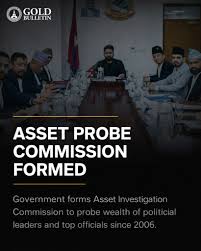
The government has moved ahead with a major decision under its 100-point agenda and 18-point commitment to investigate the assets of public officials who have served since 2006, the year Nepal formally entered the republican era. The Property Investigation Commission has now started preparatory work from its office in Kesharmahal and is expected to begin formal inquiries soon after the notice is published in the Gazette.
The scope of the commission is wide. It will examine former prime ministers, ministers, constitutional officeholders, judges, ambassadors, senior security officials, and top bureaucrats. It will also include heads of public enterprises and elected local representatives. In effect, the probe covers almost every layer of state power built over the last two decades.
This decision comes at a time when public debate over unexplained wealth has grown louder. Over the years, leaders across party lines have faced repeated allegations of disproportionate assets. Former prime ministers such as Sher Bahadur Deuba, KP Sharma Oli, and Pushpa Kamal Dahal Prachanda have all faced public scrutiny at different points, although no unified institutional process ever examined their long-term financial records in a structured way.
Similarly, former ministers from various governments, senior bureaucrats from the finance, home, and energy sectors, and officials from public enterprises have frequently been accused of accumulating assets beyond known income sources. These concerns have remained largely in the realm of public debate rather than formal investigation.
The new commission now attempts to change that pattern by bringing post-2006 public service under one investigative umbrella. It includes not only political leaders but also judges of all levels, former army chiefs, ambassadors, and provincial and local government officials. The idea is to trace how wealth has been accumulated during years of public service and whether it aligns with declared income.
On paper, this is a significant step toward accountability. In practice, however, its credibility will depend on how broadly and fairly it is applied. The decision to exclude sitting constitutional officeholders and current cabinet members has already raised early questions about consistency. Critics argue that accountability cannot begin and end with past actors while ignoring those currently in power.
This is where the political sensitivity becomes clear. A credible investigation cannot selectively focus only on opposition-linked figures or retired officials while leaving current leaders untouched. If the process is seen as politically filtered, it risks undermining its own purpose.
There is also an opportunity here for the current government led by Balendra Shah to strengthen its legitimacy. Allowing scrutiny of assets and income sources of its own ministers and senior officials, including those in the present cabinet, would send a strong signal of transparency. It would show that the reform agenda is not directed only outward but also inward.
Such openness would also help the government distance itself from accusations of selective accountability, a problem that has affected many past regimes. In Nepal’s political history, anti-corruption drives have often lost credibility when they appeared targeted or incomplete.
The commission’s mandate covers a long list of officials from across party lines. This includes leaders from the Nepali Congress, CPN-UML, CPN (Maoist Centre), Rastriya Swatantra Party, and other political formations that have held power since 2006. Figures such as ministers, parliamentary speakers, chief justices, provincial heads, and senior administrators all fall within its scope.
If implemented with consistency, this could become one of the most far-reaching accountability exercises in Nepal’s recent history. But the challenge lies not in drafting the mandate, but in enforcing it without political influence.
Public trust will depend on whether investigations are allowed to follow evidence wherever it leads, not where it is politically convenient. That means examining financial records, property holdings, business links, and declared income across all levels of leadership.
At the same time, the commission will need institutional independence, technical strength, and legal backing to withstand pressure. Without that, even a well-designed mandate could lose momentum.
Ultimately, this initiative sits at a critical point. It can either become a turning point in public accountability or another symbolic exercise that fades into routine politics. The difference will be decided by whether the government is willing to place itself under the same scrutiny it demands from others.
Because in the end, credibility in politics is not built by investigating opponents alone. It is built when power agrees to look into its own mirror without hesitation.

Login to add a comment