






By Milan Chauhan
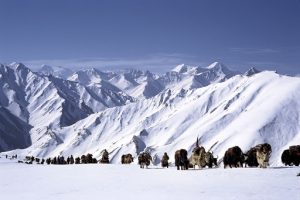
In a 1999 Oscar-nominated film, Caravan (Himalaya), the director Eric Valli displayed a striving generational conflict under the backdrop of imagery scenic beauty of rugged mountains and the delicacy of the upper Dolpo customs. Perhaps, the French photographer has been successful to portray his love and a long-time attachment to the appealing geography and the lifestyle of ethnic dwellers in thin air in 108 minutes time frame. It has not been merely a movie that features the caravan of yaks trading rock salt for grains from high altitude plateau down to the plain, but a lively depiction of the living legend that embodies theme for the rise of leadership for generations.
 Soon after the movie begins with a barnstorming native performance of two energetic herdsmen, the elderly Tinle and the young daring Karma, it opens a floor for our political culture, dashingly waiting to create a storyline for a struggle of a commoner into the throne. When Tinle is half-convinced with Karma, who brought the dead body of his son, Lhakpa, the current chieftain of the caravan from the return of the journey, he refuses to transfer the heir to the well-deserving Karma, instead seeks the replacement within his clan and finally, for himself though being lately and old pushes to the power and collects some oldies to start the journey to lead the caravanlike his young days. Though with the “first-yet-to-be-official” commanding, Karma doesn’t seem naïve but proves his adept leadership for these villagers, whose economy depends upon one leader and his leadership skills.
This is now a “108 Caravan minutes” for us, the same adage and the same rhetoric of political culture for years, but unlike the movie, Karmas aren’t ready to challenge the Tinles—can’t stand for themselves rather are competent on idolizing Tinles’ bads for goods. Since a couple of months ago, when the KP Sharma Oli government from the ruling party, Nepal Communist Party is questioned of the dearth of incapability and incompetency by the inners within the own party, Oli had come up with an artifact that he resigns only “if youth comes in power”. This has a substantive meaning on his chicanery that he stays on power anyways; he knows that youths wouldn’t oust him from power—he’s confident enough with an idea that our political institutions fall short to groom a leader.
In the middle of the movie, the story not only focuses on the derma of generations but tests the supremacy of skills they present throughout the journey, in forecasting the weather, on crossing the narrow treacherous deadly pass, battling the noncurrent weather- thick snow falling and finally landing safely under a clear sky. The same challenges are laid unfolding before our leaderships, it’s not about who? But it’s how? —the latter answers the previous. In our journey to the PM Oli’s aimed “Prosperous Nepal, Happy Nepali” with the constitutionally committed “socialist-oriented-nation”, we’re on the verge to stabilize the spirit of republicanism and giving patronage to all our epoch long achievements. The ruling party has to face, of course, many discontents to normalizing the ailing politics and agonies to revamp the situations hit by the coronavirus pandemic and the periodic natural disasters like, floods, landslides that cost lives and economy in multiple folds than the pandemic each year. Besides, the government must be liable to answer all the discrepancies during the pandemic, foul workings at governance, and resolve the ever-triggered border issues with the neighbor India. Further, the attack of Indian media on the sovereignty of Nepal and Nepalis, cultivating an explicit content, falsely claiming Chinese backing for Oli led government with the simultaneous incapability of the government to point out the fate of Millennium Challenge Corporation (MCC) compact in time, have created chaos on diplomacy and put our geopolitical stand at stake. The weakness of government abounds, however, it’s not on a single facet or neither as Oli’s double standard saying “youths in power” nor of his detractors’ “Oli must resign” is a silver bullet for now. Because the foundation must be cleared before the opinion. For instance, leadership can’t be taken for granted, it should be earned. As the rise of Karma, leadership should be an outcome of rigorous hardships, struggle and coordinating every single angle at its peak.
With great leadership, besides handling the immediate situation, comes the responsibility to protect the party legacy, the century-old movements, and up-scaling efforts for future generations. Firstly, before making an abrupt shift in the power, our political institutions must be shaped in such a way that paving path for youth would be easier and remains mandatory. It should more focus on creating leaders. It must exercise the full-fledged democratic norms, counting every inner youth voices. Secondly, the ruling party must be conscious of the vitality of its wings, whether the student wings and the youth wings.
What’s interesting about this fictional screen is, it reflects the trait of our present-day Tinles who in one way or other tries to remain in the power until all the fuel gets exhausted. This movie at the end respects years of Tinle’s experience, his passionate fortune-telling stuff and doesn’t prove him wrong either, however, fails to mention about the workings of them together—leaving the track for audiences. The oldies shouldn’t be backed only but be made into righteous critiques at the right time too to change the status quo. It is not only the question of the cult of personality rather an institution that should be a well-run factory to make good products. With more proportion than ever in the history, presence of youths in the standing committee of NCP, the discourse on the generational leadership shift should be started—they need to stand for their unified Karma voices. Though being a couple of decades older, Caravan still proves its relevance in our present-day politics and helps to figure out ways for internalizing the dimensions of leadership in need.
The author is the president of Technical Students’ Association of Nepal, Agriculture and Forestry University, Nepal. He can be reached at Twitter: elninoMilanCh
People’s Review Print Edition

Login to add a comment