








By Narayan Prasad Mishra
On June 23, 2026, the Government of Nepal issued a commemorative postage stamp in honor of my beloved late wife, Shanti Mishra, in recognition of her extraordinary and pioneering contributions to the development of modern library services in Nepal. For me, this is not merely a ceremonial act of remembrance. It is a deeply moving national acknowledgment of a life devoted to the library, knowledge, education, scholarship, public service, and the advancement of learning in Nepal.
This recognition is especially meaningful because it honors a woman whose work was far ahead of her time. In the 1960s, when the importance of modern libraries was scarcely understood in Nepal—indeed, when the very concept of a modern library had yet to take root in the country—Shanti Mishra emerged as a visionary. She had already made history as the first woman to teach history at the master’s level at the newly established Tribhuvan University in the 1960s, serving as its only full-time female professor at the time. Yet she chose to leave that prestigious academic position to pursue library science, a field she believed essential to the nation’s intellectual and educational development.
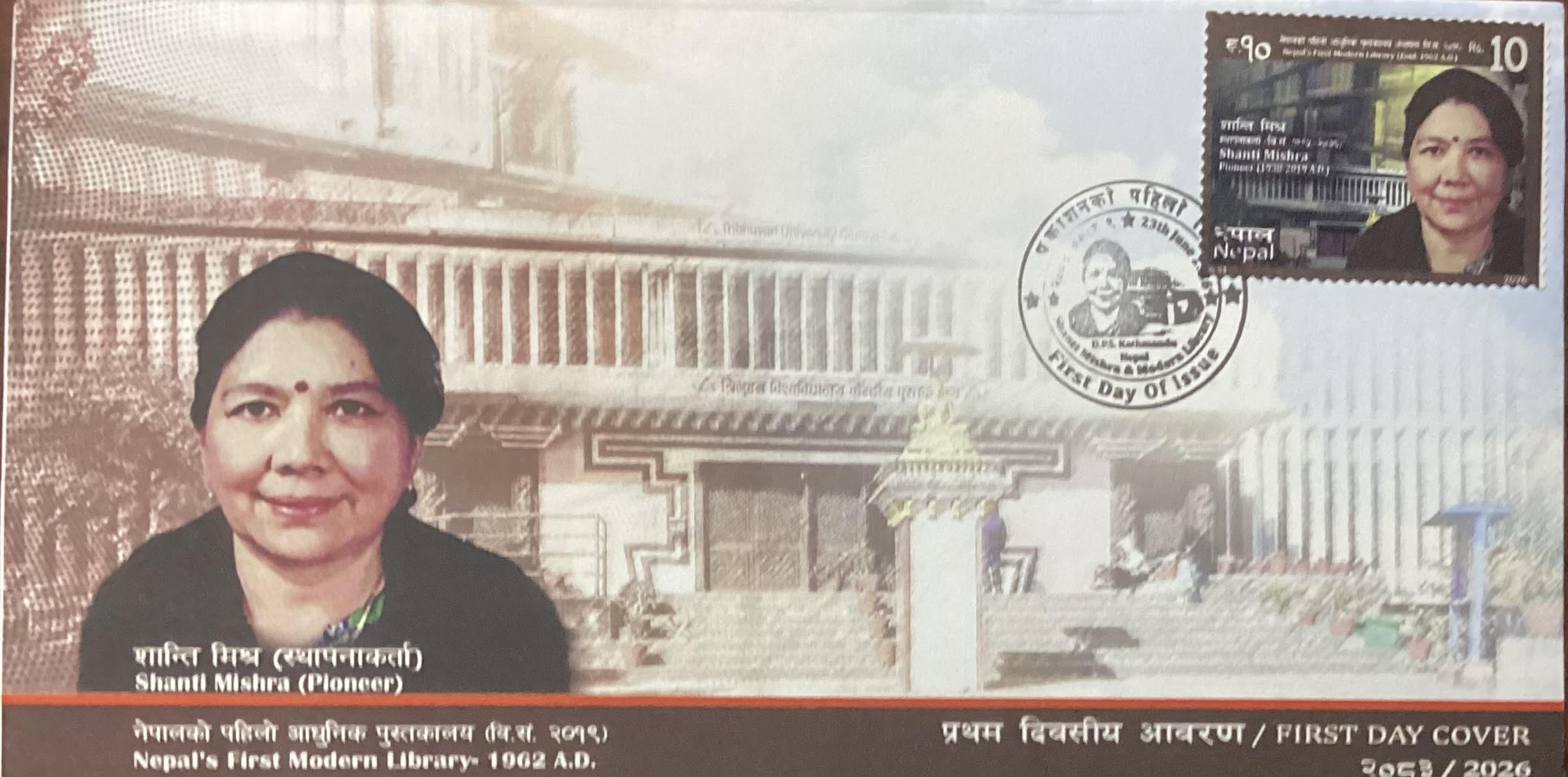
That decision was not a retreat from scholarship, but an expansion of it. She became the first Nepali woman to earn a Master of Arts degree in Library Science and later became Nepal’s first female chief librarian. Through her dedication, leadership, and tireless labor, the Tribhuvan University Central Library grew into Nepal’s first and finest modern library. More than that, she became one of the country’s foremost advocates for libraries as institutions essential to education, research, and national progress.
Through her lectures, writings, professional service, and public engagement, she worked to awaken Nepali society to the value of libraries at a time when that awareness was still in its infancy. She helped establish the idea that libraries are not mere storehouses of books, but living institutions of learning, inquiry, and civilization. It is for this reason that she came to be known in Nepal’s academic and library circles as the Mother of Modern Libraries in Nepal.
She fought and stood up to anyone—regardless of rank or status, whether higher or lower—for the cause of the library and the dignity of the library profession, often at the expense of her own personal interests. Like a tigress fiercely protecting her cubs from every danger and attack, she defended her institution with unwavering courage and determination. For this reason, many self-centered people in the country unfairly labeled her as authoritarian—even a dictator—failing to recognize that it was her profound love for the institution that motivated her actions. Especially those who behaved like termites, silently eating away at the library from within, regarded her not as its protector but as their enemy. As a result, she endured unbearable injustices throughout her life. Her books—Voice of Truth: The Challenges and Struggles of a Woman, written in English, and The Glorious History of the Tribhuvan University Central Library and Our Service, written in Nepali and co-authored with her husband, Narayan Prasad Mishra—stand as powerful testimony to the hardships, struggles, and injustices she endured.
This honor, therefore, is not only a recognition of her personal achievements. It is also a tribute to the values by which she lived: knowledge, learning, scholarship, service, integrity, and the conviction that access to knowledge can transform both individuals and nations.
In the journey of our shared life, libraries were not merely our profession; they were also our common calling. She was the first Nepali woman to earn an M.A. in Library Science in the USA, and I was the first Nepali man to earn an M.A. in Library Science in India. Together, we wrote the first Nepali book on library science, An Outline of Library Science, under our joint authorship. We also co-authored another Nepali work, The Glorious History of Tribhuvan University Central Library and Our Services. For both of us, library service was not simply an occupation. It was a mission grounded in faith in knowledge, education, and Nepal’s future.
As her husband, lifelong companion, and fellow traveler in the development of libraries, I feel profoundly honored and deeply moved to witness the nation recognizing her in this way. Yet this joy does not belong to me alone, nor only to our family. Many of you walked beside her in different stages of her journey, encouraged her work, respected her dedication, and shared in her vision. This moment of recognition also belongs to all those whose lives were touched and enriched by her work, her character, and her unwavering commitment to the growth of libraries and learning in Nepal.
I extend my heartfelt gratitude to the Government of Nepal and to the Minister of Communication and Information for making this recognition possible. I am especially grateful to Madam Laxmi Basnet, Secretary of the Ministry, and Madam Manamaya Pangeni Bhattarai, Director General of the Department of Postal Services. At the First Day Stamp Issue Program, both spoke of Shanti Mishra’s contributions with warmth, grace, and deep appreciation. Their remarks did not confine themselves only to her pioneering role in the development of modern libraries and in awakening public awareness of their importance. They also acknowledged her contributions to education, journalism, literature, women’s development, and social service.
I was deeply touched to hear such high officials of the nation speak with knowledge, respect, and genuine admiration about the many dimensions of her service to Nepal. They recalled her work as a professor and librarian; her contribution to the advancement of women as an active social figure and as Member Secretary of the International Women’s Year Committee, 1975; her support for journalism as an advisor to Sancharika Samuha; and her contribution to literature as a writer and translator of several books in both Nepali and English, including her novel A Widow’s Gift and her English translation of the novel Rupamati. To hear her life and work remembered in such thoughtful and appreciative terms, and to have the privilege of meeting those distinguished officials in person, filled my heart with joy, gratitude, and pride.
I am equally grateful to all those who, over the years, have continued to remember, honor, and preserve her legacy. In general, a national recognition, such as a commemorative postage stamp, is not granted lightly. It is earned through extraordinary contributions to a field, and it is made possible by the goodwill, trust, respect, and support of institutions and individuals who value those contributions and help preserve their record. In that spirit, I offer my sincere thanks to former Vice-Chancellor Dr. Deepak Aryal and former Rector Dr. Khadga K.C. of Tribhuvan University; former Chief Librarian Indra Prasad Adhikari and present Chief Librarian Sagar Raj Subedi of the Tribhuvan University Central Library; former Head Nira Manandhar and present Head Lila Nyaichyai of the Department of Library and Information Science; former President Indra Prasad Adhikari and present President Pushpa Raj Subedi of the Nepal Library Association; and Parbati Nepal, Vice-chairman of LIMISEC (Library Management and Information Service Center ) for the affection, respect, and goodwill they have shown toward Shanti Mishra and her memory.
It is my sincere hope that this commemorative postage stamp will serve not only as a tribute to the life and work of Shanti Mishra, but also as an inspiration to future generations. May it encourage young men and women to dedicate themselves to knowledge, education, scholarship, and service to society. May it also remind those in the library profession that their calling is a noble one, and that they must strengthen it not through division, jealousy, or petty destruction, but through unity, wisdom, cooperation, and creative work. A profession entrusted with knowledge must not be weakened from within. It must be sustained by integrity, mutual respect, and devotion to the larger good of the nation. Falsehood and propaganda may prevail for a while, but they cannot deceive a nation forever.
For me, this postage stamp is more than a public honor bestowed upon a departed wife. It is a moment of profound personal joy, gratitude, and fulfillment. It is a reminder that a life lived with sincerity, vision, discipline, and service does not vanish with death. It continues to speak. It continues to inspire. And sometimes, if a nation is wise and grateful, it continues to receive the honor it truly deserves.
About the author: A non-partisan writer of several books and numerous articles in Nepali and English; former Chief of the Office of the Tribhuvan University Service Commission, Nepal; and a senior citizen in his mid-eighties.
Email: narayanshanti70@gmail.com

Login to add a comment