







Kathmandu, June 15: Nepali Congress president Gagan Kumar Thapa has accused the government of presenting the upcoming fiscal year 2083/84 budget as tax-relieving for citizens while actually increasing revenue collection through multiple indirect channels.
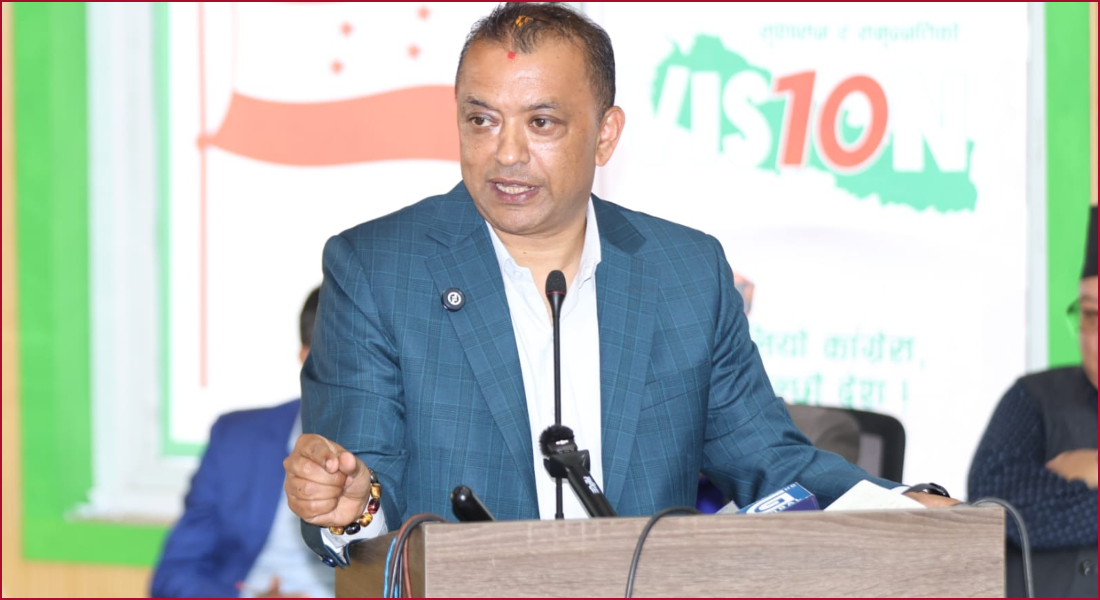
Speaking at the “Suwarna Shamsher Economic Series” program held on Sunday at the Nepali Congress central office in Sanepa, Lalitpur, Thapa said the budget claims to provide relief to middle-class families but in practice adds extra burdens in education, health, and electricity sectors.
He argued that although the government raised the income tax threshold, savings from that measure are offset by additional fees and taxes imposed elsewhere, leading to higher overall household expenses.
Thapa said the government appears to be putting money into citizens’ “front pocket” while quietly taking more from the “back pocket.” He claimed a middle-class individual earning around Rs 60,000 per month could save about Rs 20,000 annually from income tax relief, but would end up paying more than that due to added charges in education, health, and other services.
He stressed that private schooling is not a luxury for most families but a necessity, as public schools have not been made sufficiently effective. According to him, the “equity fee” imposed on private schools ultimately falls on parents.
On health, Thapa said limited services and bed shortages in public hospitals force many citizens to seek treatment in private hospitals, where new taxes effectively increase their burden. He added that a 3 percent charge in education and health sectors is unaffordable for citizens and should be withdrawn, expressing concern over the weakening state of the health insurance program he initiated.
He also objected to the introduction of VAT on electricity consumption above 50 units, saying it will raise monthly costs for middle-class families. Combined with broader revenue targets, he warned of possible pressure on bank interest rates, loan repayments, and inflation.
Thapa said when all impacts are combined, including education, health, electricity, and inflation, households may end up spending more than the benefits they receive from tax relief. He argued that the budget’s claim of being middle-class friendly does not reflect reality.
Calling for policy reversal, he urged the government to reconsider and withdraw taxes and fees imposed on education and health, and to treat private education and healthcare as necessities rather than luxury services.
He added that only policies creating opportunities for low-income citizens to rise economically can strengthen the middle class. He also urged Congress lawmakers to study the budget in depth and raise these concerns effectively in parliament.
People’s News Monitoring Service

Login to add a comment