







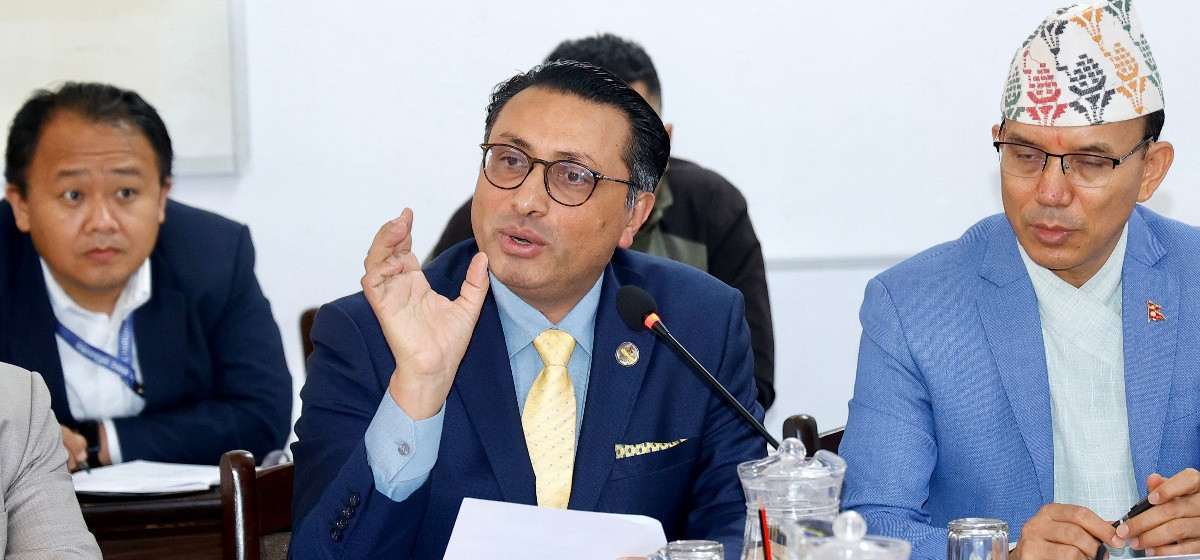
Kathmandu, June 10: Finance Minister Dr. Swarnim Wagle has been given an opportunity to explain the controversy surrounding changes to tax rates after the budget was tabled in Parliament.
The parliamentary Finance Committee on Wednesday allowed Wagle to present his clarification after he came under criticism for repeatedly revising the Financial Bill introduced on May 29 and resubmitting it to Parliament. The committee is chaired by Rastriya Swatantra Party lawmaker Krishna Hari Budhathoki.
Although concerns had already been raised in Parliament over amendments made to a bill that had already been registered, Wagle had not previously been given a chance to defend his actions. Following revelations that tax rates had been altered in multiple sections of the bill, both the Rastriya Prajatantra Party and the Shram Sanskriti Party demanded his resignation.
Addressing the Finance Committee, Wagle not only explained why changes were made to the bill after registration but also accused organized groups of targeting both the Prime Minister and the Finance Minister.
Five Point “error correction” letter
Wagle told lawmakers that after presenting the Financial Bill in both houses of the Federal Parliament on May 29, officials discovered ambiguities and language related errors in the document. He said he submitted a request to the Federal Parliament Secretariat on May 31 to correct those mistakes.
According to Wagle, he submitted a five point “error correction” letter addressed directly to the Secretary General of Parliament. He also informed lawmakers that the corrected pages were incorporated into the bill and redistributed to members of Parliament.
“As soon as we became aware of the mistakes and errors, we informed the sovereign Parliament,” Wagle said. He added that correcting errors and adjusting page layouts reduced the bill’s page count by 16 pages.
Earlier, RPP parliamentary party leader Gyanendra Shahi had described the tax rate alterations as an act of treason and demanded an investigation. Responding through the committee, Wagle questioned how the changes could be viewed as treason.
“An attempt has been made to create a storm in a teacup. This is completely wrong, and I am prepared to face it firmly,” he said.
Questions over procedure
However, Wagle did not address questions regarding the legal process and timeline for amending a bill already tabled in Parliament.
Procedures governing amendments are outlined in Chapter 15 of the House of Representatives Regulations. Under those rules, lawmakers can formally propose amendments only after the bill advances through several parliamentary stages, including permission to introduce the bill, general discussion, and a motion for clause by clause consideration.
Rule 112 states that any member wishing to amend a bill must submit proposed amendments within 72 hours after the conclusion of the general discussion.
Those stages had not yet been completed when Wagle sent the five-point correction letter to the Parliament Secretariat.
The minister also remained silent on why the correction letter remained pending in Parliament for three days and on the legal basis for submitting such corrections before the formal amendment process had begun.
Secretariat delay and subsequent registration
The Financial Bill tabled on May 29 was uploaded to the Parliament Secretariat’s website and also published by the Finance Ministry. The ministry subsequently revised, uploaded, and removed details multiple times.
Wagle’s correction letter was sent to the Secretariat on May 31. However, parliamentary officials initially refused to register it, arguing that amendment proposals could not be filed for a bill already tabled in Parliament.
According to reports, after media coverage highlighted allegations that the Finance Ministry had altered tax rates without legislative approval, pressure mounted to register the proposal. On June 3, Secretary General of the Federal Parliament Padam Prasad Pandey authorized its registration, after which the corrections were appended to the Financial Bill and reuploaded.
Wagle did not explain why the correction letter remained in limbo for three days before being formally registered.
People’s News Monitoring Service

Login to add a comment