







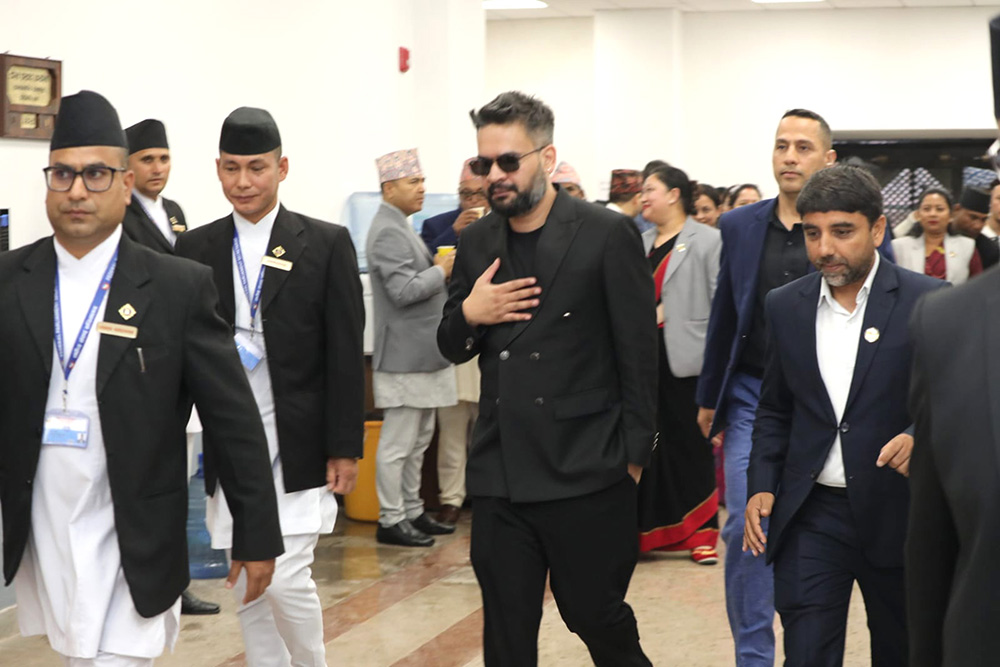
Kathmandu, June 3: Prime Minister Balen Shah’s statement in Parliament that Nepal has also encroached on Indian territory, not just the other way around, has sparked debate in both Nepal and India.
Speaking in the House of Representatives on Sunday, Shah said he had learned after becoming prime minister that border encroachment was not a one-sided issue. He also revealed that Nepal had raised the Kalapani, Lipulekh, and Limpiyadhura dispute with China and the United Kingdom, arguing that Britain’s colonial-era role was linked to the border question. He called for both countries to study the facts and resolve the issue through dialogue.
However, Shah did not specify which Indian territories Nepal had allegedly encroached upon.
Positive Reactions and Criticism
Some Indian commentators welcomed Shah’s acknowledgment that border disputes are not entirely one-sided.
Former S.D. Muni said India has long argued that Nepal occupies land in the Susta area because changes in the Narayani River altered the boundary. At the same time, he warned against internationalizing the issue.
Former Indian ambassador to Nepal, Rakesh Sood, argued that disputes such as Susta should be resolved through bilateral political understanding rather than through outside intervention. He also rejected involving China or the UK in discussions on Kalapani and Lipulekh.
Retired Indian Army officer Shokin Chauhan said Shah’s remarks reflected a shift from emotional nationalism toward recognizing technical realities on the ground. He noted that river course changes, floods, landslides and damaged border pillars have complicated boundary management for decades.
Concerns Over Foreign Policy Understanding
Not everyone was supportive. Former Indian diplomat Kanwal Sibal questioned why Shah was trying to bring Britain into the dispute.
JNU professor Rajan Kumar told Dainik Bhaskar that Shah’s comments showed limited diplomatic experience. He argued that such remarks could affect long standing Nepal India relations and should have been made more carefully.
How Indian Media Covered It
Indian media outlets largely focused on three themes: Shah’s claim that Nepal has also occupied Indian land, the political controversy that followed in Nepal, and disruptions in Parliament caused by opposition protests.
Among major outlets, NDTV published one of the more balanced analyses. It highlighted the long open border between Nepal and India established under the 1816 Sugauli Treaty while noting unresolved disputes in Susta and the Kalapani, Lipulekh and Limpiyadhura region.
The report also covered criticism from Nepal’s opposition parties, foreign policy experts and border analysts. It noted that opposition lawmakers demanded Shah’s remarks be removed from the parliamentary record.
NDTV further reported that Nepal’s Foreign Ministry later clarified that the prime minister had been referring to cross border encroachments and issues in the no man’s land area along the frontier.
Former Nepali Ambassadors Disagree
NDTV also interviewed two former Nepali ambassadors to India.
Nilamber Acharya said he was unaware of any case where Nepal had officially occupied Indian territory. He noted that around 97 percent of the border issue had already been resolved and that missing border pillars may have led individuals on both sides to use land across the boundary, but not as a state policy.
Similarly, Deep Kumar Upadhyay said no official records support claims that Nepal has encroached on Indian land. According to him, India has never formally raised such an allegation despite numerous studies over the years.
Dainik Bhaskar: Shah Could Hurt His Own Position
India’s Dainik Bhaskar argued that Shah’s remarks may ultimately weaken his own position.
The newspaper identified three risks:
- Weakening Nepal’s diplomatic case on Kalapani, Lipulekh and Limpiyadhura.
- Making the dispute more complicated by proposing the involvement of third parties, such as Britain.
- Raising questions about Shah’s credibility after Nepal’s Foreign Ministry had to issue a clarification.
The paper argued that Nepal’s longstanding claim over the disputed territories could be undermined if its own prime minister publicly says Nepal has also occupied Indian land.
Wider Coverage
Other Indian media outlets, including The Hindu, The Times of India, India Today, Aaj Tak, The Economic Times and Amar Ujala, highlighted the controversy surrounding Shah’s statement and the political fallout in Nepal.
Amar Ujala reported that the remarks had created fresh controversy instead of strengthening trust between the two neighbors. Experts quoted by the paper urged both countries to address the issue through peaceful dialogue while preserving their longstanding friendship.
Meanwhile, Zee News recalled Nepal’s opposition to the 2015 India-China agreement on trade through Lipulekh. Despite current tensions, it expressed hope that renewed discussion could eventually contribute to resolving the border dispute.
So far, the Indian government has not issued any official response to Shah’s remarks. The debate, however, has drawn significant attention in both countries and reopened discussion on how Nepal and India should handle their remaining border disagreements.

Login to add a comment