







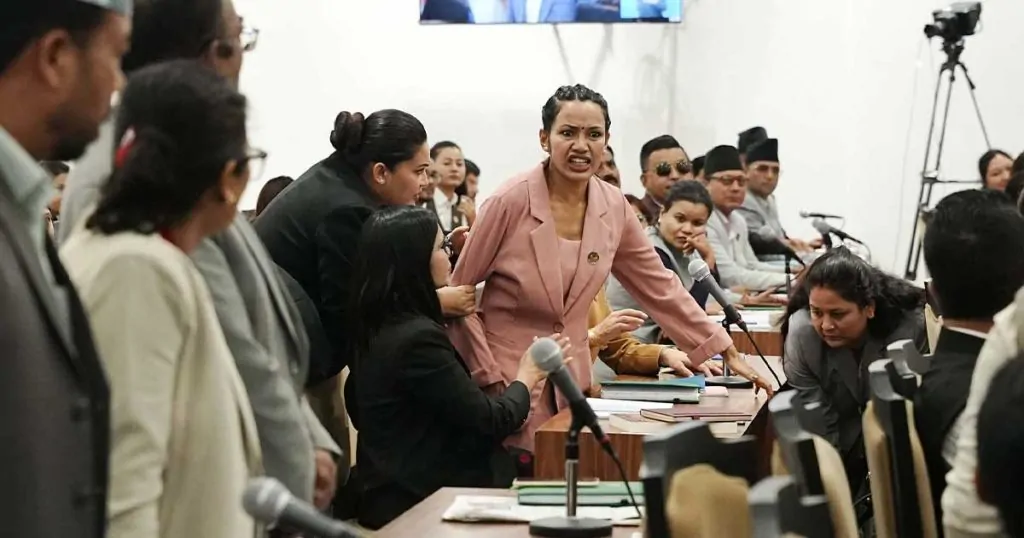
Kathmandu, June 3: Nepal’s newly adopted House of Representatives regulations have triggered a major dispute, with opposition parties accusing the ruling coalition of pushing through controversial provisions without consensus.
Parliamentary regulations serve as the key framework for running the House over the next five years. Traditionally, such rules are drafted through broad agreement among both ruling and opposition parties to ensure collective ownership. This time, however, opposition parties say the ruling coalition dominated the process and used its majority to pass the rules despite objections.
The dispute became so heated that lawmakers reportedly engaged in scuffles inside Parliament before the regulations were approved on Sunday.
Opposition parties, led by the Nepali Congress, have raised serious concerns about two provisions in particular. One relates to the constitutional amendment process, while the other is seen as granting lawmakers protection from certain legal consequences.
A controversial clause allows a constitutional amendment bill to be sent for presidential authentication if the votes supporting it amount to at least a two-thirds majority of the total members of both houses combined. Critics argue this departs from the Constitution, which requires separate approval by two-thirds of members in both the House of Representatives and the National Assembly.
Nepali Congress leaders say the provision weakens the role of the National Assembly and misinterprets constitutional procedures. They argue that parliamentary rules cannot override the Constitution and warn that the issue could ultimately end up in court.
Congress leader Gagan Thapa said the judiciary must intervene if the legislature exceeds constitutional limits, just as it would if the executive branch overstepped its authority.
Another major point of contention is a provision stating that lawmakers may continue serving despite provisions contained in other existing laws. The opposition claims this language could shield MPs facing allegations such as corruption or money laundering from suspension or disciplinary action.
Congress leaders argue that the law should apply equally to all citizens and public officials. According to them, the new rules create a privileged category of lawmakers and weaken accountability by placing Parliament beyond normal legal scrutiny.
Congress lawmaker Geeta Gurung questioned why lawmakers should receive special protections not available to ordinary citizens. She warned that the provision could become a safeguard against action in corruption or criminal cases.
The opposition has also criticized the removal of a requirement that ministers attend parliamentary committee meetings discussing issues other than legislation. Critics say the change reduces government accountability to Parliament and contradicts the constitutional principle of checks and balances.
Congress spokesperson Devaraj Chalise objected to a separate provision allowing procedural obstacles to be bypassed. He argued that exceptions should remain rare and should not become guiding principles of parliamentary practice.
Opposition parties say they repeatedly asked for the draft to be returned to committee for further discussion so that all parties could have a sense of ownership. Those requests were rejected, and the regulations were approved through a majority vote.
Congress Chief Whip Nishchal Rai said additional discussions could have resolved disputed issues. He indicated that legal action remains an option.
Criticism has not come only from Congress. Lawmakers from the opposition CPN-UML and other parties have also objected.
UML lawmaker Padma Aryal accused the ruling side of introducing provisions that undermine the Constitution, including what she described as a backdoor route for constitutional amendments.
Similarly, Yubaraj Dulal argued that the constitutional amendment clause contradicts Article 274 of the Constitution, which requires separate two thirds approval from both houses of Parliament.
The controversy has now evolved into a broader debate over parliamentary accountability, constitutional limits and whether a simple majority should be able to reshape key legislative procedures without cross-party consensus.
People’s News Monitoring Service

Login to add a comment