








By Narayan Prasad Mishra
We know we can make good, practicable policies and programs on any subject by getting the thoughts and opinions of several people. Seminars, conferences, talks, and speech programs allow people to get together and discuss a particular subject or share information. So we organize those programs for that purpose from time to time. Because of that, most people are familiar with the words – seminars, conferences, talks, and speech programs these days. We hear these words when we open the radio or television news channels, or we see these words when we read newspapers.
Most seminars and conferences discuss problems and the latest trends concerning particular topics. These are excellent sources for getting acquainted with new trends, problems, and future ways. In the same way, talks and speeches educate people on the topics of discussion. Though it is so, and most developed countries have been getting advantages from those programs, the case is different in most developing countries. The reason is that most things are done in those countries with selfish motives, nepotism, favoritism, and corruption. So even these programs cannot escape from those malpractices.
More often, the programs are organized for a particular self-centered motive for the benefit of the individual or group, not the benefit of the country and people. It, therefore, lacks free thoughts and holy decisions. Then the result can not come for the benefit of all.
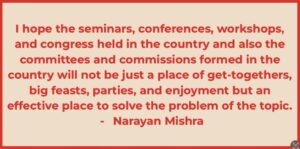 Instead of picking the paper presenters based on knowledge, experience, and expertise, sometimes even the paper presenters and participants are selected to favor the near and dear ones to benefit the person for some remuneration and cash gain. More often, the recommendations of these programs stay in the documents and the files and are not implemented when they are not in the interest of the power circles. Also, if the conferences are held in foreign countries, instead of finding people with commendable expertise who are most capable of representing the country, there is a good chance that irregularities will appear in the selection of the participants to depute the near and dear ones to give an opportunity for them to travel and enjoy the foreign country.
We often see this in our country even when they send delegation members to the United Nations General Assembly. When this is done, these programs do not bring any advantages to the people and the country. Sometimes, we see even the committees are formed not to expedite the work with the team’s free thoughts and opinions but to postpone or delay the unwanted work by getting guided decisions. Sometimes we see seminars and conferences organized more for this purpose. Often in our country, people consider conferences and seminars are like a fair getting together to enjoy a big feast and drinks, nothing else. They seldom show concern for the burning problems of the topics and bring out solutions.
I read that a national seminar of SACCOS (Savings and Credit Cooperative Societies) CEO’s National Workshop of about 450 chiefs of cooperative organizations organized by the Nepal Federation of Savings and Credit Cooperative Unions Ltd (NEFSCUN) was held in Hotel Soaltee on March 8 and that was ended with 12 points resolutions. But I am sorry not to hear whether they discussed and found a solution to solve the present painful burning problem of the savings and credit cooperative cheaters in the country. Nepal Federation of Savings and Credit Cooperative Unions Ltd. (NEFSCUN) is a member-based national apex organization of Savings and Credit Cooperative Societies (SACCOS). In some other place, I also read that the 3rd National Cooperative Congress, 2023, organized by the National Cooperative Federation of Nepal Ltd, will be held in Hotel Yak and Yeti on April 6-8,(Chaitra 23-25). It is undoubtedly good news if these workshops and congress are held with the ideal aim of organizing them and trying to solve the burning problem of the cooperative sector in the country and not just for getting together and feasting.
We all know the present problem of fraud in cooperative organizations in Nepal. Most savings and credit cooperative organizations have been torturing people by not paying their deposited money, showing artificially created reasons to cheat them. They raised billions of rupees from the public, giving a little more interest and presenting some other attraction of gifts and tokens. They also invested that money in their other companies, factories, banks, buildings, houses, etc., earned enormous amounts, and became wealthy by taking the money from the cooperatives without collateral. On the other hand, they showed the cooperative treasury was empty, and the cooperative was in a problem or loss. That was open cheating, and one could see their sinister motive clearly. Still, the government did not take action against them to punish them and give justice to the sufferers because of their political connections. The suffering people have been crying and dying. There are hundreds of cooperative organizations like this. The prime ones are 1. Civil Savings and Credit Cooperative 2. Oriental Cooperative, 3. Gautam Shree Cooperative, etc., of Kathmandu, where billions of rupees are involved, and thousands of people are affected.
I think the workshops and congress, as mentioned earlier, or any other seminars and conferences held on cooperative systems in the country, must prioritize this cheating problem and find out how to punish the cheaters and give justice to the sufferers without delay. In the same way, they must be able to advise our government to formulate new rules and regulations by which no cheaters will dare to cheat the people that way in the future. Then only people’s faith in the cooperative system can be reestablished in the country. Otherwise, the feeling of cooperative organization equating to cheating organization stamped in the people’s minds cannot be erased, and the cooperative system cannot flourish in the country.
narayanshanti70@gmail.com

Login to add a comment