







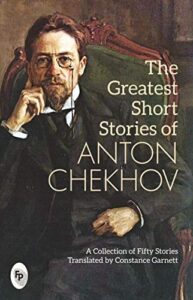
By K. C. Bhatt
That a writer of short stories, who was no one else but Anton Chekov, also had a short life, is heartbreaking to know.
The bigger irony was the fact that he was a physician by education and lived in an age when the treatment of the disease he was suffering from—Consumption, namely—was not yet available. It must have been information which might have despaired him greatly, as the disease progressed and left him increasingly fragile and feeble. How keenly he might have waited for a breakthrough treatment for it to arrive, scanning the developments in medical journals.
Having never focused on making a fortune out of his profession, which was common amongst his ilk then and even now, even after having lived a life full of struggle to earn his livelihood and finance his education; sending every spare ruble to his kin even when he was a student, Chekov lived only to write stories.
Often on tours to the remotest parts of late nineteenth-century Russia, treating the most destitute and decrepit of the patients, sometimes spending his own money to buy them medicines, he touched the lives of the people at the center and the periphery — in his career. And earned mostly only the stories he wrote.
That may be a reason that his stories are peopled with characters who appear nowhere in the work of his contemporaries like Tolstoy: Like a convict trapped by the justice system in a murder case he did not commit but an affluent uncle of him did.
Dispatched to Serbia to serve his prison term, the convict, still in his early twenties, suffers the privation of the infamous jail and his family gets decimated.
A young man is forcefully recruited into the army and his wife is seduced by one of his best friends. The soldier returns to be killed, but not by his wife, as suspected. His wife is incarcerated however and dies there and his infant son is adopted by his friend to work as a slave for him.
Such people never appear in the work of other writers like Tolstoy, who makes ponderings about spirituality or life in general leisurely in his work, at times occupying dozens of pages at a stretch of his celebrated novels, then makes a judgment as if taking refugees in a war is not worth it. This means that a surrendering enemy has no right to life, as per Tolstoy. Then people make an argument if having fought a war the writer wanted peace and was in communion with Mahatma Gandhi — with whom he was in conversation through letter writing–in this regard.
Chekov seldom writes a story which lasts a dozen pages. In that too he spends considerable space describing the ambience and the setting around the character. How often the word ‘consumption’ appears in his stories with a character is striking and sad for a reader.
It was a highly intense experience to read his work with each piece portraying a whole world more sensitively and effectively than the other writers who were far less economical.
There are a few longish short stories too by him in this collection, but they are very philosophical and possibly he wrote towards the end when his condition deteriorated more. They are full of despondency and despair.
Having spent his life serving the people with all his energy as a doctor and then presenting their stories in a way that even the Czarist Russia tolerated his latent protests, or possibly never have been able to decipher it — it never made an effort to stop Chekov, his life was a reward for a reader.
And amongst the readers, he was a hero. All his writing life his work was eagerly awaited and also it earned him a modest fortune towards the end to buy a state — albeit in a rural setting — where he received Tolstoy too once. He settled there in the hope of finally being able to rest from his hectic life and recover from his disease. Besides he had a wide female following and was one of the most eligible bachelors around.
Only towards his last years, he married an actress many years younger, who lived hundreds of miles away in St. Petersburg. In “The Dreary Story” an actress is seen off by an ailing professor–who loves her secretly — very stoically, for the last time, as the story ends. He had grudges against that actress too for having little talent, cherishing a cheap Crimean wine and having lived a wasteful life out of the money of her father. The world around him was turning sad and more lonely for Chekov at this point.
There is a doctor in his story “Ward No. 6”, who feels at loss looking after the psychiatric patients and sees no future for them in society even if they receive proper treatment and get cured. He often thinks that the work he is doing is of no use. It was also a commentary on the social conditions prevailing then in his country possibly, besides the depression a doctor may feel caring for the patients most of the time.
Likewise, Chekov holds the world around him in disagreement in some other stories too. Having dedicated his life to the service of people first as a doctor and then as a writer, he felt betrayed by it when the call for him came too early: soon after he completed forty. He possibly wanted to be around a bit longer and do a bit more work, or live a life more settled and healthier.
Possibly and hopefully, he also knew that his work will survive and give pleasure to the readers much beyond his country a long time after his death. Also, well aware of his female following in the country and his status as the most celebrated writer of his time in his country, he lived happier towards the end than it appears in some of his stories.
After his death, the First World War happened ten years and the Bolshevik revolution soon after the war turned Russia upside down. The treatment of consumption took another nearly fifty years to arrive.
One thinks that if the writers like Chekov, who lived a short life due to diseases which are easily curable now, had lived in the present age and felt happier about it in what ways the modern life and amenities might have affected their work.
However, their work conveys the times more clearly than many of their contemporaries, who lived a longer and healthier life mostly spent glossing over things or dealing with inanities endlessly in their work.

Login to add a comment