







By Our Reporter
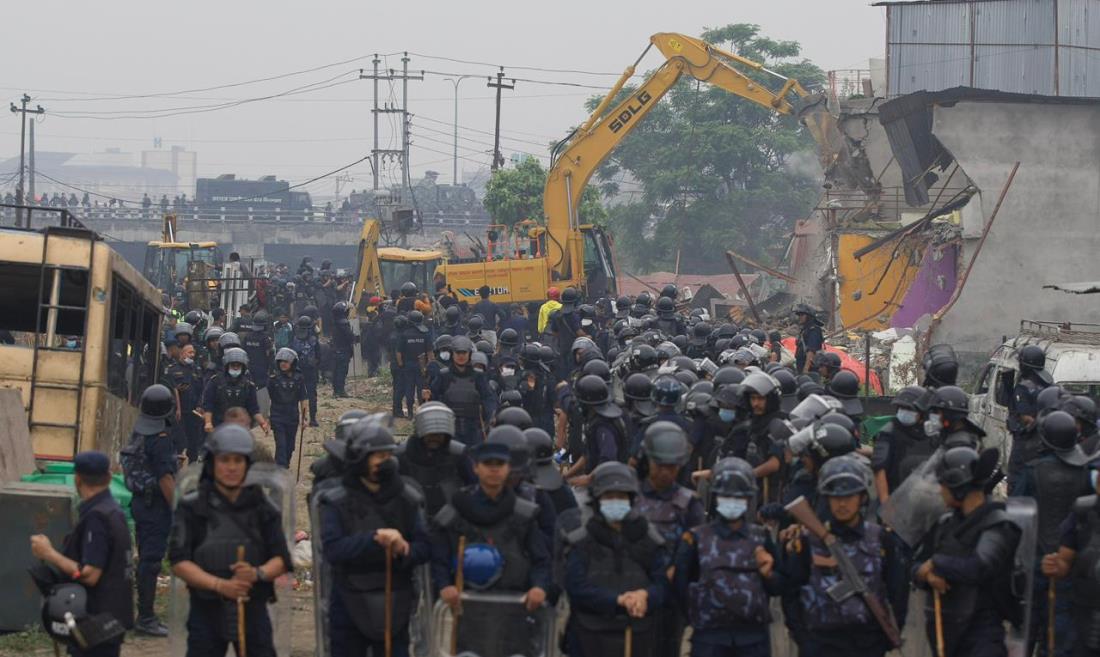
Nepal has been dealing with public land encroachment for years, but the problem keeps coming back. Riverbanks and open spaces in Kathmandu Valley are cleared, then slowly occupied again. Each time, the effort looks serious at the start but does not last. Earlier, drives often triggered resistance. Groups claiming to represent the landless would push back, sometimes forcefully. This time, in many places, people left after public notices. No clashes, no chaos. That change tells its own story. It shows that the state is being taken more seriously. It also shows that people expect enforcement to follow words. Fear of legal action has returned, and with it, a certain level of discipline.
Over 1200 houses shacks and other structures were demolished in merely three days in Kathmandu’s four places, Thapathali, Gairigaun, Manohara and Sinamangal. There are 22 squatter settlements in the Kathmandu Valley.
Still, the situation is not as simple as bulldozers razed illegal structures. Two different realities exist within these settlements. Some families have no land, no savings, and no alternative. They settled where they could survive. Others used public land as an opportunity, building houses or businesses without legal rights. Treating both groups the same would be lazy governance. Genuine squatters are hoping for support while opportunistic encroachers are worried.
Balen Shah’s involvement adds another layer. He tried a similar approach as Kathmandu’s mayor but ran into political resistance. Now, as prime minister, he has fewer excuses and more authority. The issue has also moved beyond city limits. What used to be seen as a municipal headache now demands national attention. That shift in scale could be the difference between another failed attempt and a lasting solution.
In the past, governments formed commissions, wrote reports, and spent public money. The results barely changed anything. Numbers tell an uncomfortable story. In a country with about 7.5 million households, around 1.2 million are classified as landless. That figure raises a basic question: are policies solving the problem, or quietly expanding it?
Encroachment is no longer limited to Kathmandu. It spreads across the Tarai and hill towns, along highways, rivers, and public land. In the capital, the stakes are higher. Poorly planned settlements affect drainage, increase disaster risk, and complicate urban management. Security concerns also come into play. Reports linking some settlements to criminal activity have added to public anxiety. Clearing these areas is not just about order. It is about safety and function.
Past efforts offer clear lessons. During Keshav Sthapit’s tenure, parts of the Bishnumati riverbank were cleared and turned into green spaces. That showed what is possible. Later, Baburam Bhattarai’s government pushed a stronger demolition drive. That showed what force can do. Both efforts failed to hold because they ignored what comes after demolition. Without resettlement, people return or move elsewhere. The problem shifts, not disappears.
Removing structures is the easy part while providing help is delayed. The current administration appears aware of this gap. Early signals suggest a more structured approach. Public support also seems stronger than before. That combination gives the campaign a real chance. Once people start believing that enforcement depends on who you are rather than what you did, the entire effort loses credibility. A campaign built on fairness cannot survive selective application.
Across the country, coordination has improved. Local governments, district offices, and federal agencies are working in parallel. From Parsa to Dhanusha, and from Biratnagar to Birgunj, encroachments are being identified and cleared. National projects and road authorities have also joined in, reclaiming land needed for infrastructure. This alignment is new, and it explains why the campaign feels more consistent.
Nepal has spent decades trying to solve the landless problem by distributing plots. That approach has reached its limits. Land is scarce, especially in urban areas. A more realistic solution lies in planned housing, such as apartment-based resettlement, combined with access to jobs and services. That requires planning, funding, and patience. None of those come easily in Nepal’s political system.
Which brings us to the usual spoiler: instability. Governments rarely last long enough to finish what they start. If this administration falls into the same pattern, the campaign will lose direction. Clearing land today only to see it reoccupied tomorrow would be a familiar ending.
For now, the government has acted where others hesitated. It has created a sense of order where confusion used to dominate. But this is not the time for stunts or headline-driven decisions. Quick demolitions may look impressive, but they do not solve anything on their own.

Login to add a comment