







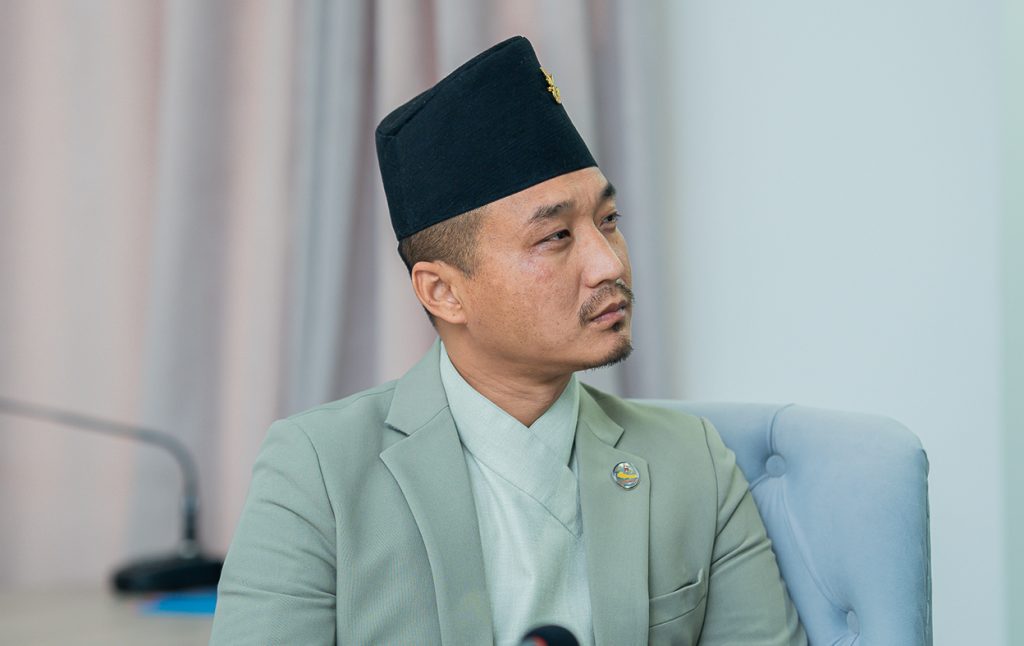
By Our Reporter
Sudhan Gurung’s exit from the Home Ministry has landed like a shock, but not a completely unexpected one.
His resignation comes at a time when the government led by Balendra Shah is still trying to define its working style and political direction. Within this short span, two ministers have already left office, including Labour Minister Deepak Gupta earlier. That kind of turnover raises questions about internal coordination and judgment at the top.
The official explanation around Sudhan’s resignation has been shaped by allegations of his alleged links with broker Deepak Bhatt, who is currently under arrest in a money laundering investigation. Reports of possible collusion created pressure that the government could not ignore. Whether these allegations will stand in court remains to be seen, but politically the damage has already been done.
Inside the ruling structure, there is also talk that the leadership of the Rastriya Swatantra Party was uneasy with Sudhan’s style of functioning for some time. His rapid decisions, informal approach, and political positioning reportedly created friction. While that tension was manageable earlier, the emergence of financial controversy appears to have tipped the balance toward resignation.
Sudhan’s political rise was unusually fast. He entered a system that was already hungry for new faces and quick results. In that environment, he was projected as a strong administrative choice, especially in a ministry as sensitive as home affairs. For a brief period, he symbolised the government’s promise of disruption and reform.
But the same speed that lifted him also left gaps. Questions around transparency, decision-making, and networks around him began to surface. The allegations involving Deepak Bhatt now sit at the centre of his fall. If investigations confirm any form of collusion, the resignation will likely be followed by legal scrutiny, not just political distance.
For the government, this episode is more than just one minister stepping down. It signals early stress within a system that was expected to be stable due to its strong mandate. Instead of consolidating authority, the administration is already dealing with reputational shocks.
Within the party, the impact may be sharper. RSP entered government on the promise of clean governance and structural change. Any perception of proximity to tainted financial networks directly challenges that image. Internal questions about candidate selection, oversight, and accountability are now unavoidable.
There is also a broader political cost. Rapid resignations create space for opponents to question the credibility of the entire governance model. Even if individual allegations are not fully proven, the perception of instability can weaken administrative confidence.
At this point, Sudhan’s case stands at an uncertain intersection. Legally, he may still defend himself if investigations do not establish wrongdoing. Politically, however, the damage is immediate and visible. His position has already collapsed under pressure.
The deeper concern now is what this signals for the government’s decision-making process. Fast appointments followed by equally fast exits suggest a lack of internal filters. That is where the real problem sits, not just in one resignation, but in how quickly trust is being built and broken.
Sudhan Gurung’s journey has moved from rapid rise to abrupt fall in a matter of weeks. And in Nepal’s already fragile political environment, this is not just the end of one minister’s tenure. It feels like a warning shot for an entire government still learning how power actually works when ambition meets scrutiny.

Login to add a comment