







 By Our Economic Analyst
Economic prosperity is the sign of a prosperous nation, whereas, a decline of economic indicators is the sign of a failed nation! Today, all the economic indicators are downgrading, and sooner or later the nation may face a serious economic crisis except a miracle.
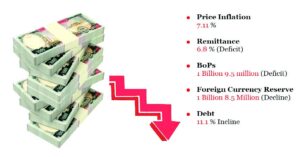
We can easily understand that the country’s economic health is not good. In the past five months, we have seen a trade loss worth 7.5 trillion rupees. Due to our dependency on foreign products, we cannot immediately reduce the deficit on trade. Considering the present trend of imports, we can hardly manage foreign currency to import goods for seven months.
The government has requested the International Monitory Fund for an especial drawing right (SDR) upto 180% to manage foreign currency reserve. Nepal, under the extended credit facility, had received 13 billion rupees out of the 395.9 million US dollars. However, the received amount was too little to cover the two trillion rupees worth negative BoPs.
The downgrading trend is the contribution of the wrong economic policy that was started along with the adoption of the multiparty democracy in 1990 and later, the so-called loktantra introduced in 2006.
So far, a group of economic experts loyal to different political parties projects a very beautiful picture of the economic growth after Nepal adopted the policy of economic liberalization, however, the result is the present gloomy economic scenario.
In a positive economic trend, international trade should be surplus. When the trade starts facing loss, immediate improvement measures have to be introduced. Unfortunately, for decades, the gap of trade deficit is continuously mounting. On the one hand, our exports are declining, on the other, our imports have been inclined in a very surprising manner.
The main base of a strong economy is the balance of payments (BoPs). Although the country was facing a loss on international trade, BoPs were in surplus, therefore, we had no scarcity of foreign currency for importing goods from abroad.
The tourism industries were flourishing, in the meantime, the foreign labour market helped to boost our foreign currency reserve. Besides, foreign grants, loans, and foreign direct investment helped us to run the economy.
However, according to the recent economic report released by the Nepal Rastra Bank, as the foreign currency reserve is declining, we may face problems in importing goods after five months.
Due to the surge of the Covid-19 pandemic, the tourism business, as well as the foreign labour market, has been directly affected. Highly dependent on foreign tourists and highly relying on foreign labour market without seeking other opportunities is harmful, which we have witnessed since the surge of the Covid-19 pandemic at the end of the year 2019.
For the first time in history, all the economic indicators have gone negative. Around two trillion rupees worth deficit has been witnessed in the foreign currency reserve compared to the previous fiscal years. Market inflation has inclined to the highest point for the last five years. Remittance revenue is continuously declining.
According to the NRB’s report, the trend of the increasing deficit on BoPs was witnessed from the first month of the present fiscal year. Economic experts opine that if BoPs continue to decline, the economy may collapse.
The only major effort to rescue the economy could be a halt on importing luxury goods, however, as the government’s revenue source is highly dependent on the tax imposed on the imported items and there is no remarkable contribution on the revenue sector from the excise duty on domestic products, the government cannot immediately stop imports of all the luxury items. In the meantime, the internal economic activities have been affected by a liquidity crunch.
According to the Office of the Auditor’s General, in the past six months of the current fiscal year, the government has been able to spend only 13.44 per cent under the capital expenditure. This is a sum of 50 billion 800 million rupees only. As the government is unable to spend money under capital expenditure, the market is facing a liquidity crunch.
The government collects revenue through different taxes from entrepreneurs and citizens which will be deposited in the government treasury. If the government will be unable to send that deposit in the market under the capital expenditure, the market will face a liquidity crunch.
The present liquidity crunch situation has also contributed to rapid inflation in the market.
As the economic indicators have gone negative, the government should initiate immediate measures to rescue the economy. However, the government has very limited options for rescuing the economy. Sure, the government may improve its expenditure process and send money in the market, but if curtailed imports, the market may face a recession as economic activities will be affected. And the government cannot stop imports of petroleum products which has contributed a lot to creating deficit on our foreign trade.
The government is hopeful that the remittance revenue can be improved within a few months as those employees who have gone for foreign employment will start to send money again. However, spending the remittance amount on imports of foreign luxury goods is not good. The foreign currency reserve should be spent on infrastructural development.
Be that as it may, if the government fails to manage the present economic crisis, the nation may face a situation of bankruptcy.

Login to add a comment