






View from America

By M.R. Josse
TAMPA, FL: The observance on 1 July 2021 of the centenary of the founding of the Communist Party of China (CPC) has resulted in a flood of global commentary on myriad facets of the Chinese saga with a focus on China’s spectacular rise, steered by the CPC.
The torrent of punditry therein has generally varied from the patently and predictably hostile to verging on hagiography. In this column, I choose to hew a narrow geopolitical, non-ideological path guided largely by Nepal’s experience in dealing with the People’s Republic of China (PRC).
CHINESE YIN AND YANG
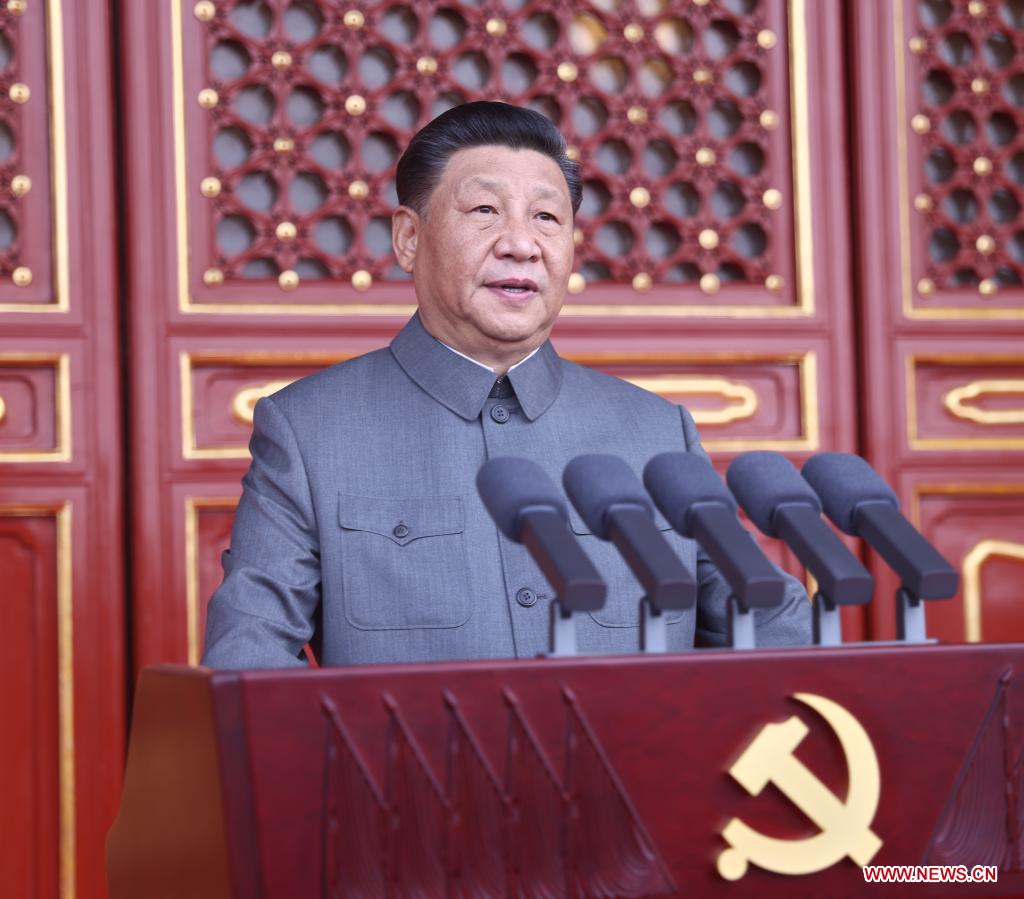 Chinese President and general secretary of the Communist Party of China, Xi Jinping, delivering a speech at the centenary of the CPC in Beijing, July 1. Photo: Xinhua
At the outset, one may recall the much-quoted epigram attributed to Napoleon Bonaparte: “When China wakes, it will shake the world.” Today, 100 years after the establishment of the CPC and 72 years since Mao proclaimed with justifiable pride – following a long and gory civil war – that “China has stood up”, that prescient observation finds global purchase.
It will be salutary to note that the CPC has not only survived – thus far – for eight years longer than the Communist Party of the Soviet Union did but also that the PRC has proved countless prophets of doom, who gleefully predicted its demise, to be patently and repeatedly wrong.
As Nicholas D. Kristop and Sheryl WuDunn (China Wakes: The Struggle for the Soul of a Rising Power, Random House, New York, 1996) pertinently point out:
“Westerners often make the mistake of seeing China in stark, almost Manichean terms: Human rights campaigners focus on the horrific treatment of political prisoners, while business executives regale their home offices with stories of new millionaires. The important thing is to realize the reality of both dimensions of China, to acknowledge that the government represses the people at the same time that it allows them to emerge from polio and poverty…
“Ultimately, we simply have to accept that there are two sides to China and they can’t be measured on the same scale. They are the yin and yang of China, both genuine, both relevant, both crucial to understanding the whole.”
Let us now deal with the highlights of Chinese President Xi Jinping’s peroration on Tiananmen Square, on the occasion of the CPC’s centenary.
The Western media reflexively focused on Xi’s warning that Beijing would not be bullied. This was, in fact, hardly astonishing given the constant barrage of withering criticism against China and the CPC, in recent months/years, including that at the G-7 summit in Cornwall and the NATO and EU-US summits in Brussels last month, where China was singled out as Enemy Number One.
But, as Xi explained, according to Xinhua reporting, the CPC’s continuous role in fighting off foreign domestic oppression is essential in ensuring that China stays on course on becoming a wealthy and advanced world power.
He claimed that the CPC is the only force capable of ensuring China’s rise: “The Chinese people have never bullied, oppressed or enslaved peoples of other countries, not in the past, not now, and not in the future.”
Xi also asserted: “At the same time, the Chinese people will never allow foreign forces to bully, oppress or enslave us…Whoever nurses delusions of doing that will bash their heads and spill their blood on the Great Wall of steel built from the flesh and blood of 1.4 billion Chinese people.”
Before moving on, let me remind readers that most nations that accuse China of human rights abuses tend to forget their own dark histories of colonialism, racism, exploitation, genocide and massacres. They invariably choose to cherry-pick, excoriating China while turning the Nelson’s eye to egregious human abuses by, for example, India and Saudi Arabia.
China’s ‘century of humiliation’ at the hands of Japan and major European powers is glossed over; admitted policy blunders and missteps such as the ‘Great Leap Forward’, ‘People’s Communes’ and the ‘Cultural Revolution’ are exaggerated; the significance of her reform and opening up minimized, while her studious non-involvement in umpteen conflicts that have engaged many of those who reflexively and routinely bash China is cynically ignored.
Finally, it would be remiss not to mention that although all countries have the right to unfettered development, all-round prosperity and defence, China’s endeavours in those realms have been consistently and constantly demonized. It almost seems that the West cannot stomach a rich and prosperous China but needs her, portrayed as an implacable ‘enemy’, to keep her assorted alliances intact!
NEPAL AND PRC
Xinhua reminds Xi had thus explained China’s core goals in his New Year message back in 2017: “What we Chinese Communists are doing is to better the lives of the Chinese people, rejuvenate the Chinese nation and to promote peace and development for humanity. While striving to improve the wellbeing of its own people, the CPC has also been committed to promoting the world’s common development.”
As BBC reported it, the Chinese leader declared that China would resolve the ‘Taiwan question’ to achieve complete reunification, while also saying, in remarks widely interpreted as directed at the United States, that Beijing would not allow “sanctimonious preaching” while adding that “no one should underestimate the resolve, the will and the ability of the Chinese people to defend national sovereignty and territorial integrity.”
So far as Nepal-China relations go, it is a fact that Nepal-China relations have grown from strength to strength since the establishment of diplomatic relations on 1 August 1955.
This has not only been reflected in the vast scope and variety of development projects that China has assisted in Nepal since then but also underscored by the frequency of high-level visits between leaders of the two governments.
China has made good on its policy of respecting the principle of the sovereign equality of states and has refrained from indulging in the common affliction of interfering in Nepal’s domestic affairs so beloved of our other immediate neighbour. Neither does she bully, arm-twist or resort to such crude devices as blockades as instruments of foreign policy.
Nepal, for her part, has always adhered to a One-China policy. Beijing has maintained excellent relations with all manner of governments in Nepal, including those in the heyday of the monarchy. It should be recalled that it was not Communist China that supported the Maoist insurrection in Nepal; nor was she instrumental in toppling the monarchy; other ‘democratic’ countries jointly did, for their own vested interests.
Given India’s proven predatory intentions and track-record in Nepal and in the region generally, I hold that if Beijing had not re-established her sovereign presence in Tibet soon after the establishment of the PRC, Nepal’s fate would not have been very different from that of Bhutan’s – if not Sikkim’s.
China’s immutable geostrategic presence in Nepal’s immediate north is the best guarantee that Kathmandu will not have to face any onslaught on her territorial integrity from the south.
Nepal does not feel threatened in any way from China’s rise and awesome progress and prosperity. She in fact takes pride that, just before the centenary celebrations, WHO officially declared China to be malaria-free, after a 70-year fight against the disease.
So, too, that China with a staggering population of 1.4 billion has, from the period of reform and opening up, uplifted nearly 800 million people from poverty. This feat is not only widely considered as a miracle but also a stupendous achievement in terms of promoting human rights at the most basic level. Another stellar achievement is that, beginning from a per capita annual income of $ 280 in 1980, China’s per capita income is now estimated at $ 10,000.
Apart from umpteen technological advances she has recorded in recent years, China has administered more than 1 billion Covid-19 vaccinations; provided more than 350 million vaccine doses as assistance to more than 80 countries and direct vaccine assistance to more than 40 countries. And so on.
EXIT FROM BAGRAM
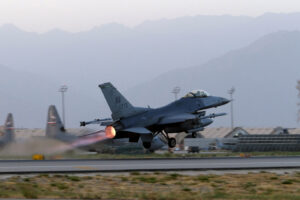
US forces leaving Afghanistan’s Bagram airbase after 20 years. Photo: Al Jazeera
Turning our attention, now, to Afghanistan and America’s on-going process of withdrawing her military forces from that beleaguered nation, I begin with a quote from Lord Curzon, speaking at the annual dinner of the Central Asian Society in London, in 1908.
As documented in Ahmed Rashid’s eminently readable book, ‘Descent into Chaos’, (Penguin Group, New York, 2009), Curzon proclaimed: “If the Central Asian Society exists and is meeting in fifty or one hundred years hence, Afghanistan will be as vital and important a question as it is now.”
“Afghanistan has been a gateway for invasion since the earliest Aryan invasion from Central Asia into the Indian sub-continent six thousand years ago. Easy to pass through, the country has nonetheless been impossible to conquer.”
Some equally salient geopolitical facts Rashid reminds us include: “The Soviet withdrawal from Afghanistan (1989) was followed by another withdrawal – that of the United States from the entire region under George H.W. Bush. Having won the cold war, Washington had no further interest in Afghanistan or the region. This left a critical power vacuum for which the United States would pay an enormously high price a decade later.”
Fast forward to 2 July 2021, as the last U.S. troops begin to leave Bagram Airbase, tersely described by CNN as a “hushed finale that portends the imminent conclusion of America’s longest war.” The news report went on to conclude: “But the withdrawal from Bagram, devoid of any pomp and ceremony, is a symbolic victory for the Taliban.”
It quoted an unnamed Afghan as prophesying: “Now the war between the Afghan government and the Taliban will be worse. The Taliban have reached the border of the cities and this is a big problem. Now the Afghan people are afraid for our future and they are concerned about what the future holds.”
Meanwhile, the Guardian reported that with the United States and NATO forces expected to be gone by mid-July, only British and Turkish forces are still on the ground. There is spiraling violence with the Taliban having seized at least 50 of the 400 districts, since May.
It starkly reminds that “trillions of dollars, 20 years and above 2,300 U.S. military deaths did not buy security.”
Zahid Hussain, a Dawn columnist, 1 July, said that “with the revival of armed regional militias to stop the Afghan Taliban, Afghanistan is edging towards civil war” and disclosed that “a U.S. intelligence report says the Ghani government in Kabul could collapse within six months of U.S. withdrawal.”
A 4 July editorial in Pakistan’s Dawn newspaper is noteworthy, too. Terming the United States/NATO forces’ exit from Bagram as “an end of an era”, it characterizes it as “one that saw another failed attempt of Western states at nation-building and the ‘air-lifting’ of democracy.”
The editorial opines: “The involvement of foreign forces in Afghanistan – first by the Soviets in 1979 and later by the Americas and their NATO cohorts – has only prolonged the Afghan nightmare. While the Afghan political forces and warlords are no doubt also to blame for the dysfunction that haunts their land, the influence of foreign powers and the playing of geopolitical games on Afghan soil have had a major part in destabilizing the country, and preventing an organic evolution and political process from taking root.”
LESSONS FOR NEPAL
What are the lessons for Nepal?
They are pretty basic and can be pinpointed as: 1. Do not permit interference by foreign powers in Nepal’s domestic affairs – under any guise. 2. Ensure that external forces are provided no excuse to engage in geopolitical games in her territory, which, like Afghanistan, is of enormous geostrategic value to China and India, as well as regionally.
This is even more so when China has been openly targeted as a prime hunting trophy by the West, even as India is virtually conjoined with the United States’-led anti-China alliance, including via the ‘Quad’ mechanism.
This corollary may be added: As recent Afghan history so eloquently illustrates, it would be the height of folly for New Delhi to assume that the United States’ interest in her geopolitical assets vis-à-vis China is permanent.

Login to add a comment