







By Our Reporter
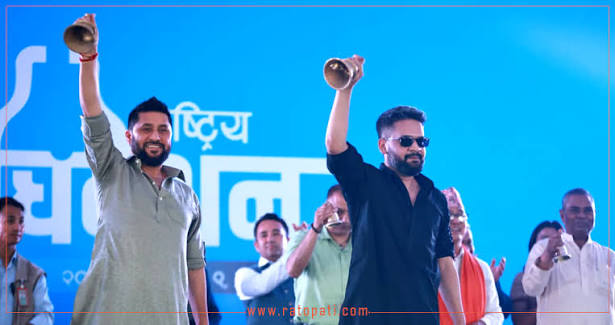
The Rastriya Swatantra Party’s first general convention was expected to mark its transition from a movement built around public frustration into a mature political organization. Instead, it exposed a contradiction that the party has long used to criticize its rivals. While the leadership repeatedly insisted that the RSP would reject camps, panels and patronage politics, the election of office bearers unfolded in a way that suggested informal factions had already taken root. Coordinated candidate withdrawals, public endorsements and allegations of backroom negotiations cast a shadow over a convention that was supposed to showcase internal democracy. The election itself was completed peacefully, but the process has left behind questions that the leadership cannot simply dismiss.
Whether the RSP now formally has factions is open to debate. The party has no officially declared camps. Yet politics is often defined by behavior rather than labels. When candidates withdraw after consultations with senior leaders, when multiple contenders rally behind one preferred nominee, and when delegates receive clear signals about who represents the establishment, informal groupism becomes difficult to deny. Such coordination may not amount to institutional factionalism, but it reflects the emergence of power centers within the party.
The strongest evidence came during the contest for general secretary. A series of withdrawals in favor of Bipin Kumar Acharya effectively narrowed the race before delegates had the opportunity to make a full choice. Those who remained in the contest argued that decisions were being shaped behind closed doors instead of on the convention floor. Their criticism was directed less at Acharya’s candidacy than at the process through which support was consolidated.
Ganesh Karki openly questioned the leadership’s approach. He argued that democracy is strengthened through delegates’ votes, not private agreements. His criticism carried extra weight because it echoed Rabi Lamichhane’s own speech at the convention’s opening, where the party chairman declared that genuine RSP members should not campaign for other candidates. Within days, several candidates had withdrawn and publicly endorsed another contender. That sequence made it difficult for the leadership to explain the difference between its public message and its internal practice.
Manish Jha raised similar concerns. He questioned why candidates who had confidently entered the race withdrew almost immediately after conversations with influential figures. His criticism reflected frustration that political calculations appeared to outweigh open competition. Even after accepting defeat, he maintained that his candidacy had been an attempt to prevent faction-based politics from becoming the party’s culture. His response after the result was measured, but his concerns remained.
Those who withdrew offered a different explanation. Kabindra Burlakoti argued that consensus served the party’s broader interests better than a crowded contest. That argument deserves consideration. Every political party encourages negotiations before elections. Consensus candidates are common across democratic systems, particularly when leaders seek to preserve unity. Political bargaining is not, by itself, evidence of unhealthy factionalism.
The concern arises when consensus appears selective or driven by an identifiable establishment group. If some candidates are encouraged to withdraw while others remain outside the consultation process, delegates naturally begin to question whether the outcome was genuinely competitive. Once that perception takes hold, trust becomes harder to rebuild.
The vice-presidential races reinforced that perception. Swarnim Wagle secured an uncontested victory after Biraj Bhakta Shrestha withdrew. In the women’s contest, several names disappeared before nominations were finalized, leaving only two serious candidates. Sobita Gautam’s nomination, proposed by a leader widely regarded as close to Lamichhane, was interpreted by many delegates as an endorsement from the party establishment. Whether intended or not, such signals influence internal elections.
Another issue deserves equal attention. The dramatic fall in voter participation weakens the convention’s democratic credentials. Party leaders said around 4,311 delegates attended the convention. Fewer than 3,000 voted in the Central Committee election, while only 1,289 participated in the election for office bearers. Nearly 70 percent of delegates did not cast ballots in the final round. Ravi Lamichhane himself remained in Chitwan but did not vote, while senior leader Balen Shah had already returned to Kathmandu.
Some delegates had legitimate reasons for leaving early. Yet the leadership must explain why participation declined so sharply during the convention’s most important elections. Internal democracy depends not only on fair competition but also on broad participation. A leadership elected by barely one third of convention delegates inevitably faces questions about its mandate.
None of this means the RSP has become identical to the parties it once criticized. It remains younger, less hierarchical and more open to internal debate than many established political organizations. The fact that candidates publicly challenged the leadership, accepted defeat peacefully and continued to express commitment to the party reflects a degree of democratic maturity.
Even so, the convention has exposed warning signs that cannot be ignored. Every party develops informal networks of influence as it grows. The challenge lies in preventing those networks from evolving into permanent factions that determine outcomes before delegates vote. The RSP built its political identity on rejecting exactly that culture.
Its first general convention has shown that resisting old political habits is far more difficult than criticizing them. The leadership now faces a defining test. It can acknowledge the concerns raised by its own members, improve transparency in future internal elections and reinforce democratic procedures. Or it can dismiss the criticism as routine post-election disappointment. The choice it makes will determine not only the party’s internal health but also the credibility of its promise to practice a different kind of politics.

Login to add a comment