







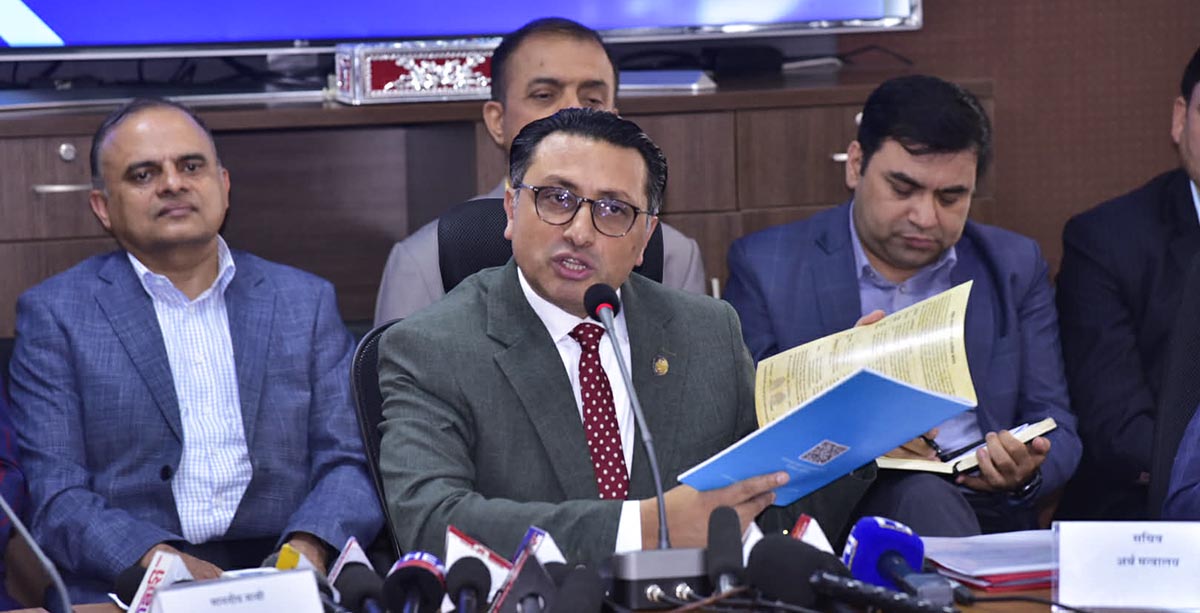
Kathmandu, June 30: During parliamentary deliberations on the Appropriation Bill about a week and a half ago, Minister for Science, Technology and Innovation Mahabir Pun made an unexpected admission.
Pun said that before becoming a minister, he had never even heard the term “abanda” budget, a lump sum allocation made without specifying how the money will be spent. Yet, after taking office, he found that more than one percent of the national budget had been placed under his ministry without any detailed programs attached.
According to Pun, the Ministry of Science, Technology and Innovation has been allocated Rs 3.5 billion as an unspecified discretionary budget.
Ironically, the ministry is not new. By Pun’s own account, it has simply been reorganized for the seventh time. Previously, it operated with clearly defined programs and corresponding budget allocations. This year, however, the government allocated Rs 3.5 billion without specifying projects, effectively giving the minister broad discretion over how the money will eventually be spent.
Governments typically keep a small contingency fund to respond to unforeseen events such as natural disasters. Most of the national budget is allocated under clearly defined expenditure headings.
An abanda allocation, however, carries no specific spending category. The Ministry of Finance later decides where the money will go by breaking it into detailed expenditure headings. Public finance experts have long criticized this practice because it gives the Finance Ministry broad discretionary authority over public spending.
Despite the criticism, successive governments have routinely kept around five percent of the national budget under such discretionary allocations. While Rs 78 billion was set aside this fiscal year, the government has increased that figure to Rs 90 billion for the upcoming fiscal year.
A former Finance Ministry secretary said such allocations are often used because politicians want funds reserved for favored projects before feasibility studies or project details are completed, making it impossible to assign them to specific budget headings.
Another former Finance Ministry official said large discretionary allocations undermine fiscal discipline.
“Nobody knows exactly where the money will be spent. The programs have not been prepared, activities have not been finalized, and unit costs have not even been calculated,” he said.
He added that funds are often parked under discretionary headings for projects that lack detailed project reports, before later being distributed to ministries under miscellaneous expenditure.
This year, while limiting discretionary allocations for other ministries, the Finance Ministry has retained the largest discretionary fund for itself.
According to the budget’s Red Book, the ministry has allocated Rs 90.31 billion under miscellaneous expenditure for the next fiscal year.
The amount is significantly higher than this year’s revised spending estimate. The government now expects to spend only Rs 8.78 billion from the miscellaneous budget during the current fiscal year.
Although the opposition has remained relatively weak during budget discussions, concerns have still been raised. Even ruling party lawmaker Badan Kumar Bhandari questioned the large discretionary allocation, arguing that it weakens transparency.
Finance Minister Dr. Swarnim Wagle has defended the allocation, repeating the government’s standard explanation that contingency needs and the creation of new ministries made it difficult to finalize detailed spending plans before presenting the budget.
Several ministers have also told lawmakers during parliamentary debates that any omitted projects could later be accommodated by approaching their respective ministries. Infrastructure Development Minister Sunil Lamsal repeatedly made such assurances, while Wagle also suggested that projects left out of the Infrastructure Ministry’s budget could still be addressed later.
Former National Planning Commission Vice Chair and lawmaker Dr. Pushpa Raj Kandel said these remarks indicate that the government intends to implement projects largely through discretionary authority.
“The Finance Ministry alone will oversee nearly Rs 800 billion in spending next year,” Kandel said. “On top of that, it has more than Rs 90 billion in discretionary funds. This reflects a growing tendency to direct public money according to political interests rather than transparent budget planning.”

Login to add a comment