







KATHMANDU, June 1: A newly adopted provision in the House of Representatives Regulations has sparked controversy after legal and political observers argued that it could shield lawmakers accused of corruption and money laundering from suspension.
The debate centers on Rule 259 of the House Regulations, which states that, regardless of provisions contained in other prevailing laws, the parliamentary rules will function as a special law in matters concerning the House, its committees and members. The provision further stipulates that interpretation of the regulations rests solely with the Speaker, whose decision will be final.
Rule 260 grants the Speaker exclusive authority to interpret the regulations, while Rule 261 classifies such decisions as internal parliamentary proceedings that cannot be challenged in court.
The controversy is closely linked to provisions governing the suspension of lawmakers. Under Rule 147(3), an MP can be suspended only if a charge sheet has been filed in a criminal case carrying a sentence of three years or more, or involving moral turpitude, and the lawmaker is either held in pre-trial detention or absconding despite a court order requiring detention.
In such cases, the member loses the right to perform parliamentary duties and is barred from receiving salary, benefits and parliamentary privileges until the suspension is lifted. The suspension is revoked if the member is released from detention or acquitted by the court.
However, the regulations do not explicitly provide for automatic suspension merely because an MP has been arrested or charged in a criminal case. The Constitution requires Parliament to be informed if a lawmaker is arrested on criminal charges, but it does not clearly state whether such an arrest should trigger suspension.
This ambiguity has fueled concerns over how cases involving corruption and money laundering will be handled. Critics argue that Rule 259 effectively overrides provisions in other laws that mandate suspension of public officials once such charges are filed.
The issue gained prominence following the case of Rabi Lamichhane, whose parliamentary position was suspended in 2024 after prosecutors filed money laundering, organized crime and cooperative fraud charges against him. At the time, the suspension was based on provisions of the Anti-Money Laundering Act, which requires public office holders to be automatically suspended once a money laundering case is registered.
Lawmakers from opposition parties, particularly the Nepali Congress, had objected to the new rule during deliberations. Congress Chief Whip Nishchal Rai questioned why MPs should receive special protections in corruption cases, arguing that Parliament and lawmakers cannot be placed above the reach of other laws.
Opposition lawmakers proposed 35 amendments and demanded clause-by-clause scrutiny through a parliamentary committee. Chief Whip Basana Thapa formally requested that the amendments be referred to a subject committee for detailed review.
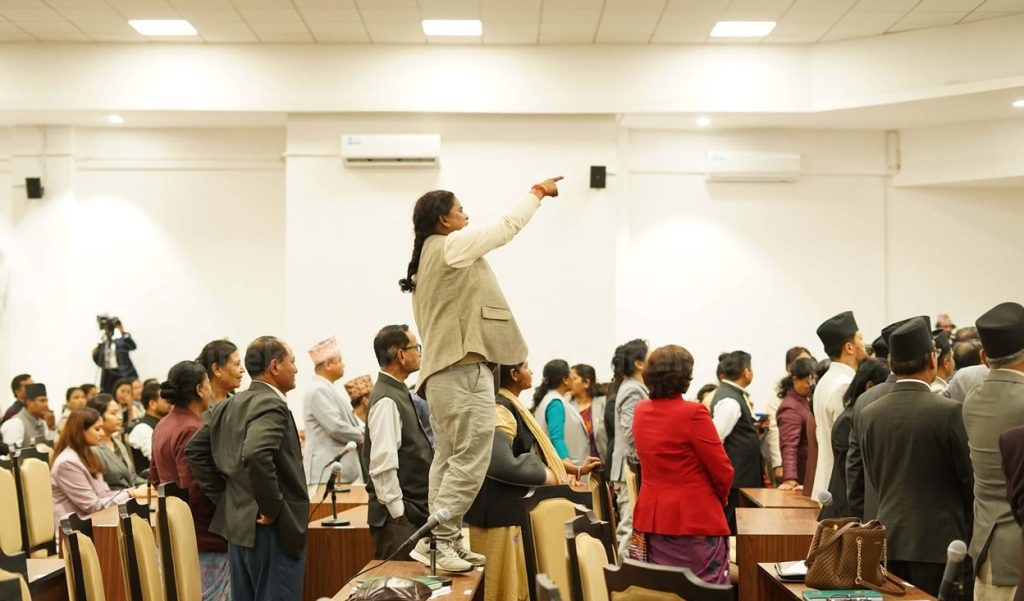
Speaker Dol Prasad Aryal rejected the demand and proceeded directly to voting. The move triggered protests from opposition MPs, who surrounded the well of the House, chanted slogans and accused the ruling coalition of forcing the regulations through without proper deliberation.
Tensions escalated into physical jostling between ruling and opposition lawmakers, forcing the House session to be adjourned for 15 minutes. Despite continued protests after the meeting resumed, the Speaker completed the voting process and declared the regulations endorsed by a majority vote.
The dispute has now evolved into a broader debate over parliamentary privilege, accountability and whether elected lawmakers should remain subject to the same suspension standards that apply to other public officials facing corruption or money laundering charges.
People’s News Monitoring Service

Login to add a comment