







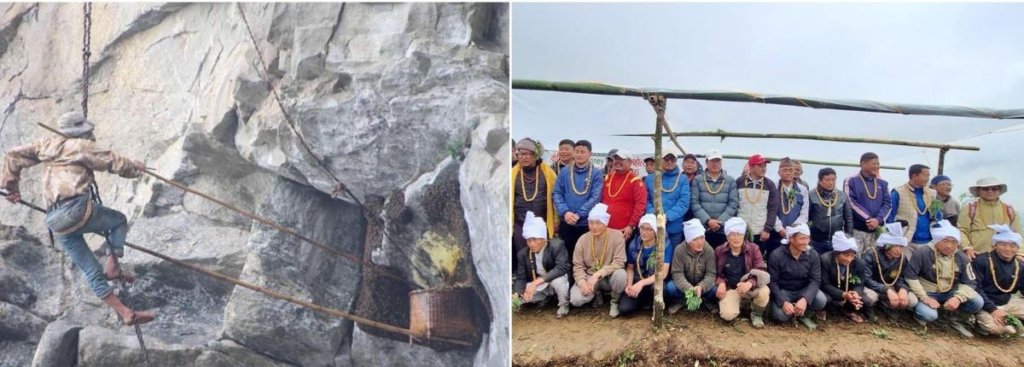
Kathmandu, May 23: The Honey Hunting Festival organized by Kepilasgadhi Rural Municipality in Khotang has witnessed an increase in both domestic and foreign tourists. The rural municipality, in coordination with the Koshi Province Government’s Ministry of Tourism, Forest and Environment, organized the festival with the aim of conserving the endangered cliff bees and promoting tourism.
According to the municipality’s Chief Administrative Officer Saudhan Rai, the main attraction of the festival was the traditional cliff honey hunting carried out by locals at the Terawa Mahabhir cliff in Phedi.
The organizers stated that people from all local levels within the district as well as neighboring districts including Bhojpur, Okhaldhunga, Jhapa, and Biratnagar participated in the event to witness the traditional honey hunting practice conducted using local resources and materials.
The organizers also said that arrangements had been made for domestic and foreign tourists participating in the festival to observe the daring cliff honey hunting practice and to study and research the customs and culture of the local Sampang Rai community.
The festival, organized for the first time by the rural municipality in collaboration with the provincial government under eco-tourism promotion, saw participation from representatives of all local levels in the district, tourism entrepreneurs, and Ramesh Rai, Chairperson of the Maiyung–Temke–Salpa–Silichung Tourism Promotion Center. Local residents arranged food and accommodation for domestic and foreign tourists by setting up tents in the highland area of Terawa in Phedi, where the festival was held.
Rural Municipality Chairperson Samir Rai expressed confidence that the festival, held in Phedi along the “Mundum Trail,” one of the 100 tourist destinations designated by the Government of Nepal, would greatly contribute to the conservation of cliff bees and the promotion of tourism.
“There are cliff bees in many cliffs of our rural municipality. This year, in coordination with the provincial government, we organized the festival to conserve the endangered cliff bees and connect them with tourism,” he said.
Cliff bees have inhabited areas such as Kuhire Chhangabhir of Ripdaula in the Phungalung Community Forest, Mahabhir Waterfall in Makhamla of Chilim Lahure Community Forest, and Terawabhir in Terawa for many years in Kepilasgadhi Rural Municipality, located in the northern part of the district.
Local residents of Phedi traditionally hunt cliff honey twice a year—during Ubhauli in the months of Jestha–Ashadh and during Udhauli in Kartik–Mangsir. Local honey hunters say that honey worth at least Rs. 500,000 to Rs. 700,000 is harvested from a single cliff in one season.
Honey hunter Hastaram Rai said that cliff honey hunting has been practiced in Phedi for generations as part of Kirat culture.
Traditional cliff honey hunting is carried out using equipment made from locally available materials, including ladders woven from bamboo strips, safety ropes, thread ropes, baskets, bamboo sticks, and containers. Hunters climb using the ladder and collect honey with the help of ropes, baskets, containers, and sticks.
In the language of local honey hunters, the person who descends the cliff to collect honey is called a “Paryange,” while the person who sends ladders, sticks, baskets, and other necessary materials to the hunter using ropes is called a “Sutare.” Those who help filter the honey, pour it into containers, and create smoke are referred to as assistants.
On the day of honey hunting, local residents from Terawa, Makhamla, Piping, and other settlements in Phedi gather in celebration, bringing homemade liquor, alcohol, snacks, and other food items from their homes.
Honey produced in Phedi is exported not only to Diktel Bazaar, Dharan, Biratnagar, and Kathmandu, but also to countries such as the United Kingdom, Hong Kong, and Singapore.
The Kirat Rai (Sampang) community of Phedi also associates the tradition of cliff honey hunting with their cultural and religious practices. They first offer the harvested honey to their ancestral hearths and deceased forefathers before consuming it as a sacred offering.
Since cliff bees produce honey from medicinal herbs and flowers, the honey is considered to have medicinal properties. Experts say that this honey, which can cause intoxication if consumed excessively, is beneficial for people suffering from bone and joint problems, nerve-related illnesses, uric acid, blood pressure, and other chronic diseases.
People’s News Monitoring Service.

Login to add a comment