








By Our Political Analyst
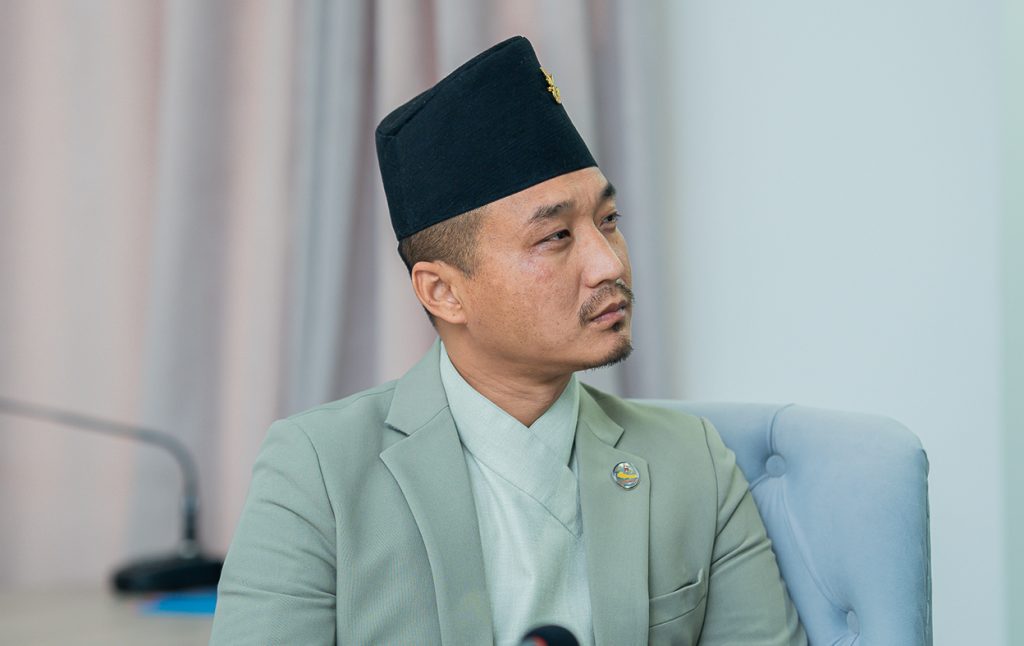
Politics sometimes turns strong leadership into headache for the party that promotes him or her. Home Minister Sudhan Gurung seems to be walking that exact line inside the Rastriya Swatantra Party (RSP), and not in a subtle way.
Let us start with the Gurung’s asset disclosure. On paper, declaring wealth should calm suspicion. In his case, it did the opposite. The scale of assets, including large gold holdings and stock investments, triggered curiosity first, then doubt. That doubt hardened after reports linked part of his investments to a microfinance connected to Deepak Bhatta, a figure already under investigation for financial irregularities and currently under police custody. The problem is not just that an investment exists. When a sitting Home Minister, who oversees law enforcement, is financially tied, even indirectly, to a controversial middleman, it creates an awkward contradiction. The state appears to be investigating one side while being financially entangled with the other.
Around Rs 5 million undeclared wealth may not sound dramatic in a system used to much bigger scandals, but omissions matter more than size. If disclosures are incomplete, the entire exercise loses credibility. Add to that the conflicting explanations between Gurung and his father about the source of wealth, and the story starts to feel less like a misunderstanding and more like a moving target. None of this exists in isolation. Gurung had already built a reputation for being unusually hands-on, some would say heavy-handed, in his role. His early days in office were marked by a series of high-profile arrests A new minister trying to prove he means business. But the courts quietly dismantled that narrative by releasing most of those detained.
That sequence matters. Arrest first, justify later is not how the system is supposed to work, even if it makes for good headlines. Legal observers began asking whether due process had been treated as a technicality rather than a requirement. The Home Ministry is meant to set policy and ensure coordination, not operate like an action desk for individual cases.
His interactions with security agencies added another layer. Frequent visits, direct involvement, and a tone that critics describe as forceful raised concerns about blurred lines. Civilian oversight is expected. Operational intrusion is not. When those boundaries start to shift, institutions tend to become cautious, sometimes even defensive. That is not a great environment for consistent law enforcement. For the RSP, which built its brand around clean governance and outsider credibility, Gurung’s controversies land differently. This is not just another minister under fire. This is a test of whether the party applies its own standards when it becomes inconvenient.
There are already signals of discomfort. Rabi Lamichhane, who has his own complicated history with allegations and investigations, reportedly is not fully at ease with Gurung’s approach and the mounting scrutiny. That creates an internal contradiction. A party that rose by challenging the old system now risks looking like it is managing damage within it.
Meanwhile, Prime Minister Balendra Shah has continued to back Gurung. That support adds a layer of political protection, but it also raises the stakes. The longer the controversy drags, the harder it becomes to treat it as routine criticism. It starts to look like a deliberate choice to absorb the cost.
Opposition parties have done what opposition parties do best. They have amplified every inconsistency and pushed for his removal. That part is predictable. What is less predictable is the steady criticism from legal experts, former officials, and even neutral observers. When criticism spreads beyond party lines, it tends to stick. So, is Gurung a pain in the neck for the RSP? At this point, it is hard to argue otherwise. Not because any single allegation has been legally proven, but because of the cumulative effect. Questionable financial links, incomplete disclosures, aggressive administrative style, and mixed signals from leadership have combined into a persistent distraction. The bigger issue is not Gurung alone. It is what the party does with him. If the RSP ignores the controversy, it risks eroding the very credibility that brought it into power. If it acts, it admits that its internal vetting and political judgment fell short.

Login to add a comment