







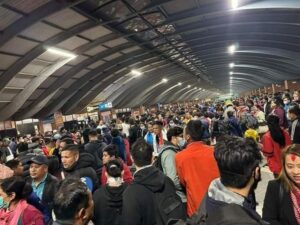
 The crowd of youths at the Tribhuvan International Airport waiting for their flights to foreign countries. Photo courtesy: Social network
By P.R. Pradhan
A responsible minister from the ruling party, Sudan Kirati said, “The country is torn wherever we touch, it is not easy to build.”
Kirati is the Minister for Tourism, Civil Aviation and Culture. Perhaps, he is talking about the organs under his ministry which have been torn away.
Already, it has been more than a month since 16 ministries are running without a minister.
The nation is functioning without the active leadership of the ministers since the November election was announced. Since the announcement of the election date, the government was turned into an election government. The government was allowed to conduct only day-to-day work.
After the 20 November elections, Pushpakamal Dahal was elected to the post of Prime Minister. Within two months, he had to seek a vote of confidence as he wished to change the partners in his government.
It became a Herculean task for him in expanding his cabinet by adjusting those 10 parties in the ruling alliance.
This is an example that the nation can function even without the ministers.
Constitutionally, PM Dahal is the strong executive chief of the government, however, he is helpless and very weak as NC, the largest party dominates the government. Moreover, other small parties demand more shares in the government. This has caused a delay in the expansion of his cabinet for more than a week.
After ending the alliance with the UML, the second largest party, already, PM Dahal has lost a big bargaining option and now he is solely dependent on NC support. Understandably, the strong base of the present government has become Indo-Waste support. And when there is a weak government, foreigners try to serve their interests.
Murky scenario:
The country is passing through a very fluid situation. One demonstrator died in the agitation launched expressing dissatisfaction with the name of Koshi Province. Eastern Nepal is agitated since the No 1 Province was named the Koshi Province. People from different parts of the country have arrived in Kathmandu seeking government support in rescuing them from the loan sharks. Businessmen are in agitation demanding a reduction in the bank interest rates. Squatters are in agitation denying evacuating the government land occupied by them. In fact, these are the problems created by the revolutionary political parties. Those loan sharks who are exploiting poor and helpless people by imposing heavy interest rates and even occupying their land are being protected by the political parties. Accordingly, squatters are being protected by different political parties. Similarly, businessmen dominate politics.
Moreover, the country is facing an economic recession. Market price has skyrocketed, whereas, economic activities have been hit very badly. Meanwhile, all the economic indicators have gone into the red zone. Besides, the global recession may impact the economy further.
Instead of resolving these issues and taking timely precautions, PM Dahal and those parties in the alliance government are concerned about their share in the government. The main intention of the ruling alliance is to loot the government coffer rather than to introduce good governance, curb corruption and make the nation prosperous.
Delhi visit:
PM Dahal has felt that he can retain his position as the PM and can strengthen his party if he will be able to please New Delhi. His all efforts are thus intended to please Delhi. He is trying his best to visit Delhi in the third week of April, yet he has not received a formal invitation.
Since the introduction of the multiparty democracy, every prime minister visits Delhi as if it has become mandatory to the present letter of credence there.
Every time, during such visits, India is rewarded with strategically important projects. This time, when our PM decided to gift to India, we have to wait till the visit.
Quit the nation:
When youths see no future in their home country, every day, thousands and thousands of people are flying to the Gulf countries and Malaysia seeking a job.
Also, youths from middle and higher-class families are going abroad for further study. In the past seven months, the nation spent 44 billion rupees worth of foreign currency for the study of Nepali students. It makes clear that Nepali youths don’t trust our higher education highly influenced by partisan politics. They will remain jobless even if completed their study. No efforts have been made by the political parties for quality education ensuring job opportunities after completion of their education. There is a high scope for transforming Nepal as an educational and health service hub but the political leaders are intended for destroying both potential sectors.
To conclude, there is no hope at all for the betterment of the nation under the present political system and the present leadership.

Login to add a comment