







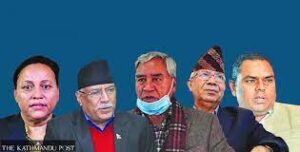
 By Our Reporter
The five ruling parties have failed to sort out the seat-sharing issue even after holding a series of meetings almost every day for the last three weeks.
The ruling parties which have decided to contest the upcoming elections by forging an electoral alliance have formed an 11-member task force to divide the seats of the House of Representatives and Provincial Assemblies among them under NC leader Krishna Sitaula. But the task force has been unable even to develop a model of seat sharing as the parties in the government continued bargaining for more seats. While only 165 members of the 275-member House of Representatives are elected directly under the First-Past-The-Post category, the five parties are reportedly demanding 232 seats in total.
While NC, the largest party in the alliance, has sought 100 seats, the Maoist Centre has demanded 60, the CPN (Unified Socialist) 40, Janata Sawmjwadi Party 30 and Rastriya Janamocrha 2.
When the task force failed to finalise the issues, the top leaders have also been holding meetings, but in vain. When the parties have been bargaining for more seats, they have also started announcing their candidates on their own.
Despite failing the sort out the issue of seat sharing, top party leaders like Pushpa Kamal Dahal have been claiming that the issue would be sorted out by Thursday. But looking at the developments made as of Wednesday, they may not conclude.
The Nepali Congress, which is the largest party in the coalition, has proved its popularity by winning 329 local levels in the recent polls and is demanding 60 per cent of the total seats. When the rival faction in NC led by Shekhar Koirala openly said that alliance could be impossible if NC is not given 100 of the 165 seats, party president Sher Bahadur Deuba is under pressure because of the rival faction. If the rival faction which is popular among the voters and supporters revolts, the NC will lose the polls. As such, NC may not agree on less than 90 seats, and the other four parties have to divide the remaining 75 seats among them.
It seems the Moist Centre and the CPN (Unified Socialist) are demanding more seats despite their poor organizational base only to prevent the NC from winning majority seats (138) in the House. However, if they do not forge an alliance with NC, they may not win seats in double digits.
Again, there is a challenge in allocating a few seats when NC leaders like Ram Chandra Paudel and Bishwa Prakash Sharma lost polls and the leaders of coalition parties won.
Parties under pressure for not repeating PR candidates
After Nepali Congress and the CPN-UML issued circulars to the party organisations asking them not to recommend the leaders who were elected under the proportional (PR) election system, and were candidates under PR category candidates in the 2017 elections as PR candidates this time. The two parties have also decided not to make the leaders who contested the recent local polls candidate in the upcoming elections to the House of Representatives and Provincial Assemblies.
This decision though will give chances to new faces and will exclude many leaders from the parliament. Moreover, the decision has exerted pressure on the Maoist Centre and Janata Samajwadi Party, because they have been bringing the same faces into the parliament under PR system.
Even many leaders in NC like Umesh Shrestha, Min Biswakarma and Binod Chaudhary will be unable to reach the parliament if the decision was implemented. Although Chaudhary may contest the poll under the First-Past-The-Post category from Nawalparasi, Shrestha and Bishwakarma have no constituency. Moreover, when the ruling parties are contesting elections by forging an alliance, there will be limited seats to adjust all.
Even Home Minister Bal Krishna Khand who was elected to the House under PR category in 2017 has to contest a direct election from Rupandehi this time.
However, the provision will discourage leaders from picking the same old face under PR category.

Login to add a comment