








By Pu Jin
In 1957, the successful launch of Sputnik by the Soviet Union ushered into a new era that sparked a space race with the US and a few countries around the world contesting to develop and launch their own satellites, while, China was nowhere near to be seen. Throughout the Cold War, activity in space was mainly dominated by the US and the Soviet Union, although France and Japan delivered their own satellites into orbit in the following years. After the launch of mankind’s first artificial satellite, Chairman Mao decided to make China equal with the superpowers by adopting Project 581 with the objective of placing a satellite in orbit by 1959 to celebrate the 10th anniversary of the PRC’s founding.
Fast forward over six decades and China is quickly becoming a Space Superpower, from Satellites to the Moon and the Mars. On top of that, plans for hypersonic aircraft capable of flying between Beijing and New York in an hour have been unveiled. A Beijing based Chinese company called Space Transportation is developing a rocket with wings, an ultra-fast space plane, for space tourism and point-to-point travel by going into space and coming back down. With an estimated travelling speed of 7000 kilometres per hour, Space Transportation is designing its aircraft for suborbital flight and city-to-city travel anywhere in the world. By putting a rocket and a jet together this incredible hypersonic will be able to fly from Beijing to New York in just one hour which is usually a 15-hour flight, for reference, Concorde’s top speed was 2,179 km/h.
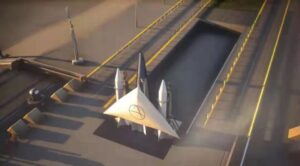 Among the dozen already existing Chinese rocket start-ups, Beijing Lingkong Tianxing Technology Co., Ltd. also known as Space Transportation, founded in August 2018 is a Chinese company known for developing reusable rockets and launcher manufacturers. Space Transportation is a provider of space mission launch services using its launch vehicles which are reusable launch vehicle that is used for high-altitude and high-speed flights. It also develops testing platforms for flights and offers design support, professional department assembly, final assembly, and arrow test services along with providing solutions for government, universities, scientific research institutions, and commercial customers.
“We are developing a winged rocket for a high-speed point-to-point transportation, which is lower in cost than rockets that carry satellites and faster than traditional aircraft,” Space Transportation told Chinese media. A video presentation on the company’s website demonstrates its ambitious plans and shows animated passengers boarding an aircraft attached to a wing powered by rockets. After a vertical takeoff, the aircraft detaches from the rocket-powered wing and continues its suborbital journey to Dubai. Meanwhile, the wing and boosters then land back on the launch pad while the super plane proceeds to its destination and lands vertically on three legs deployed from the rear. From the promotional video, it is obvious that this prototype will require both vertical take-off and landing.
This may all seem a bit fast for a company that was first founded just four years ago, but, hypersonic aircraft are significant among China’s hi-tech plans with the country continuing to pour large sums of money and resources into the sector. Even more ambitiously, the company said it had recently conducted successful test flights on rockets, named Tianxing 1 and Tianxing 2 and a 10th flight test was conducted on January 23, followed by another test. However, details about these test flight activities have been limited possibly due to the sensitive nature of hypersonic related technologies, manned test flights are set to begin in 2025, with a commercial service planned by the end of the decade. Space Transportation’s aircraft will comparably resemble rockets to traditional aeroplanes and because they will be launched up to the edge of the atmosphere before coming back down to their destination they will technically be classed as ‘space flights’. The prototype has a pair of delta wings similar to those of the French and British designed Concorde, but with tips pointing up.
For decades, NASA has maintained a monopoly on global space culture, however, space is now another battleground between the US and China amid a broader technological competition for supremacy. Despite being excluded from the International Space Station, the speed at which China is surpassing each technological hurdle spotlights how Beijing views space as vital for boosting the economy and promoting high-end industry. China launched its first satellite in 1970 and put its first human in space in 2003, becoming the world’s third nation, after Russia and the United States, to reach that milestone. In January 2019, China became the first country to land a probe on the far side of the moon. In addition to the possibility of a future crewed mission to Mars, China is planning a single, 10-year mission to collect a sample from an asteroid and pass by a comet and has also proposed orbiters for Venus and Jupiter.

Login to add a comment