






View from America

By M.R. Josse
GAITHERSBURG, MD: American President Joe Biden faces daunting new problems created by the deliberate spread of lies and disinformation about Covid-19 vaccines by right-wing personalities on media outlets, as well as on popular social media platforms such as Facebook.
BIDEN’S WOES
Despite that one half of the country astonishingly believe Biden’s stole the presidential election from former President Donald Trump, an influential segment of public opinion is increasingly turning its attention to Afghanistan. U.S. intelligence is painting a far bleaker picture of its future than hitherto.
Biden’s decision to pull out all U.S. military forces from Afghanistan by August end – a job reportedly 90% completed – has no doubt accelerated the pace of Taliban’s retaking control of much of the country, despite his repeated logical-sounding justification for ending America’s ‘forever war’ in Afghanistan which had initially found considerable traction domestically.
On the vaccine front, Biden has had to bluntly if extravagantly accuse social media of ‘killing people’ with blatant misinformation on the vaccines – a landmark success story of his administration, by all objective accounts.
Meanwhile, other issues have emerged on Biden’s national security agenda including what, if at all, he can do about the still tense and confused situation in Haiti, not to mention the unprecedented wave of anti-establishment protests in Cuba and the support it has garnered, particularly among the émigré Cuban population in south Florida.
And, not to forget, the United States and its foreign allies have, as this is being drafted, accused China of widespread malfeasance in cyberspace, including through a massive hack of Microsoft’s email system and other ransomeware attacks, a dramatic escalation in the increasingly urgent attempt by the Biden administration to stave off further breaches, as per CNN.
Is a further deterioration of America-China ties inevitable, perhaps even sparking off armed clashes? Who can say for sure?
In any case, it is salutary to be reminded – as I was by Donald Kagan’s impressive and intellectually deep tome – “On the origins of war” – that the Great War of 1914-1918 was, in essence, provoked by the emergence of a powerful united Germany that presented a challenge to the old order established in Vienna in 1815 by the “five great powers of Austria, France, Great Britain, Prussia and Russia, as a way of preventing the domination of a single state over all of Europe, such as had almost been achieved by Napoleon Bonaparte.”
Substitute China for a powerful united Germany and the United States to represent the existing international order and the analogy should be clear.
JITTERS
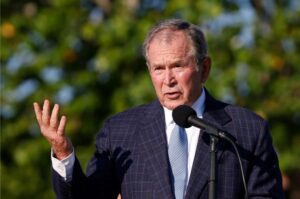 Former US President George W. Bush criticizing the withdrawal of American and NATO forces from Afghanistan. Photo: New York Post
Now, back to Afghanistan, starting with former U.S. President George W. Bush’s statement, 14 July, criticizing the withdrawal of U.S./NATO troops from Afghanistan, predicting that civilians were being left to be “slaughtered” by the Taliban. Answering a question by German broadcaster, Deutsche Welle, whether he thought the withdrawal was a mistake, Bush replied: “Yes, I think it is.”
The former American president, who sent troops to Afghanistan in the autumn of 2001, after the September attacks on New York’s World Trade Center, said he believed German Chancellor Angela Merkel “feels the same way.”
U.S. Gen (retd.) David Petraeus, former head of Coalition Forces in Iraq and Afghanistan, and former Director, CIA, told Fareed Zakaria, on TV, 18 July, that the situation in Afghanistan was “increasingly dire”, clarifying that “we are ending only U.S. involvement in an endless war;” that the ‘forever war’ itself was not coming to a close, as such.
Petraeus went on to predict that America will “regret” the decision to withdraw, especially the “hasty” manner in which it was being executed.
He reminded his TV audience that America has a “moral obligation to help those who helped us,” including the umpteen civilians and interpreters that did so. He opined that Afghanistan seems to be on “the brink of what looks like a brutal conflict” in the offing. He predicted that one could witness the reemergence of some manifestation of the al-Qaeda and the Islamic State in the future – a jittery prospect by any measure.
A quick reminder of some key metrics/features of the Afghan conflict, in contemporary times, may be germane, at this juncture. As F.S. Aijazuddin detailed in Dawn, 15 July, they include such factoids as these: the erstwhile Soviet Union occupied the country, 1979-1989; it generated a flood of 3 million refugees into Pakistan and 2 million into Iran, with 4 million Afghans being displaced internally.
Aijazuddin also recalls that Afghanistan “endured” 4 American presidents; three “Afghan presidential puppets” and 3 heads of the “Islamic Emirate of Afghanistan” (recognized by Pakistan, Saudi Arabia and the UAE.) He advances this equally scary prognosis: “If history is any measure, Afghanistan will remain sovereign without a sovereign, a state but no nation, unstable, never free, never at peace” – prompting this observer to wonder if a similar fate awaits Nepal, of which more later.
As Pakistan Prime Minister Imran Khan told the recent conference in Tashkent, Uzbekistan, “Central and South Asian Regional Connectivity: Challenges and Opportunities” – as per Dawn, 16 July – “the country that will be most affected by turmoil in Afghanistan is Pakistan. Pakistan suffered 70,000 casualties in the last 15 years. The last thing Pakistan wants is more conflict.” Khan’s assertions advertised the familiar story of fraught Afghan-Pakistan relations.
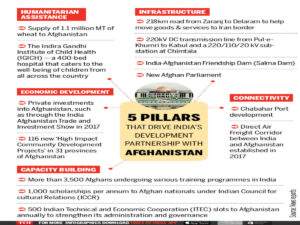
India’s development aid to Afghanis
Incidentally, one may take note of Indian Foreign Minister S. Jaishankar’s perspective outlined at Dushanbe, in Kirjizistan, 14 July, at a Shanghai Cooperation Organization’s Foreign Ministers’ Contact Group meeting, against the backdrop of the Taliban claiming to have control of over 85 percent of Afghanistan.
As reported by the Indian Express, Jaishankar loftily proclaimed that Kabul’s “future cannot be its past” and declared that the world is against the seizure of power by violence and force, adding that such actions are not legitimate. He also emphasized the need for ensuring that Kabul’s neighbours are not “threatened by terrorism, separatism and extremism.”
Not unexpectedly, perhaps, quite a different story is narrated by Nirupama Subramanian in the Indian Express, 16 July, thus: “As the Taliban push ahead…India faces a situation in which it may have no role to play in Afghanistan and, in a worst case scenario, not even a diplomatic presence.”
That, she avers, would be “a reversal of nearly 20 years of a relationship that goes back centuries. Afghanistan is vital to India’s strategic interests in the region. It is also perhaps the only SAARC nation whose people have much affection for India.”
She continues: “After a break between 1996 and 2001, when India joined the world in shunning the previous Taliban regime, New Delhi re-established ties with the country.” In the two decades after the 9/11 attacks, India was to pour in development assistance, under the protective umbrella of the U.S. presence.
That was timely help she asserts and recalls that, after five years of nearly near-medieval rule by the Taliban, preceded by half-a-dozen years of fighting among the mujahideen warlords following the Red Army’s (Soviet) withdrawal in 1989, Afghanistan was in ruins.
She continues: “India built vital roads, dams, electricity transmission lines and substations, schools and hospitals, etc…And India, unlike in other countries where India’s infrastructure projects have barely gotten off the ground, or are mired in the host country’s politics, has delivered in Afghanistan.
She then quotes a speech by Jaishankar in 2020: “No part of Afghanistan today is untouched by the 400-plus projects India has undertaken in all 34 of Afghan provinces.” She laments – quite legitimately – “the fate of these projects is now up in the air.”
SURPRISES
The worrisome current situation in Afghanistan has some unexpected surprises to offer. One of the most stunning has been elaborately and credibly projected by CNN’s Ben Westcoff, 14 July, thus: China could soon have an unlikely supporter in Central Asia – the Taliban!
Among the salient points that Hong Kong-based Westcott makes are:
Despite their vast differences, the Chinese Communist Party and the Taliban may soon find themselves working together, at least tentatively.
Following the withdrawal of American troops from Afghanistan, the Taliban is again resurgent, taking control of great swathes of territory of the country. The speed at which Afghan security forces have lost control to the Taliban has shocked many and led to concerns that Kabul may be the next to fall.
The Islamist group is already planning for such a future, with a Taliban spokesman telling the Hong Kong-based South China Post earlier this week that China was a “welcome friend” and conversations over reconstruction should begin “as soon as possible.”
Afghanistan remains a key component in Beijing’s long-term regional development plans.
In May, Chinese Foreign Ministry spokesman Zhao Lijian said Beijing was in discussions with Islamabad and Kabul to extend the China-Pakistan Economic Corridor (CPEC) to Afghanistan, including trade and transportation networks between the three countries.
Nor is Beijing averse to dealing with the Taliban, having publicly welcomed the group to Beijing in September 2019 for peace talks.
Meanwhile, it may be recalled that a Taliban spokesman has told the Wall Street Journal earlier this month: “We are against oppression of Muslims…But what we are not going to do is interfere in China’s internal affairs (on the issue of alleged repression of Muslims in Xinjiang).
Besides, it is commonsensical that if the Taliban assumed power in Kabul they would need Chinese support for Afghanistan’s stability and reconstruction.
Any deterioration in Afghanistan’s security situation would be of significant concern to Beijing, which has invested heavily in Central Asia through its Belt and Road trade and infrastructure scheme. In a widely-shared social media post Hu Xijin, the editor of the state-owned Global Times, said the Taliban considered China a “friend.”
The Global Times has suggested that Western media outlets were trying to ruin the Taliban’s relationship with Beijing by raising questions over Xinjiang.
LESSONS
Are there any lessons one can draw from the recent turn of events in Afghanistan – in terms of diplomacy, geopolitics or realpolitik?
As far as diplomacy goes, the cardinal lesson to be imbibed is that no country should bank 100 percent on another for diplomatic support in the furtherance of its national interests – as India, for example, has so rashly done with respect to the United States in the matter of confronting China.
Today, when the United States has, once again, demonstrated the primacy of her own national interest in the pursuit of her global foreign/security policy, it should be possible for Indians to understand India’s sheer folly in assuming that she could depend on Washington to be at her side, at a time of grave need.
In the past, after the era of the Soviet occupation of Afghanistan ended, it was then Pakistan that was left high and dry by the United States’ withdrawal from the region; today, it is India.
In terms of geopolitics, I believe it was – and still is – plain silly for the powers that be in Lyuten’s Delhi to turn for help from a power thousands of miles away to resolve her boundary dispute with Beijing – rather than coming to terms with geopolitical realism and settling her dispute with China, her immediate neighbour.
The superpowers practice realpolitik, not altruism: New Delhi, which does the same in our region, seems to have forgotten that in the current US-Afghan-Taliban context.
DEUBA AGAIN
So, NC’s Sher Bahadur Deuba has gained the support of the majority in the House of Representatives – obtaining help from a disparate and outlandish group of politicos and just rumps of political parties. Normal canons of parliamentary governance have been flouted; contradictions abound and the familiar phantom of instability – which is conjoined with corruption – looms large, possibly beginning with the ‘sale’ of ambassadorships whose value over the years has diminished to almost the vanishing point.
Indeed, while its destiny to be another Afghanistan – in terms explained above – appears sadly all too real, institutions including the Prime Minister’s Office, the Supreme Court and the Presidency have all been plunged into controversy.
How long will this dystopia last? Not long.

Login to add a comment