






View from America

By M.R. Josse
TAMPA, FL: The past week has been jam-packed with a passel of significant if disparate geopolitical moves unfolding across the board, here in America, in Covid-19 devastated India, on the South Asian chessboard and, even back home, in politically unstable Nepal.
While it may be difficult to digest all of it in one morsel, an attempt is nevertheless being made to connect a few of the more intriguing or telling geopolitical dots that seem to have lately emerged on the international relations radar.
BIDEN’S ADDRESS TO CONGRESS
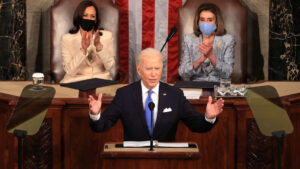
Biden’s first presidential address to Congress. Photo courtesy: Internet
President Joe Biden’s much awaited speech to a joint session of Congress the other day – or the traditional State of the Union address – on the eve of completion of the first 100 days of his administration must necessarily figure, even if in a necessarily condensed format.
To begin, there were a few notable ‘firsts’– a State of the Union address during a pandemic that has humbled even this rich and powerful nation; the first-ever occasion that the President was book-ended by two women – Vice President Kamala Harris, and House Speaker Nancy Pelosi – seated directly behind him; and the only joint session of Congress that was filled with just a fraction of the full strength of the two houses of Congress, with members all properly masked up.
Aside from such optics, the occasion was marked by a striking assertion of confidence, even exuberance, on Biden’s part as he proclaimed in a more-than-hour-long peroration that America is on the move again and is ready for a take-off, amid a historic boom in job creation and against a backdrop of mass vaccinations, in ‘one of the greatest logistical operations’ of its kind anywhere.
And yet, independent analysts such as BBC’s Antony Zurcher, assess Biden’s first 100 days’ record in much more prosaic terms: as a sort of glass half full/half empty affair. By one measure, Biden and his allies in Congress have passed a coronavirus relief deal and are making progress on a second massive bill – a multi-trillion-dollar spending package of what has broadly been described as ‘infrastructure.’
Furthermore, public opinion polls show that Biden has the support of the majority of the American population. And, while ‘his slow-but-steady approach to governing is a welcome break from the nonstop drama of Donald Trump’s presidency’, his legislative agenda has yet to receive any support from Republicans in Congress – despite Biden’s constant refrain about seeking the holy grail of bipartisanship.
Besides, his immigration policies have been haltingly implemented, say critics – and taking hits both from the right and the left; progress on such ‘liberal’ priorities such as healthcare, education and gun-control is uncertain, they affirm.
One of Biden’s three key claims was that ‘we’ll have provided 220 million Covid shots in 100 days’. This has been fact-checked by BBC and established as correct. Also found to be factual is that, as claimed, ‘1.3 million new jobs…in the first 100 days’ were created, more than what any president on record has achieved.
Interestingly, what was fact-checked and established as not true was his claim that ‘the fastest-growing population in the U.S. is Hispanic.’ According to the Pew Research Center and the U.S. Census Bureau, the Asian American population grew by 81% between 2000 and 2019, from 10.5 million to about 19 million, while the Hispanic population grew by 70% during the same period, now standing at 60 million.
Listening to Biden’s address, I was struck by a number of things not mentioned in any commentary on the subject that I’ve seen since. First of all, is that Biden came across as far more confident and fluent a speaker than any time in the past.
Secondly, I couldn’t but be impressed that he called out China multiple times, as no other country was, indirectly elevating China’s international status and clearly indicating that it is China that is most on America’s mind today. India, by contrast, received just one mention – and that too only in conjunction with China in the context of carbon emissions in the broader backdrop of Biden’s climate agenda.
Incidentally, speaking about China, it is pretty well-known that blanket criticism of China, especially in the context of human rights, finds no traction in Africa as a recent BBC story credibly documented.
Thirdly, this observer of the American political landscape could hardly fail to notice that while Biden was repeatedly applauded by Democrats, the Republicans seemed to turn a deaf ear to the president’s sweeping claims and, at times, stirring oratory.
Fourthly, given the near-equal respective strengths of the two parties in Congress, and indications that Trumpism is alive and well in the Republican Party, I could not help but wonder whether Biden’s myriad ambitious political goals would be fulfilled.
Sixthly, one would be remiss in not mentioning that many of America’s adversaries – China, Russia, Iran, Turkey and North Korea, to name but a few – do not seem to be exhibiting any visible signs of wilting to American power, despite the forceful rhetoric emanating from Washington.
Finally, Biden seemed to go out of the way to praise his Secretary of State, Antony Blinken, clearly indicating that their relationship is especially close and cordial.
MODI’S RESIGNATION?
India’s heartbreaking Covid-19 situation continues to grab international news headlines even as a growing number of knowledgeable commentators hold Indian Prime Minister Narendra Modi and his alter-ego Home Minister Amit Shah personally culpable for the mega-tragedy that is unfolding in India today.
Sumit Ganguly, writing in the Washington Post, for example, says: “Though harsh lockdown measures, the nation had controlled the initial wave by January. Then, Prime Minister Narendra Modi’s government abandoned its caution and, in a series of stunningly reckless decisions, invited the second wave that is now crushing the country. The colossal failure of policymaking has many forebears: general callousness, crass electoral considerations and sheer ineptitude. For a government that first assumed office in 2014 with a promise of sound, technocratic governance and an end to political paralysis, the second wave represents an astonishing abdication.”
Shubhajit Roy of the Indian Express provides another dimension of the Indian public health crisis, thus: “In what marks a major shift in 16 years, India has now started accepting gifts, donations and aid from foreign nations as the country reels under a massive shortage of oxygen, drugs and related equipment amid a surge in Covid cases.”
There have been two other changes in approach that signal this shift. India now has “no conceptual problem” in procuring oxygen-related equipment and life-saving medicines from China. “Besides, state governments are also free to procure these life-saving devices and medicines from foreign agencies and the Central Government will not come in the way.”
Another Indian Express account reported that India’s foreign minister S. Jaishankar, 29 April, in a virtual meeting with Indian diplomats, conveyed the message that the “one-sided” narrative in the international media – that Prime Minister Narendra Modi’s and his government failed the country by their “incompetent” handling of the Covid-19 wave – must be countered.
This meeting came in a tsunami of strong editorials, commentary and reports in leading international newspapers such as the New York Times, the Guardian, Le Monde, and Strait Times and TV channels for ignoring warnings, holding an extended electioneering campaign in West Bengal and for not cancelling the Kumbh Mela.
Besides Jaishanakar’s panicky ‘shoot-the-messenger’ advice to Indian diplomats, another revealing side to the Indian government’s jitteriness, was recently provided by the Wall Street Journal which reported that “Facebook blocks, then restores, content calling on Indian Prime Minister Modi to resign” following pressure from the Indian government.
The fact that the ruling BJP managed to hold power in recent Assembly elections only in Assam but failed to make major gains in Tamil Nadu, Kerala and the union territory of Punducherry – while losing royally to the Trinamool Congress (TMC) in West Bengal, comfortably held by Chief Minister Mamata Banerjee, carries its own commentary. She is a fierce Modi critic and India’s only woman chief minister.
If the Indian Express account is credible, key members of the government’s Covid-19 task force believe that there is an urgent need to break transmission of the Covid-19 virus and are thus ‘pushing hard’ for a national lockdown.
But what if, as many experts believe, the dire situation in India explodes beyond all control – despite a stream of foreign aid in the form of medicines and equipment? Who will be held accountable? Who will take charge if there is a complete breakdown in governance? Who will pick up the pieces?
Though one is well aware that there has not been an Army coup in India – thus far – can such an eventuality be ruled out altogether? Don’t forget, already the authorities have called on the Army to help out in the Indian capital. Could they be tempted to do more? Who knows? Let’s wait and see.
In any case, our policy makers must closely monitor what happens in the weeks and months ahead in India; already, their baleful effects are being manifested in Nepal.
GEOPOLITICAL GAMES
Against the above backdrop, I found it simply weird that India’s chief of defence staff, Gen. Bipin Rawat, has been invited to Nepal, with family – yes, all this while the pandemic rages furiously on in India and the situation in Nepal is only a few degrees better.
This piece of startling ‘news’ was served up by a vernacular news outlet, Pardaphas, which informed that the brilliant idea came from no less an eminent personage than Prime Minister Oli. I would have dismissed it as balderdash – but for the attribution of the public disclosure to Information Minister Parbat Gurung!
Personally speaking, I would have thought that Gen. Rawat and his cohorts would have a great deal to do right in India itself, especially at this time.
This story was sort of balanced by an account in ekaraj.com which reported that the Chinese Defence Minister Gen. Wei Fenghe recently paid a one-day visit to Dhaka where, as the Bangladesh newspaper Prothom told it, he came with the message that for the sake of peace and stability in South Asia, Bangladesh ought to oppose the Quad grouping comprising the United States, Japan, India and Australia as members.
China holds that the Quad arrangement is a military alliance, according to the report.
It is not immediately known however what the official reaction or response of the Bangladesh government was, though the Bangla newspaper added that, in a meeting with Bangladesh President Mohammed Abdul Hamid, the Chinese visitor dwelt at length on the subject of Beijing-Washington and Beijing-New Delhi relations.
At this juncture, in any case, I believe it would be germane to refer to excerpts from a write-up of mine published in this journal in the second half of 2020, entitled ‘Is another ‘Quad’ emerging?’
I had opened, thus: “The politico-diplomatic-military gambits in our region often constitute a mega jig-saw puzzle. The faint contours of an ‘emergent’ Quad are discernible therein, a nascent one grouping China, Pakistan, Nepal and Bangladesh.’
In conclusion, this is what I penned: Though that “has not jelled into a formal arrangement, there is a possibility that it could eventually surface in concrete shape in the not too distant a future – depending on how events pan out in our region and beyond.
FINALLY
Apart from the fact that at home the Covid-19 pandemic has spiked in a lethal second wave and all attendant inconveniences associated with it, PM Oli is reportedly going to face a vote of confidence motion on 10 May 2021. Seemingly, he has put a big fat cat among the opposition kittens: one can only wait and see what happens next.
There may be a geopolitical undercurrent to this, too, though it is difficult to say for sure from the other side of the world. Soon, we should know for sure, one way or another.

Login to add a comment