






View from America

By M.R. Josse
NEW YORK, NY: In a week jam-packed with dramatic geopolitical developments, this column will mainly focus on those that shed new light on India’s much-hyped Quad nexus recently proclaimed to have been greatly burnished during its first summit meet hosted by American President Joe Biden a month ago.
The other participants of that openly anti-China grouping – whose formal nomenclature is ‘Quadrilateral Security Dialogue’ – were Japanese Prime Minister Yoshihide Suga, Indian Prime Minister Narendra Modi and Australian Prime Minister Scott Morrison.
NOT TICKETY-BOO
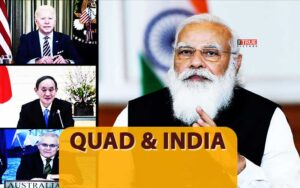
Photo: Internet
Despite all the hullaballoo and fanfare about the supposedly stellar achievements of that virtual conference, the actual state of play within the Quad, principally with its Indian member, would suggest that things are not altogether tickety-boo.
As much, surely, is indicated by a 6 April 2021 Times of India (TOI) disclosure that, during his first trip to India, U.S. Secretary of Defense Lloyd Austin reportedly raised the issue of the risk to India from the purchase of Russia’s S-400 advanced, air defence missile systems, as it could invite U.S. sanctions.
As per the TOI report, Austin indicated that the purchase of the Russian S-400s would run the risk of sanctions under domestic U.S. law, ‘Countering America’s Adversaries Through Sanctions’ Act. He said that experts believe that any move under the Act would have a deleterious effect on the relationship between the two countries.
Though at the conclusion of Austin’s brief visit to New Delhi, the Indian media put on an effusive spin to his Indian sojourn, it now appears that there were other less rosy dimensions which were not then made public.
In any case, a former Indian Foreign Secretary, Kanwal Sibal – a deputy chief of mission at the Indian embassy in Kathmandu decades ago – argued in an interview with the newspaper that sanctions were uncalled for and would damage U.S.-India relations.
Among the other salient points Sibal made was that Russia gives access to technologies that other countries don’t give to India; that ties with Russia would be damaged; and that India should do whatever is feasible but Delhi should maintain defence cooperation with Russia.
While expressing optimism that the United States wouldn’t actually impose sanctions on India, he went on to argue that it was ‘better to learn our lessons now’ and that ‘things will come to the test when the S-400s are delivered to India’ in a few months time.
Interestingly, Russian Foreign Minister Sergei Lavrov, who recently paid a quick sortie to India, told his Indian counterpart, S. Jaishankar – as per TOI’s Sachin Parashar – that alleged efforts to cobble together NATO-like alliances is Asia would be counter-productive to peace.
Though one is informed that Lavrov didn’t directly mention the Quad, he reminded that India too held the same position on military alliances. Tellingly, the Lavrov visit came in the middle of a three-day Quad plus France naval exercise in the Bay of Bengal not long after the Austin mission to New Delhi.
It is hard to believe that India’s now-open support for advancing the strategic objectives of the United States via the Quad would not have been raised by Lavrov, not forgetting that Russia continues to be on the cross-hairs of the United States’ targeting sights, across a wide swath of issues, of regional and international import.
ANOTHER JOLT
A news story in the Indian Express, 9 April 2021 by Krishn Kaushik provided unexpected illumination on another dimension of the Indo-America saga whose ramifications touch upon the Quad. In a nutshell, it reported that recently the U.S. Navy conducted Freedom of Navigation Operation in Indian waters ‘without prior consent’ of the Indian authorities.
As Kaushik tells it, reacting to the development, the Ministry of External Affairs adhered to the government’s stand on not allowing military exercises in its exclusive economic zone without its consent and said it had conveyed its concerns to the U.S. government through diplomatic channels.
In a highly unusual, even though not unprecedented, move, Kaushik reported, the U.S. Navy admitted it conducted a Freedom of Navigation Operation in the Indian Ocean Region, as its warship entered India’s Exclusive Economic Zone near Lakshadweep without seeking prior consent from India.
In a statement on 7 April 2021, the 7th Fleet of the U.S. Navy – the largest forward deployed naval fleet of the United States – said its guided missile destroyer U.S.S. John Paul Jones “asserted navigational rights and freedom approximately 130 nautical miles west of the Lakhshadweep Islands, inside India’s exclusive economic zone, without requesting India’s prior consent, consistent with international law. This Freedom of Navigation Operation upheld the rights, freedom, and lawful uses of the sea recognized in international law by challenging India’s exclusive maritime claims.”
It went to declare that that U.S. forces “operate in the Indo-Pacific region on a daily basis” and “all operations are designed in accordance with international law and demonstrate that the United States will fly, sail and operate wherever international law allows.”
Given that this blunt U.S. message came in the wake of the Quad summit; naval exercises with the Quad and France in the Bay of Bengal, around the same time; and not forgetting the backdrop of the Austin visit where the threat of sanctions against Indian was raised, it is pretty plain that India’s Quad association doesn’t count for too much with its principal driver – the United States.
Even within the Quad, let us not forget, India is the only member of the quadrangular arrangement that is not a treaty ally of the United States. Perhaps it is time for Modi to decide that India becomes a full-blooded military allay of the United States, or step back from it altogether.
To be sure, recalling Lavrov’s reported comment about NATO-like arrangements in Asia being counter-productive to peace it is difficult to imagine that Russia would continue to court a India that is a full treaty ally of the United States, its principal adversary.
In the context of the Indo-American relationship, I now wish to share some perceptive observations by Javid Naqvi, Dawn’s New Delhi correspondent.
He quotes Rahul Gandhi telling former U.S. diplomat Nicholas Burns in an on-line conversation: “I don’t hear anything from the U.S. establishment about what’s happening in India. If you are saying partnership of democracies, I mean what is your view on what is going on here.”
Naqvi own comments are: “The U.S. needs India (instead) to join the Quad against China, which Mr. Modi is ready to deliver. Why would they disturb such a cosy arrangement?
“As for the U.S. coming to anyone’s help, its own democracy is facing a mortal threat from within. The Democrats accuse the Republicans and Donald Trump for the current pass. They are deaf to the wise saying that you reap what you sow. You can’t use gunboat diplomacy to dismantle nations and discourage your own people for loving the culture of the gun at home. You can’t berate China on human rights and court General Sisi in Egypt and Benjamin Nethanyahu in Israel. Indians fancy themselves as a multicultural democracy before the advent of Narendra Modi. The U.S. uses two yardsticks here. It supported the dismantling of a multi-ethnic Yugoslavia with lethal firepower but advocated a truth and reconciliation commission where it came to South Africa.”
KUMBH MELA PRESENCE
As far as Nepal is concerned, former King Gyanendra Shah’s participation as a special guest at the once-in-12-years Maha Kumbh Mela’s hoary rituals in Haridwar, Uttarkhanda, India the other day clearly overshadowed the desultory domestic political scene – at least for a while.
What was most compelling was that the former monarch was almost constantly and publicly referred to by the organizers as Nepal’s King or even as “Shree Pancha Maharajdhiraj Gyanendra Bir Bikram Shah Dev.” While that must obviously have delighted the Nepali dignitary, it must have scared the daylights out of Nepal’s ever-squabbling politicos, angered hordes of our ‘secular’ intellectuals, offended the Communists but perhaps acted as morale-boosters for RPP-types.
That Prime Minister Narendra Modi wasn’t around – apparently he was electioneering in southern West Bengal – may have consoled some people, as there was no meeting between them, as many may have speculated.
I found Shah’s public address – in Nepali – most interesting, even somewhat elevating. While he emphasized the imperative of saving “our religion and culture, and cultural heritage sites” he briefly delved into the historicity of the Hindu religion, elaborated on the significance of a dip in the holy Ganga and waxed eloquent on its myriad environmental underpinnings.
In doing so, he underscored the close cultural and religious affinity between Nepal and India.
He chose, besides, to articulate concerns about the ‘religious and cultural invasion’ of values and traditions dear to all Hindus.
He reiterated Laxmi Prasad Devkota’s oft-quoted writing debunking the notion that Nepal is a ‘small’ country proclaiming, instead, that she is at the very centre of the Aryan civilization.
Politically, his address I believe would have sounded like music to BJP ears, while being off-putting to a Western or non-Hindu audience.
While the impact of his high-profile visit and the significance of his public utterances will doubtless be endlessly debated in Kathmandu and elsewhere, sadly it will also be associated in the public mind with the fact that it coincided with a second deadly Covid-19 wave that continues to sweep India.
Both BBC and CNN, for instance, gave fulsome coverage to the millions of devotees who gathered on the banks for the Ganges (Ganga) for their traditional ritualistic bath in the river. Both international news outlets feared that the fact that humungous masses of humanity had been packed closely together for days on end might trigger further surges in the pandemic when the pilgrims return to their respective homes. Already Covid-19 cases, both claimed, have overtaken that in Brazil.
I did not, incidentally, notice any reference to the former King of Nepal being an esteemed guest of the organizers – not by the BBC, not by the CNN or even the Indian Express.
Yet, if I were a betting man, I’d wager that former King Gyanendra’s pilgrimage to the Kumbh Mela at Hardwar, 2021 will be hugely impactful, in one way or another. We’ll soon know.

Login to add a comment