







View from America

By M.R. Josse
NEW YORK, NY: ‘A Promised Land’ [Crown, New York, 2020], Barak Obama’s memoirs of his first term in office, describes in fulsome and arresting detail the landmark moments of his historic presidency.
The 44th head of state, and the first African-American President of the United States, serves a sumptuous banquet, indeed.
They include his thoughts relating to grass-roots political activism in America as well as those concerning his improbable journey, culminating in his securing the presidency.
These offerings have been garnished with dollops of enjoyable geopolitical insights, and shared memories – not all of them vanilla – of a cavalcade of global leaders with whom he interacted at various times, at different locales.
As the publisher claims, Obama “offers a unique and thoughtful exploration of both the awesome breath and the limits of presidential power, as well as singular insights into the dynamics of U.S.’s partisan politics and international diplomacy.”
A PROMISED LAND
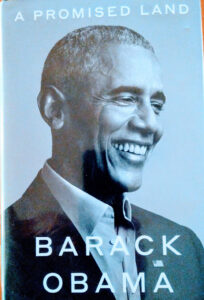
There are admittedly large swathes of territory that have not been covered in this review, for reasons of space. Inevitably, this reviewer must resort to cherry-picking, selecting what I believe would most interest this column’s readership.
Yet, it would be remiss to overlook matters, including Obama’s broad-brush observations on myriad aspects of American political life.
They include such bland assertions as “choices in people reflected choices in policy” to this telling disclosure: “That the U.S. Defense Department, the Intelligence Community…wielded a military budget larger than those of the next thirty-seven countries combined.”
His snapshots of the character of the two houses of Congress are engaging:
“Disdain between the two chambers of Congress is a time-honored tradition in Washington that even transcended party. Senators generally consider House members to be impulsive, parochial and ill-informed, while House members tend to view Senators as long-winded, pompous and ineffectual.”
Equally thought-provoking are his sobering recollections – in a speech at the West Point military academy – of some dark realities of American history.
“…Just as it was necessary to recall that Lee had led a Confederate Army intent on preserving slavery and Grant had overseen the slaughter of Indian tribes, that McArthur had defied Truman’s orders in Korea to disastrous effect and Westmoreland had helped to orchestrate an escalation in Vietnam that would scar a generation. Glory and tradition, courage and stupidity – one set of truths didn’t negate the other. For war was contradiction, as was the history of America.”
Admitting that in her interactions with other nations America had become “obdurate and short-sighted” Obama expounds:
“I believed that America’s security depended on strengthening our alliances and international institutions. I saw military action as a tool of last, not first, resort.”
An intrinsically optimistic view on America has also been outlined:
“Even those who complained about America’s role in the world still relied on us to keep the system afloat. To varying degrees, other countries were willing to pitch in – contributing troops to U.N. peacekeeping efforts, say, or providing cash and logistics support for famine relief.
“Some, like the Scandinavian countries, consistently pitched well above their weight. But, otherwise, few nations felt obliged to act beyond narrow self-interest, and those that shared America’s basic constituent principles upon which a liberal, market-based system depended…lacked the economic and political heft, not to mention the army of diplomats and policy experts, to promote those principles on a global scale.”
BRICS
Obama’s observations on BRICS – the economic grouping bringing together Brazil, Russia, India, China and South Africa – are interesting.
“They were big, proud nations that in one way or another had awoken from long slumbers. They were no longer satisfied with being relegated to the margins of history, or seeing their status reduced to that of regional powers…
“Together they represented just over 40% of the world’s population but about a quarter of the world’s GDP and only a fraction of its wealth…
“If the United States wanted to preserve the global system that had long served us, it made sense for us to give those emerging powers a greater say in how it operated – while also insisting that they take more responsibility for the cost of its maintenance.”
The author then throws this barb at BRICS: “For the BRICS, responsible foreign policy meant tending to one’s own affairs. They abided by the established rules only insofar as their own interests were advanced, out of necessity rather than conviction and they appeared happy to violate them when they thought they could get away with it. If they assisted another country, they preferred to do it on a bilateral basis expecting some benefit in return.
“These nations certainly felt no obligation to underwrite the system as a whole. As far as they were concerned, that was a luxury only a fat and happy West could afford.”
INDIA
There are, of course, umpteen references to India and China, with the former representing a small fraction of the latter.
While informing readers that he found (Prime Minister Manmohan) “Singh to be wise, thoughtful, and scrupulously honest”, Obama adds:
“Despite its genuine economic progress, though, India remained a chaotic and impoverished place: largely divided by religion and caste, captive to the whims of corrupt local officials and power brokers, hamstrung by a parochial bureaucracy that was resistant to change.”
In the context of his 2010 visit to India, Obama serves up additional commentary on Singh (Modi, of course, was not in the picture, then) and India.
“Manmohan Singh and I developed a warm and productive relationship. While he was cautious on foreign policy, unwilling to go out too far ahead of Indian bureaucracy that was historically suspicious of U.S. intentions, our time together confirmed my initial impression of him as a man of uncommon wisdom and decency, and…we reached agreements to strengthen U.S. cooperation on counter-terrorism, global health, nuclear security and trade.”
Obama’s assessment of India is far from optimistic. He believed, “India still bore little resemblance to the egalitarian, peaceful, and sustainable society Gandhi had envisioned. Across the country millions continued to live in squalor, trapped in sun-baked villages or labyrinthine slums…Violence, both public and private, remained an all-too-pervasive part of Indian life.
“Expressing hostility towards Pakistan was still the quickest route to national unity, with many Indians taking pride in the knowledge that their country had developed a nuclear weapons program to match Pakistan’s, untroubled by the fact that a single miscalculation by either side would risk regional annihilation.”
Obama is not betraying any secrets in letting on that Singh “hadn’t originally become prime minister as a result of his own popularity. In fact, he owed his position to Sonia Gandhi, the Italian-born widow of the former prime minister Rajiv Gandhi, who’d declined to take the job herself after leading her party to victory and instead appointed Singh.
“More than one political observer believed that she’d chosen Singh precisely because as an elderly Sikh with no national political base, he posed no threat to her forty-year-old son Rahul whom she was grooming to take over the Congress Party…
“As for Rahul, he seemed smart and earnest, his good looks resembling his mother’s. He offered up his thoughts on the future of progressive politics, occasionally pausing to probe me on details of 2008 campaign…But there was a nervous, uninformed quality about him as if he were a student who’d done his course work and was eager to impress his teacher but deep down lacked either the aptitude or the passion to master the subject.”
CHINA
Obama’s comments on China are more expansive and substantive than on India, though he barely delves deeply into the leading Chinese figures of his time: President Hu Jintao and Premier Wen Jaibao. However, he does acknowledge Wen to be a well-informed leader and shrewd negotiator.
In general reference to Chinese leaders, the 44th American president offers these sparkling glimpses:
“I was once again reminded that for Wen and the rest of China’s leaders, foreign relations remained purely transactional. How much they gave and how much they got would depend not on abstract principles of international law but on their assessment of the other side’s power and leverage. Where they met no resistance, they kept on taking.”
Obama’s keen and somewhat clinical assessment of China’s politics merit close attention, including the following:
“Since the late 1970s, when Deng Xiaoping effectively abandoned Mao Zedong’s Marxist-Leninist vision in favor of an export-driven, state managed form of capitalism, no nation in history had developed faster or moved more people out of abject poverty.
“Once, little more than a hub of low-grade manufacturing and assembly for foreign companies looking to take advantage of its endless supply of low-wage workers, China now boasted of top flight engineers and world-class companies working at the cutting edge of advanced technology. Its massive trade surplus made it a major investor on every continent: gleaming cities like Shanghai and Guangzhou…had become sophisticated financial centers, home to a burgeoning consumer class.
“Given its growth rate and sheer size, China’s GDP was guaranteed at some point to surpass America’s. When you added this to the country’s powerful, increasingly skilled workforce, shrewd and pragmatic government, and cohesive five-thousand-year-old culture, the conclusion felt obvious. If any country was likely to challenge U.S. pre-eminence on the world stage, it was China.”
Obama has also this to say on China: “Although the Chinese Communist Party maintained tight control over the country’s politics, it made no effort to export its ideology. China transacted business with all comers whether democracies or dictatorships, claiming virtue in not judging the way other countries managed their internal affairs.
“China could throw its elbows around when it felt its territorial claims being challenged, and it bristled at Western criticism at its human rights record. But even on flashpoints like U.S. arms sales to Taiwan, Chinese officials did their best to ritualize disputes – registering displeasure through strongly-worded letters or cancellation of bilateral meetings but never letting things escalate to a point where they might impede the flow of shipping containers full of Chinese-made sneakers, electronics, and auto-parts into U.S. ports and a Walmart near you.
“History told me that a chaotic and impoverished China posed a bigger threat to the United States than a prosperous one…China’s booming economy made even close allies like Japan and South Korea increasingly dependent on its bad side.”
PUTIN
What has Obama to say about Russian President Vladimir Putin? His views on Putin are well summed up here:
“There was just one problem for Putin: Russia wasn’t a superpower anymore. Despite having a nuclear arsenal second only to our own, Russia lacked the vast network of alliances and bases that allowed the United States to project its military power across the globe. Russia’s economy remained smaller than those of Italy, Canada and Brazil, dependent almost entirely on oil, gas and minerals and arms exports.
“Moscow’s high-end shopping districts testified to the country’s transformation from a creaky state-run economy to one with a growing number of billionaires, but the pinched lives of ordinary Russians spoke of how little of this wealth trickled down…
“Putin did, in fact, remind me of the sorts of men who had once run the Chicago machine or Tammany Hall – tough, street-smart, unsentimental characters who knew what they knew, who never moved outside their narrow experiences and who viewed patronage, bribes, shakedowns, fraud and occasional violence as legitimate tools of the trade.
“For them, as for Putin, life was a zero-sum game; you might do business with those outside your tribe, but in the end, you couldn’t trust them. You looked for yourself, first and then for your own. In such a world, a lack of scruples and a contempt for any high-minded aspiration beyond accumulating power, were not flaws. They were an advantage.”
PAKISTAN
Observations on Pakistan are often conjoined with those relating to India or Afghanistan – and the scourge of terrorism, including the sort practiced by al-Qaeda and preached by its former high-priest, Osama bin Laden.
In this context, Obama frames the American dilemma, thus:
“Although Pakistan’s government cooperated with us on a host of counter-terrorism operations and provided a vital supply path for our forces in Afghanistan, it was an open secret that certain elements inside the country’s military, and especially its intelligence services, maintained links to the Taliban and perhaps even al-Qaeda sometimes using them as strategic assets to ensure that the Afghan government remained weak and unable to align with Pakistan’s number one rival, India.
“The fact that the Abbottabad compound was just a few miles from Pakistan’s military equivalent to West Point only heightened the possibility that anything we told the Pakistanis would end up tipping off our targets.
“Whatever we chose to do in Abbottabad then would involve violating the territory of a putative ally in the most egregious way possible, short of war – raising both the diplomatic stakes and operational complexities.”
While the American Navy Seals’ assault on Bin Laden’s Abbottabad sanctuary, and his subsequent killing, are too well known to merit reiteration here, I believe Obama’s disclosure of how the then President of Pakistan, Asif Ali Zardari, reacted to his phone call informing him of Bin Laden’s end deserves to be recounted.
As Obaba tells it, he expected that Zardari who would surely face a backlash at home over our violation of Pakistan’s sovereignty.
“When I reached him, however, he expressed congratulations and support. ’It’s very good news’. He showed genuine emotion, recalling how his wife, Benazir Bhutto, had been killed by extremists with reported ties to the al-Qaeda.”
The writer can be reached at: manajosse@gmail.com

Login to add a comment