







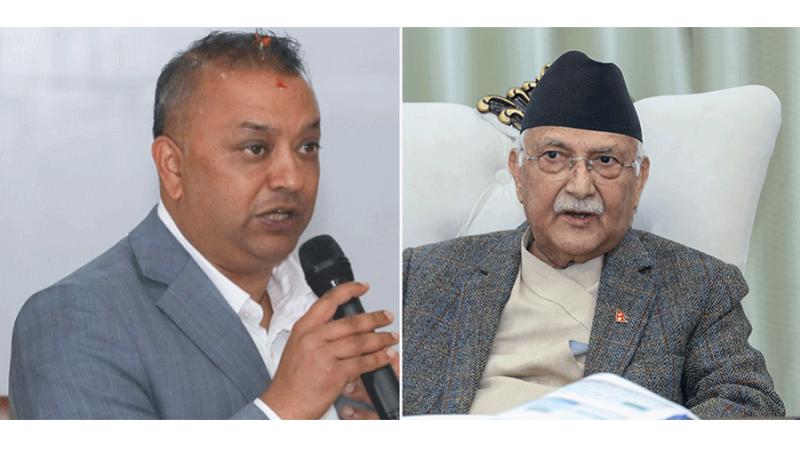
Kathmandu, July 17: The widening rift between the ruling Nepali Congress and CPN-UML has begun spilling into provincial politics, raising the prospect of government reshuffles across all seven provinces.
The clearest sign came in Sudurpaschim, where Congress Chief Minister Kamal Bahadur Shah dismissed four UML ministers, triggering speculation that the coalition has effectively collapsed in the province. In Karnali, Congress ministers have already quit the UML-led government. Similar moves are being considered elsewhere, with Congress weighing the withdrawal of its ministers from UML-led governments and the removal of UML ministers from governments it leads.
If the alliance formally breaks down, new provincial coalitions are likely. Current numbers suggest Congress and the CPN can comfortably form governments in Bagmati, Gandaki, Karnali and Sudurpaschim. In Koshi, Madhesh and Lumbini, however, regional and smaller parties would hold the balance of power.
In Bagmati and Gandaki, the combined strength of Congress and the CPN is enough to secure a majority. Karnali presents the biggest challenge for the UML because the Congress-CPN alliance would command a clear majority there. Sudurpaschim has already taken the first step toward a new coalition after the dismissal of UML ministers.
The picture is more complicated in Koshi, Madhesh and Lumbini, where the numbers fall short of a majority. Parties such as the Janata Samajbadi Party, Janamat Party, Nagarik Unmukti Party, Loktantrik Samajbadi Party and independent lawmakers are expected to play a decisive role.
In the 93-member Koshi Provincial Assembly, 47 votes are needed to form a government. The UML remains the largest party with 40 seats, while Congress has 29 and the CPN 17. Their combined strength reaches only 46, making the five RPP lawmakers and one JSP member pivotal.
Political arithmetic alone may not determine the outcome. Congress leaders in Koshi remain divided, with a section reportedly reluctant to support a change in government despite waiting for guidance from the party’s central leadership. The RPP has also said it will decide its position only after receiving instructions from the party headquarters.
Madhesh presents an even tighter contest. Of the assembly’s 107 seats, only 103 are currently active, meaning 52 votes are needed for a majority. The UML has 24 seats, Congress 22, the CPN 17, JSP 28 and Janamat 12. Without support from at least one Madhesh-based party, neither Congress nor the UML can form a government. JSP leaders have indicated they prefer a government under their own leadership.
In Lumbini, Congress and the CPN also lack a majority, making smaller parties essential.
Despite growing speculation, leaders from across the political spectrum have urged restraint. CPN leader Dev Gurung warned against destabilising provincial governments for power, while UML publicity chief Niraj Acharya said negotiations remain underway. Congress Joint General Secretary Prakash Snehi acknowledged tensions but expressed hope that dialogue could still prevent a complete collapse of the alliance.
People’s News Monitoring Service

Login to add a comment