







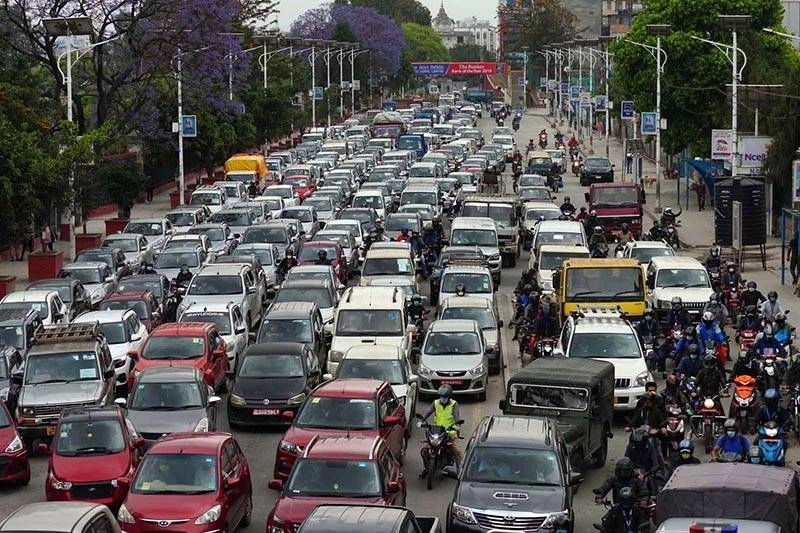
Kathmandu, June 16: Senior Superintendent of Police (SSP) Suresh Prasad Kafle of the Valley Traffic Police Office has warned that without immediate reforms in Kathmandu Valley’s traffic system, the situation could become so severe within two years that even basic road mobility may be impossible.
Presenting at a meeting of the Federal Parliament’s Infrastructure Development Committee on “Public Transport and Freight Management,” SSP Kafle said the valley’s traffic problems are worsening because the system is not technology-driven.
According to Kafle, around 6.5 million vehicles are registered in Nepal, while an average of 2 million vehicles operate daily within Kathmandu Valley alone. He also noted that only about 2,500 to 2,600 traffic police personnel are available nationwide to manage this massive volume of vehicles.
He further said that 2,000 to 3,500 Indian vehicles enter Nepal every day, and the lack of proper monitoring of their load capacity is contributing to rapid road damage.
To discourage traffic violations, SSP Kafle proposed a major increase in fines. “The current penalties of Rs 500 and Rs 1,000 are too low and do not create fear,” he said. “We need a legal provision that imposes fines ranging from Rs 5,000 to Rs 50,000 for violations.”
He also recommended replacing manual, hand signal-based traffic management in Kathmandu with an AI-generated integrated traffic light system. The estimated cost of implementing such a system is around Rs 15 to 20 billion.
“Current traffic lights are not synchronized with each other, which is causing severe congestion,” he said. “If we do not invest in technology now, there may come a time when even ambulances cannot reach hospitals on time.”
He suggested making dashboard cameras mandatory in both public and private vehicles to ensure evidence collection in accidents and to reduce disputes. He also called for digitally integrated checkpoints at border points, government-managed weigh stations, and an immediate scrap policy to remove old and expired vehicles from the roads.
Other proposals included integrating traffic rules into school curricula and increasing the use of drones and robots for traffic monitoring.
SSP Kafle also argued that issuing route permits without considering road capacity and design has contributed to congestion. He urged the government and stakeholders to invest more in infrastructure and technology instead of relying solely on traffic police for management.
People’s News Monitoring Service

Login to add a comment