







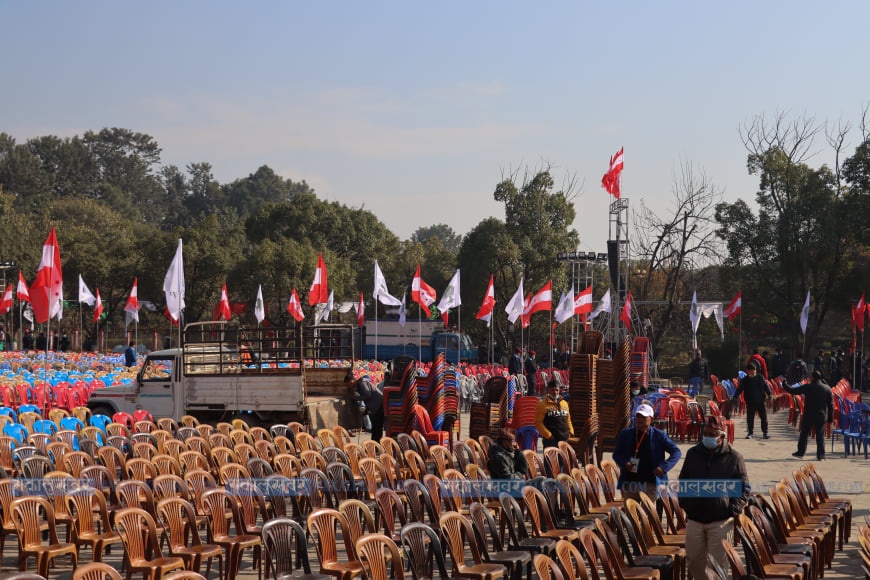
Kathmandu, June 14: In a landmark ruling, the Supreme Court has barred political parties from holding rallies, mass meetings and demonstrations at Bhrikutimandap and along Exhibition Road, citing threats to public health, education and the right to a clean environment.
The decision ends decades of political gatherings at one of Kathmandu’s most prominent public venues.
The ruling stems from a petition filed by Bibek Chaudhary, a law student at Nepal Law Campus, following a large youth festival organised by a UML affiliated youth group on Democracy Day, April 24, 2025. The event, held on Exhibition Road, featured loud music, traffic congestion and large crowds.
According to the petition, ambulances were delayed, hospital services were disrupted and students sitting examinations nearby faced disturbances. The area is home to several educational and health institutions, including Padmodaya School, Valmiki Vidyapith, Ratna Rajya Campus, Nepal Law Campus and Model Hospital.
Scientific evidence presented before the court showed noise levels in the area reaching up to 100 decibels, well above the 35 to 50 decibel limit generally considered safe around hospitals and other sensitive locations.
A joint bench of Justices Manoj Kumar Sharma and Sunil Kumar Pokharel issued three key directives:
- Political rallies, demonstrations and gatherings that obstruct traffic or public movement on Exhibition Road are prohibited.
- The exhibition grounds at Bhrikutimandap can no longer be rented out for political mass gatherings. The venue may only host commercial, educational, cultural and heritage related events.
- Organisers of events elsewhere in the country must adopt measures to prevent noise and air pollution around schools and hospitals.
During hearings, several government agencies argued that the matter fell outside their responsibility. The court rejected those claims, stating that constitutional rights to free expression cannot override the rights of others to health, education and a peaceful environment.
Citing the United Nations Universal Declaration of Human Rights and international human rights treaties, the court said the right to a clean environment is a universal human right.
The judgment also noted that a similar court order on noise pollution issued in 2017 had not been effectively enforced. To ensure compliance this time, the court directed its implementation directorate to closely monitor execution of the ruling.
The decision is expected to transform Bhrikutimandap from a long-standing political rally ground into a dedicated educational, commercial and cultural venue.
People’s News Monitoring Service

Login to add a comment