







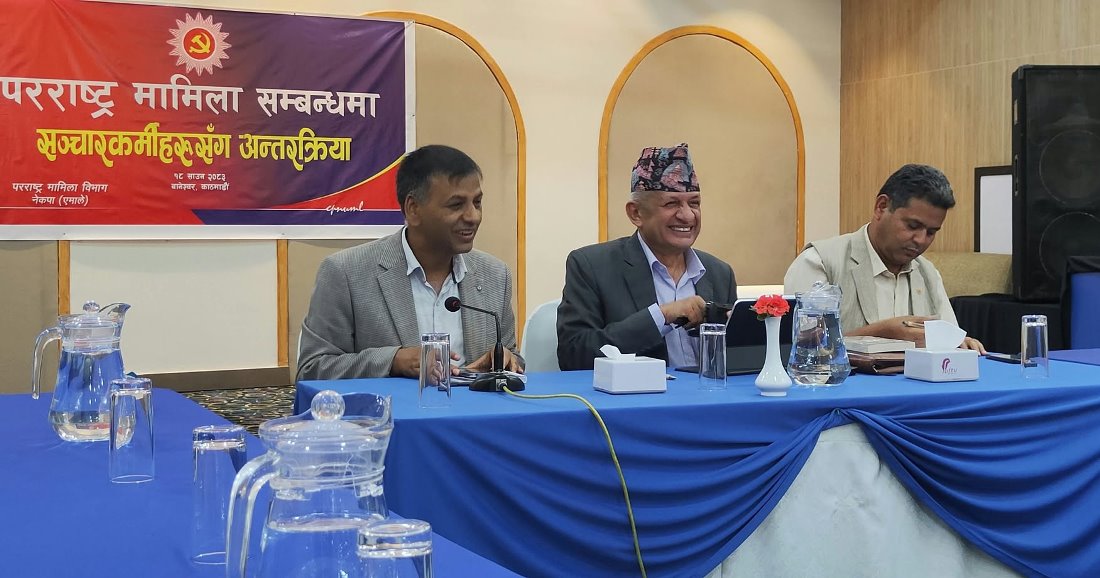
Kathmandu, Aug 4: The main opposition Communist Party of Nepal (Unified Marxist-Leninist) has raised concerns over the foreign policy direction of Prime Minister Balendra Shah’s government, arguing that Nepal is struggling to earn the trust of both India and China while missing key diplomatic opportunities.
Speaking at an interaction with journalists covering foreign affairs in Kathmandu on Monday, former foreign minister and UML Foreign Affairs Department chief Pradeep Gyawali said Nepal was facing growing diplomatic risks despite having significant opportunities.
“Nobody is taking Nepal seriously after the political change,” Gyawali said. “The government has many opportunities, but it also faces many risks.”
His remarks came four months after Shah assumed office. During that period, the prime minister has not made an official visit abroad and has not held one-on-one courtesy meetings with any foreign ambassador. Instead, he has met ambassadors twice in group settings, a move seen as reflecting his strict adherence to diplomatic protocol.
Meanwhile, Foreign Minister Shishir Khanal has paid official visits to both India and China in what observers see as an effort to reassure Nepal’s two neighbours and rebuild confidence.
Gyawali criticised the government’s reported description of Nepal as a “buffer state,” saying the country had never officially adopted such a characterisation in the past.
“Are they trying to change the country’s fundamental foreign policy course?” he asked.
According to Gyawali, neither India nor China fully trusts the current government, and that lack of confidence could have consequences beyond party politics.
“The impact will not be limited to the ruling party. It will affect the country,” he said.
While disagreements with neighbours are natural, he argued that they should never come at the expense of long-term partnerships.
“Risks have increased, and distrust exists on both sides. India appears willing to engage, but this gap is not healthy,” Gyawali said. “How can Nepal move forward without engaging both India and China? Building the best possible relations with both neighbours is in Nepal’s national interest.”
He also claimed that the United States has stepped up its security interest in Nepal, pointing to the visits of American security officials since Shah became prime minister.
Gyawali further said some of Shah’s remarks on Nepal’s border issues were “self-defeating” and could weaken the country’s position in future negotiations, although he acknowledged that the prime minister later attempted to clarify his comments.
At the same time, he praised Shah for observing diplomatic protocol, saying protocol itself serves the national interest.
“If a country sends an ambassador and the prime minister says the level does not match, how would that country view Nepal?” he asked.
Gyawali also criticised the lack of consultation between the government and political parties on foreign affairs.
“There has been very little dialogue between the government and political parties on foreign policy. The prime minister has not initiated such consultations, and that is not a good sign,” he said.
He also questioned the government’s open application process for ambassadorial appointments, saying the approach generated more publicity than results.
“The government should identify capable individuals for ambassadorial posts. People with self-respect do not apply for such positions through an open competition,” he said.
The government earlier invited applications for ambassadors to 13 countries, the first such exercise in Nepal’s history. Around 4,000 applications were received, and about 3,000 applicants were shortlisted, but appointments have yet to be recommended. Nepal currently has ambassadorial vacancies in 18 diplomatic missions.
Gyawali concluded by warning that Nepal’s internal unity had become “fragile” and said the country remained vulnerable to further challenges if political divisions persist.
People’s News Monitoring Service

Login to add a comment