







Kathmandu, August 4: The Government of Nepal has lodged a protest with India over an incident in which Indian security personnel entered the Susta area of West Nawalparasi on Sunday and demolished a temporary earthen embankment built by local residents for flood control.
A Foreign Ministry official said the Nepali Embassy in New Delhi raised the issue with India’s Ministry of External Affairs on Sunday. According to the official, the Nepali side also expressed its objection to the conduct of the Indian security personnel.
However, the Indian side reiterated its position that no new structures should be built in the disputed area, arguing that doing so would violate the existing “status quo” between the two countries.
Tensions briefly flared on Sunday after Indian security personnel in plain clothes entered Nepali territory and began dismantling the earthen embankment constructed by local residents. The situation returned to normal after coordination between Nepal’s Armed Police Force (APF) and India’s Sashastra Seema Bal (SSB).
Susta and Kalapani are the two major border dispute areas between Nepal and India. In 2014, the two sides agreed to resolve the disputes through a foreign secretary-level mechanism and the Boundary Working Group. However, no meeting at the foreign secretary level has been held since then.
Two months ago, the Sashastra Seema Bal (SSB) also halted the construction of a permanent flood-control embankment that the Government of Nepal had begun building. Deepak Nepal, Chief District Officer of West Nawalparasi, said on Monday that the situation in Susta remained normal.
The Government of Nepal has awarded a contract to construct a 132-metre-long flood-control embankment along the Narayani River. According to local officials, the permanent embankment has not been built in that section because of objections raised by the Indian side.
Although embankment construction has been completed elsewhere, only this 132-metre stretch remains unfinished. In the absence of the embankment, erosion along the Narayani River has continued to worsen. Local residents said the Indian side has also prevented them from constructing temporary protective structures on undisputed Nepali territory outside the disputed area. According to the locals, floodwaters enter the village through this vulnerable section during the monsoon season.
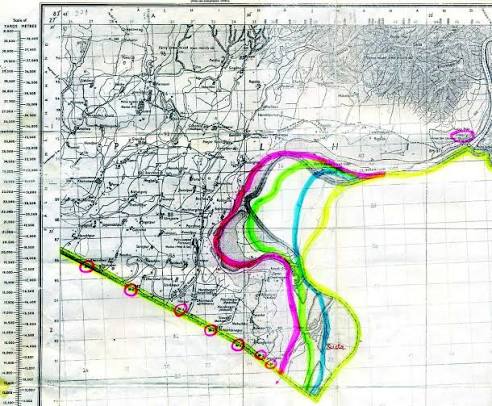
According to former Director General of the Survey Department, Buddhi Narayan Shrestha, Nepal and India agreed on December 8, 1988, to recognize the Narayani River as a boundary river based on the principle of a “fixed boundary.” Under this principle, the international boundary is determined by the river’s course at the time of the agreement. Even if the river subsequently changes its course, the boundary itself does not. However, as the Narayani River has shifted its course over the past decades, disputes over land ownership and boundary claims have become increasingly complex.
The spokesperson for the Susta Samrakshan Abhiyan (Save Susta Campaign), said local residents were forced to build a temporary earthen embankment to protect the settlement after construction of the permanent embankment was obstructed.
Two weeks ago, 52 local residents led by Munna Khan of the Susta Samrakshan Abhiyan travelled to Kathmandu and staged a demonstration at Maitighar Mandala. They met Home Minister Sudhan Gurung and demanded the establishment of a Nepal Army security post in Susta, an end to the alleged mistreatment of local residents by Indian security personnel, and a stronger presence of the Nepali state in the area.
Meanwhile, India and China resumed border trade through the Lipulekh Pass in Darchula on August 1. Nepal has long maintained that Lipulekh, along with Kalapani and Limpiyadhura, is part of its sovereign territory and has protested the decision by India and China against the use the pass as a bilateral trade route.
People’s News Monitoring Service.

Login to add a comment