







By Our Analyst
Diplomatic visits have picked up pace lately, making the new government quite busy. Meetings are lining up as every major power seems keen to understand the priorities of the new leadership. Since Prime Minister Balendra Shah took office on March 27, the capital has hosted a steady stream of officials from the United States and China. India is now preparing its own high-level outreach. Indian Foreign Secretary Vikram Misri is expected to visit Kathmandu in mid-May, following formal communication and invitation from his Nepali counterpart Amrit Bahadur Rai. The visit is expected to set the stage for broader engagement, including a possible India trip by Shah at the invitation of Prime Minister Narendra Modi.
This wave of visits has drawn attention not only because of its intensity but also because of the narrative surrounding the new government. Critics have been quick to label it as one formed under Western influence, particularly that of the United States. The timing of American engagements, including visits by senior officials, has fed into that perception. At the same time, parallel outreach from China and India has complicated the picture, making it less about one influence and more about competing interests converging at once.
Nepal has long occupied a sensitive geopolitical space. Positioned between India and China, and increasingly engaged by the United States, the country finds itself in a constant balancing act. That reality has not changed with the new government, but the early days of its tenure have made the balancing more visible.
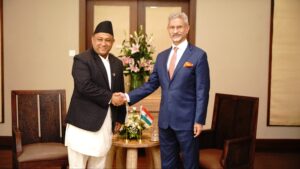
India’s approach remains rooted in proximity and interdependence. The two countries share deep economic ties, an open border, and a wide range of institutional mechanisms that cover sectors from trade to water resources. Many of these mechanisms have been underutilised or delayed in recent years. The upcoming visit by Misri appears aimed at reviving these channels and aligning them with the priorities of the new government. Recent discussions between Foreign Minister Shisir Khanal and his Indian counterpart S Jaishankar in Mauritius reflect this intent. Both sides have agreed to activate bilateral mechanisms and move towards more structured engagement before high-level visits take place. India’s interest lies in clarity and continuity. A new government in Kathmandu often prompts a recalibration, and early engagement helps avoid drift.
China’s engagement follows a quieter but steady pattern. Its recent diplomatic presence in Kathmandu signals continuity in its approach. Beijing has focused on infrastructure cooperation, connectivity, and political stability in Nepal. It tends to avoid public pressure but remains attentive to shifts in political alignment. For China, Nepal is both a development partner and a strategic neighbour. Stability in Kathmandu aligns with its broader regional interests.
The United States, meanwhile, approaches Nepal through governance, development cooperation, and strategic outreach under its broader regional framework. Visits by American officials have drawn attention partly because of domestic political narratives. The claim that the government was formed under Western backing has gained traction in some quarters, though it remains more political rhetoric than established fact.
The government’s cautious handling of diplomatic engagement reflects an awareness of this sensitivity. Prime Minister Shah has so far followed a strict protocol, avoiding meetings with visiting officials below the rank of foreign minister. This has created some uncertainty around engagements, including the upcoming visit of US envoy Sergio Gor. Within the government, there appears to be a more pragmatic view. Leaders like Finance Minister Swarnim Wagle and Foreign Minister Khanal have been encouraging broader engagement with all key partners. Their focus has been on maintaining continuity in relationships that support Nepal’s development and economic needs.
The challenge for the new government lies in moving beyond perception and defining a clear foreign policy approach. Nepal’s strength has historically come from its ability to engage multiple partners without aligning too closely with any one of them. That approach requires consistency, clarity, and active diplomacy. At the same time, internal coordination becomes crucial. Diplomatic visits can open doors, but outcomes depend on how well the government aligns its priorities and communicates them.
Without clear direction, even the most frequent engagements risk becoming symbolic rather than substantive. The current flurry of visits offers both opportunity and pressure. India wants reassurance and continuity. China seeks stability and steady cooperation. The United States looks for engagement within its broader strategic framework. In the end, Nepal’s position has not changed. It remains a country that draws attention because of where it stands. Managing that attention has always been part of governance.

Login to add a comment