







By Our Reporter
Kathmandu’s financial markets are currently under intense pressure following allegations of a coordinated share manipulation scheme involving Nepal Reinsurance Company (Nepal Re). What initially appeared as isolated regulatory violations has now widened into one of the most complex market scandals in recent years, linking brokers, insurers, listed companies, and influential business groups.
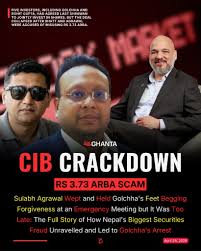
At the centre of the investigation is Deepak Bhatta, founder of Infinity Holdings, who was arrested on April 2, 2026. He is accused of orchestrating insider trading, artificial price inflation, and illegal credit-based share transactions worth billions. Investigators allege that he structured a trading loop in which shares were acquired cheaply through private entities and later sold at inflated prices to institutional investors using public and policyholder funds.
Shortly after, Sulabh Agrawal, director of Shankar Group and chairman of Jagdamba Holdings, was arrested on April 4 on charges of money laundering and collusion in manipulating share prices through interconnected corporate entities. Former FNCCI president Shekhar Golchha was arrested on April 23, identified by regulatory reports as a facilitator who allegedly enabled questionable transactions linked to Himalayan Reinsurance during his leadership tenure.
The investigation has since expanded to several other figures, including Shankarlal Agrawal, Shubhi Agrawal, Raj Bahadur Shah of Jawalakhel Group, Rishi Raj More of Lucky Group, and Sandip Chachan of Bhrikuti Stock Broking. Multiple institutions such as Himalayan Reinsurance Limited, Nepal Micro Insurance, Himalayan CapServ, and HLI Large Cap Fund are now under scrutiny.
Authorities believe a closely linked network of companies under the Himalayan Group umbrella played a central role in accumulating nearly 6.87 million shares of Nepal Re, creating concentrated ownership that influenced market pricing. The alleged misuse of insurance funds has become a major concern, particularly because life insurers are legally restricted in their stock market exposure. Yet reports suggest these limits were exceeded.
The controversy has also raised questions about regulatory oversight. The Nepal Insurance Authority recently increased the equity investment ceiling from 10 percent to 15 percent even after violations were reported, prompting criticism of regulatory capture and delayed enforcement.
However, beyond the legal and regulatory concerns, the scandal has triggered a strong reaction from traders and entrepreneurs. Market participants argue that the ongoing arrests and aggressive enforcement actions are discouraging investment sentiment and creating fear among legitimate business operators. They say the current environment risks punishing the broader private sector for the actions of a few individuals.
Kathmandu’s leading private sector bodies—the Federation of Nepalese Chambers of Commerce and Industry (FNCCI), the Confederation of Nepalese Industries (CNI), and the Nepal Chamber of Commerce (NCC)—have jointly voiced concern over the situation. They argue that while accountability is necessary, arrests based solely on preliminary regulatory findings create uncertainty in the business environment.
Their statement emphasizes that the private sector contributes around 81 percent to the economy and 86 percent to employment, warning that continued instability could disrupt jobs, supply chains, banking flows, and overall economic recovery. Entrepreneurs insist they are willing to cooperate with investigations and appear before authorities when required, but argue that detention before due legal process undermines trust.
The broader concern is that investor confidence is already weakening. Retail investors, who dominate NEPSE trading, are increasingly worried that market movements are being influenced by powerful institutional actors rather than genuine economic fundamentals.
This crisis has exposed deep structural weaknesses in Nepal’s capital market. Weak enforcement, overlapping roles of brokers and institutional investors, and delayed regulatory responses have allowed systemic risks to accumulate over time. The blending of insurance funds with speculative trading has further blurred financial boundaries.
Experts argue that cleaning up NEPSE requires more than arrests. Regulators must be strengthened and insulated from political and corporate influence. Surveillance systems need upgrading to detect abnormal trading in real time. Insurance funds must be strictly separated from speculative equity exposure, and ownership structures of brokers and investment firms must be fully transparent.
There is also a growing demand for accountability within regulatory bodies themselves. When oversight institutions appear to change rules after violations occur, credibility weakens further. Prevention, not reaction, must become the guiding principle.
At its core, the Nepal Re case is not just about individual wrongdoing. It reflects a system where institutional money, policyholder savings, and corporate networks intersect with limited oversight. If left unaddressed, it risks turning the stock market into a controlled space for a small group of insiders.
For now, arrests have sent a strong signal. But traders warn that without deeper reform, fear will replace confidence. And when markets begin to run on fear instead of trust, recovery becomes far harder than correction.

Login to add a comment