







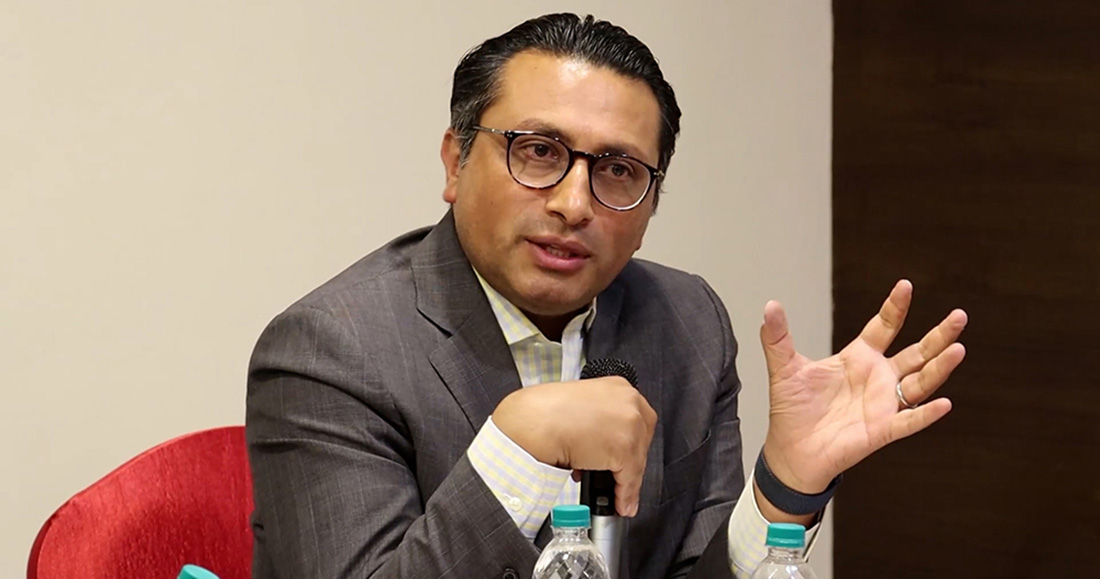
Kathmandu, April 28: Finance Minister Swarnim Wagle has delivered a blunt assessment of Nepal’s economy, describing it as stuck in a persistent unproductive cycle that threatens long-term stability and growth.
Presenting the State of the Economy Report on Monday, Wagle said the economy continues to struggle with deep structural weaknesses despite political stability under a government backed by a near two-thirds majority in Parliament. The report suggests that growth is being constrained less by short-term shocks and more by long-standing policy failures and institutional bottlenecks.
One of the key concerns flagged is Nepal’s placement on the international grey list due to shortcomings in anti-money laundering and counter-terror financing standards. Wagle warned that this has weakened global financial credibility and made it harder to attract foreign investment at a time when external capital is increasingly important for development. He also noted that while Nepal is on course to graduate from the least developed country category, sustaining that progress remains uncertain without major reforms.
The report paints an economy still heavily dependent on traditional agriculture, with a gradual but uneven shift toward services. Industrial growth remains weak, limiting job creation and forcing a large share of the workforce to seek employment abroad. Hydropower expansion, though significant, has not yet translated into wider structural transformation.
Despite abundant natural resources, including forests and minerals, their economic contribution remains minimal. The services sector has expanded, but it has not generated enough productive or decent jobs to absorb the growing labor force, reinforcing Nepal’s reliance on remittances as a primary income source.
Fiscal pressures remain serious. Revenue collection has consistently fallen short of targets, the tax base remains narrow, and the informal economy continues to dominate. Much of the budget is consumed by recurrent spending, while weak capital expenditure undermines development outcomes. Rising public debt, arrears, and unpaid liabilities are adding further strain.
Although credit expansion by banks has increased, lending has not significantly supported productive industrial investment. Investment remains sluggish even in a low-interest environment. Foreign aid is declining, foreign direct investment remains below expectations, and trade imbalances continue to widen due to import dependency.
Wagle also highlighted distortions in the political economy. He said costly elections, opaque financing, and oversized party structures have turned politics into what he described as a “profession and investment channel” rather than public service. This, he argued, has encouraged policy capture, rent-seeking, and crony capitalism.
Instead of innovation-driven growth, access-based systems built around licenses, contracts, and regulatory influence have become more dominant. This has discouraged competitive entrepreneurship and weakened incentives for productive investment.
The report further notes a dual failure of institutions: markets have not become dynamic, and the state has not become sufficiently accountable. Weak property rights, poor contract enforcement, and regulatory unpredictability continue to discourage long-term investment.
Expanding welfare commitments without assessing fiscal sustainability could also create future intergenerational burdens, Wagle warned. For now, Nepal’s economy remains anchored in remittances, foreign employment, and limited domestic job creation.
Despite these challenges, the report describes the current phase as one of transition. The government aims to push economic growth to 6–7 percent annually, raise per capita income beyond 3,000 US dollars, and expand the economy to around 100 billion dollars within five years.
Priority sectors include energy, agriculture, tourism, and information technology. Plans include expanding hydropower capacity to 15,000 megawatts, modernizing agriculture, boosting agro-processing, and strengthening tourism infrastructure. Digital technology, including AI and IT services, is also identified as a potential growth driver.
The report concludes that sustained progress will depend on improving governance, ensuring policy stability, strengthening public service delivery, and building a predictable investment environment. Without that, the cycle Wagle described may simply keep spinning in place.
People’s News Monitoring Service

Login to add a comment