







By Our Diplomatic Analyst
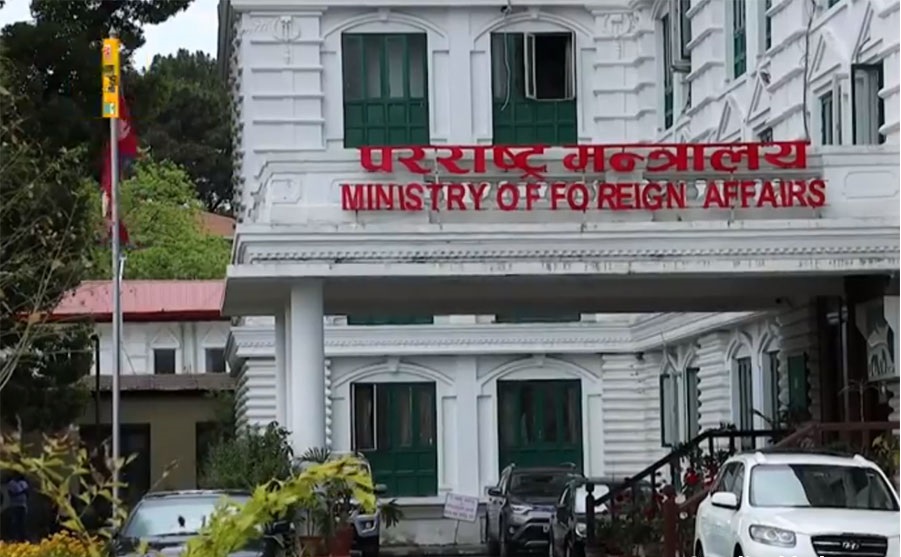
The use of foreign policy language often sheds light on how a country is seen and how it sees itself. That is why the government’s recent description of Nepal as a “buffer state” has raised concern among foreign policy experts. The issue surfaced when the Office of the Prime Minister and Council of Ministers released a draft national commitment framework. The document presents Nepal as a “buffer state” aiming to become a “vibrant bridge” between India and China through economic cooperation and connectivity. It also refers to a policy of “equidistance and equi proximity,” suggesting Nepal will maintain balanced relations with all countries.
At first glance, the framing appears balanced. But the choice of words creates a problem. In international relations, a buffer state refers to a smaller country located between two rival or potentially hostile powers, acting as a neutral zone to reduce conflict. The term carries historical baggage. It comes from a period when powerful states shaped smaller ones into strategic cushions. It also assumes limited agency for the country being described.
Former foreign minister Pradeep Gyawali has pointed out that Nepal has never formally described itself as a buffer state. More importantly, the relationship between India and China does not fit the rigid model that the term implies. The two countries compete in some areas, but they also cooperate in trade, diplomacy, and global platforms. Describing Nepal as a passive space between them simplifies a more complex regional dynamic.
Analyst Chandra Dev Bhatta raises another concern. Even if the term has theoretical grounding, it sends the wrong message. It suggests that Nepal’s role is defined by others rather than by its own choices. That kind of framing does not help build confidence, either domestically or internationally.
This matters because the issue is not only semantic. It touches on how Nepal positions itself as a sovereign state. Nepal has maintained independence throughout its history. It has developed its own diplomatic practices and political identity. Reducing that to a buffer role risks overlooking that record. Nepal’s own history offers a different perspective. King Birendra rejected the idea of Nepal as a buffer and instead described it as a bridge between two major civilizations. That idea focused on connection, cooperation, and mutual benefit. It presented Nepal as an active participant rather than a passive space.
The current document tries to combine both ideas by using “buffer state” and “vibrant bridge” together. But the two do not sit comfortably. A buffer implies distance and separation. A bridge implies connection and engagement. Using both terms in the same framework creates confusion about Nepal’s intended role. The use of “equidistance” and “equi-proximity” raises similar concerns. These terms suggest a fixed balance in foreign relations. In practice, diplomacy does not work that way. Countries adjust their relationships based on economic interests, security concerns, and changing regional conditions. A rigid interpretation can limit flexibility and reduce foreign policy to a formula.
There is also a broader issue behind these choices. Terms like “buffer state” often originate from the perspective of larger powers. They describe smaller countries in relation to others, rather than on their own terms. When Nepal adopts such language, it risks reinforcing a view that places it in a secondary role. Geography, of course, cannot be ignored. Nepal lies between India and China, and that location shapes its opportunities and challenges. Trade routes, connectivity projects, and regional cooperation all depend on this reality. But geography should guide strategy, not define identity.
Nepal can engage both neighbors while maintaining an independent position. It can expand economic ties, improve infrastructure links, and take part in regional initiatives without adopting labels that limit its role. A clear and confident foreign policy would focus on interests, not inherited terminology.
The government still has room to refine its approach. Rethinking the language in official documents would be a useful step. Choosing words that reflect sovereignty and agency would better align with Nepal’s long-term interests. In the end, how a country describes itself matters. Labels shape expectations, both at home and abroad. Nepal has the history, capacity, and position to define its own role. It does not need to rely on terms that reduce it to a function between others. Nepal is better understood as an independent state engaging with its neighbors on its own terms. That is a more accurate description, and a more useful starting point for foreign policy.

Login to add a comment