








Narayan Prasad Mishra
We all know we had the Rana regime, the family rule of the Ranas until 1951. Until then, Tribhuvan Bir Bikram Shah Dev was our King. After his death on March 14, 1955, his son Mahendra Bir Bikram Shah Dev became our King. The rule of King Mahendra (June 11, 1920-January 31, 1972), the father of King Birendra, and King Gyanendra, was not long ago. He was the King of Nepal from 1955 to 1972 and ruled the country for about 17 years. We still have a large number of people living who witnessed his rule. I am also one of them.
Not only did I witness his rule, but I also had an opportunity to have an audience with him and experience him as the first person with a Master’s Degree in Library Science from Delhi University, India, and a man instrumental in creating the Tribhuvan University Central Library. That was the time in 1969 when he visited the library on the auspicious occasion of the annual day of establishing Tribhuvan University. The saintly vice chancellor Sardar Rudra Raj Pandey introduced me to him in the office of Shanti Shrestha, the chief librarian and the first woman in the country with a Master’s Degree in Library Science who became Shanti Mishra after I got married in 1970.
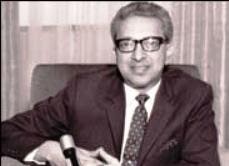
I vividly remember how, with joy, King Mahendra asked me about where and what I studied and also asked me to work for the upliftment of the nation with honesty and dignity when Sardar Pandey presented me to him with great appreciation of my study, knowledge, and dedication for developing the library. My late beloved wife, Shanti Mishra, was so pleased to hear about it, though we were not married then.
The King was a man of dignified personality, polite, humble, and gracious, who attracted and commanded your love and respect not just because of his royal position but because of his well-mannered, lovely behavior. He was so pleased to see the well-organized modern library with various disseminating services, a beautiful arrangement of different sections with valuable books, catalogues, furniture, and the beautiful garden outside. The library was undoubtedly beautiful, attractive, and pleasant then. According to the comments made by one distinguished visitor in this period, “The library is almost like the jewel in the lotus. It is difficult to say which is most attractive and appealing–the exterior or the interior.”. The King congratulated us, and his visit inspired us all. We were happy to have an opportunity to give him a tour of the library.
There should not be any controversy in saying that King Mahendra was an unparalleled role model in protecting our sovereignty and developing this nation. Our history witnesses that we did not even have good motorable road connections from the Kathmandu Valley to most cities and districts. In some parts of Nepal, we even needed to go through India for easy access. He created our East-West Highway with help and cooperation from our friendly countries. He created the Kathmandu-Tibet Road (Kodari Raj Marga), with the help of the Chinese Government and made it easy to access our places and also a foreign land. He initiated and established dozens of industries and factories according to the country’s needs for textiles, clothes, leather, shoes, paper, bricks, agricultural tools, cigarettes, sugar, etc., most of which have been closed and thrown out by the so-called revolutionaries and democrats. We all remember that Indian currency was still circulated and valued rather than our own money in our country. He stopped it with some regulations. He brought about a radical change in the development of all fields—education, administration, social reforms, science and technology, arts and architecture, and literature—by establishing different organizations and offices and enacting new laws. In this context, the establishments of Tribhuvan University, Royal Nepal Academy, and Nepal Rastra Bank, and the enactment of the Muluki Ain (National Laws) and the Land Reform Act are well remembered.
He also established excellent diplomatic relations with all countries, as well as, very cordial relations with our neighbors—India and China–and earned a noticeable prestige for the nation. He taught the people to be disciplined, patriotic, and honest and also to take pride as being proud citizens of an independent country by pushing foreign pressure with his sweet words, smile, and wisdom. Because of it, we could easily resist the pressure from our giant neighbors–political pressure or other pressure. Compared to the long years enjoyed by the present politicians after the introduction of parliamentary multiparty democracy, his period was just half. He visibly took the nation up a noticeable development path during his short period. Unfortunately, he had to take the step to dissolve the then-elected government under B. P. Koirala, then Prime Minister and the leader of the Nepali Congress Party, with reasons he stated in his royal address that were not untrue and seemed based on truths and facts.
Because of his good rule and the contributions mentioned above and many more not mentioned here, his admirers regarded him as the unparalleled hero of the nation. They think he should be respected and revered as a creator of modern Nepal with great love and respect, no less than Prithivinarayan Shah, the founder and creator of the consolidated Nepal. But because of his royal coup and dissolution of the elected government, he was and is regarded as the most condemnable figure by his opponents, especially the leaders and followers of the Nepali Congress Party, who lost their power and positions then. To them, he was a national villain.
However, the independent thinkers think he was an unforgettable national hero but were misunderstood by some because of their biased outlook and, in many cases, because of their ignorance and correct judgment, as, once upon a time, when I was young, I thought the King was power-hungry and took state power in his hands with a royal coup to make himself more powerful. That was because of my lack of knowledge and experience and my biased nature. I detailed it in my article,”Democracies, King Mahendra, and My Ignorance,” published in People’s Review on April 13, 2022. I never wrote any articles on the Panchayat System or King Mahendra during the Panchayat period. I could understand him only after I experienced the selfishness and bitterness of multiparty leaders after the introduction of multiparty democracy in 1990 and witnessed the pathetic state of the country with its unlimited misdoings and corruption. I could understand him only after my beloved wife, Shanti Mishra, and I lost our jobs in 1992 without any fault, just being independent national servers due to the dishonesty of the party politics. We were neither followers of the Panchayat System nor enemies of other systems, leaders, or parties. We were pure professionals who always stood for the profession with truth and justice. We spoke the truth and wanted only justice in our lives, no favor or anything else. To their eyes, it seemed that it had become our unbearable fault. We see the same situation now.
With more than eight decades of life, I can definitely say that people learn more from experience than from study. That is why we say experience makes man wise. But it is also true that studying is a way to learn from other people’s experiences. But sometimes, in the name of educated people, they keep themselves ignorant without experience and study. As a result, millions of educated people are ignorant of the country’s real political history because of their egos, not opening their eyes to see the truth, and being blind followers of political parties.
In the course of changing times and periods, we now have the federal democratic republic system, the system without monarchy. Most of the time, the Nepali Congress, Nepal Communist Party (Maoists), and Nepal Communist Party (UML) were and are in the government. In this context, the parties’ governments think of King Mahendra as a villain of the nation and do not like to open their eyes to see his contributions. We know they installed a statue of a poet, removing King Mahendra’s statue even in Kalimati, Kathmandu, to demean him. What can be more disrespectful and hateful than this?
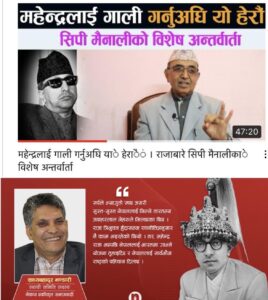
In this situation, I am surprised and happy to see the unforgettable contributions of King Mahendra highlighted based on truths and facts by some communist leaders – 1: C. P. Mainali, the General Secretary of the Communist Party of Nepal (Marxist, Lenninist) 2. Saadhya Bahadur Bhandari is a member of the Standing Committee of the Nepal Communist Party (S). Both are well-known communists and are still very active in their communist activities. Mainali was once the General Secretary of the Communist Party, to which the ex-prime ministers K.P. Sharma Oli, Jhala Nath Khanal, and Madhav Kumar Nepal belonged. Mainali said Nepal could escape the conspiracy and clutches of India due to the wise and farsighted leadership of King Mahendra and could stay independent and sovereign until now. He appreciated King Mahendra’s remarkable contributions to the development of Nepal, including the legal and social aspects. He said these things in his interview with Rohit Bhandari of Ajako Press on December 17, 2023.
Similarly, Bhandari depicted King Mahendra, a savior of the country and the architect of the development model, with examples of the varieties of development he did, as I mentioned above. It was published on nepalpress.com on December 17, 2023. According to the news, the writing was based on his dialogue.
In my opinion, all people–great people or ordinary people–have goodness and weaknesses. However, the degree may be different. When you talk, criticize, or depict someone, you should be honest in saying good and evil about it, not being biased. One should be able to appreciate even the enemy if there is a point to admire. In the same way, one should have the courage and honesty to criticize one’s own father or leader if there is a point to disagree. That is honesty and righteousness. That is also the culture of democracy. In this context, I think King Mahendra is not judged correctly by his opponents, who ignore his valuable contributions to the nation and people. The remarkable things done by King Mahendra cannot or should not be undone just because you do not like him for some reason. We also know that the things done by someone can never be undone or hidden–good or bad. I also think all patriots should study King Mahendra well for the country’s benefit.
The views expressed in this article are the author’s own and do not necessarily reflect People’s Review’s editorial stance.

Login to add a comment