








National/Regional/International Affairs
“The greatest need of our time is to clean out the enormous mass of mental and emotional rubbish that clutters our minds.”
-Thomas Merton.

By N. P. Upadhyaya ( Aryal)
Biratnagar: The victory of Dr. Mohammad Muizzu as the new President of the Maldives in the fresh elections held this September has come as a pleasant surprise for those who wish to see the Islamophobic and “uneducated” Indian Prime Minister Modi defeated in the approaching Indian elections.
India is in shock back-to-back with the election results.
Engineer Dr. Muizzu’s victory indicates that Modi’s aura in the South Asian countries is on the wane, much ahead of the Indian elections.
Indian stooge President Solih’s defeat speaks of India’s decreasing clout in South Asia.
If the election results in the Maldives are any indication, then what is for sure is that its impact will surely be felt in the Indian elections and, to some extent, in the upcoming Pakistan elections in January 2024.
Pakistan may have one energetic, strong nationalist Prime Minister approaching January.
The man who emerged with flying colors in this election in the Maldives was a runner in the Coalition between the People’s National Congress and the Progressive Party of the Maldives.
Moreover, the emergence of Engineer Mohammad Muizzu in the Maldives as President of the Archipelago will politically be registered in South Asian politics as the grand failure of the “neighbourhood first policy” which instead was coercion and intervention first policy.
The grand defeat of the former Maldivian President Ibrahim Mohamed Solih is a tight slap on the face of India which ruled in effect the Indian Ocean Archipelago the Maldives was in effect a rule of Indian proxy.
And this meant by implication that India in tacit arrangement with President Solih had distanced China. He did so under India’s instructions and orders, surely.
With the change of the new guard in Maldives, South Asian commentators say that engineer Dr. Muizzu possesses a soft corner for China.
New President Muizzu is taken as the prime champion and crusader of the vitriolic “India Out” campaign.
This does indicate that Indian hatred in Maldives is increasing with each passing day a la Nepal save a few paid Lendhups Dorjes.
This then again means that the new President Dr. Muizzu shall in all likelihood brave the Indian domination in day-to-day Maldivian politics which has already taken deep roots in Maldivian politics through the Indian diplomatic mission in Male.
Sources even claimed that “instructions and dictates” used to come straight from India’s foreign ministry to the Maldivian government through the Indian diplomatic mission.
I faintly recall, some two years ago, a sea of Maldivian population came out in the streets in Male demanding the immediate removal of the Indian Military presence in Maldives.
The campaign was named as “Indian Military Out campaign” which perhaps was led by former Maldivian President Abdullah Yameen.
Yameen at the start was very friendly to India, however, as the Indian intrusion and interference increased, Yameen kept himself at a distance from India and since then Abdullah Yameen has been widely taken as an “anti-India” political personality by India.
Now with the arrival of President Muizzu having a slight China tilt, let’s for the moment assume that “opposing Indian lobby” has an upper hand whose corollary would be that “pro-China” adherents have now suddenly increased in Maldives.
Diplomacy is never stationary. It is instead ever dynamic.
This then again means that the declared “anti-India “political man Abdullah Yameen would in all likelihood support the new Maldivian President having China bend.
This further means that both India and China shall compete with each other in this part of the Ocean to have a greater say which unmistakably will invite the US-designed security mechanism/apparatus of the QUAD (The US, Australia, Japan and India) not to allow China to increase its political influence.
Among the Quad members, India will be more interested in distancing China from the region which India assumes is her sole prerogative which it is not and should be not.
China too will not lag behind if the Quad strategic partners wish to push China to the wall.
All put together, the entire South Asia more so the middle of the Indian Ocean is likely to become a battlefield of forces: both inimical and antagonists to each other.
Finally, this brings China and the US face-to-face once again.
However, President Joe Biden is shortly meeting President Xi Jinping in San Francisco, California, USA.
Unconfirmed reports say that the President has said that the US side is willing to maintain communication with China and work together to address the global challenges”.
Notably, US Secretary of State Antony Blinken and China’s ace diplomat Wang Yi have already met and have eased the US-China strained ties.
They met in Washington recently.
Yet it is time that the new President of the Maldives takes the determined initiatives to revive the India-slaughtered SAARC whose killing is being witnessed by the current Chair of the SAARC regional body-Nepal-the perfect tail of India and the next SAARC Summit holder Pakistan, a country at the moment heavily engaged in the conduct of its approaching Parliamentary polls scheduled to be held in January-early next year. Maldivian initiative in this regard shall be highly appreciated.
Sovereign Nepal has now become the official servant of the Indian regime, as per the sitting Chinese Ambassador in Kathmandu, Chen Song, “Nepal is unfortunate to have India as its immediate neighbor”.
Perhaps this dictum applies to entire South Asian nations that unfortunately border India.
Yet Bangladesh is lucky enough to have a long, six-lane tunnel built under China’s BRI project.
Should this mean that Dhaka too prefers a distance from coercive Delhi?
A real pain in the neck in South Asia is India. So PM Modi’s defeat is a must which shall at least console the South Asian nations for a while, as the one who commands the seat of government in Delhi will necessarily be a continuation of the same old “Nehruvian doctrine” which is more or less close to the Monroe Doctrine of the US.
The Monroe Doctrine is a US foreign policy position that opposes European colonialism in the Western Hemisphere. It holds that any intervention in the political affairs of the Americas by foreign powers is a potentially hostile act against the USA. The doctrine was central to American grand strategy in the 20th century.
For the record, US President James Monroe first articulated the doctrine on December 2, 1823. (Wikipedia).
Foreign policy change in Maldives:
With the election results and engineer Muizzu being declared as the new President, South Asian commentators have reasons to believe that some “foreign policy” changes may be in the pipeline which may, for sure, heighten the India-China intense rivalry to secure its space in the Maldivian politics.
Undeniably, China in recent months, more so after October 2023, has been trying to approach as many countries in South Asia and beyond to secure its space as against the speed with which the Quad strategic partners, individually and collectively both, are trying to halt the Chinese endeavors.
Obviously, as the Quad members wish to expand and enhance their reach across the world, China too is trying to blunt their activities accordingly thus creating a situation that brings China and the US face to face.
India for China is not at all a problem. The 1962 war had already exhibited China’s superiority over India.
Enters Indian Protectorate Bhutan:
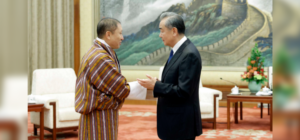
Perhaps emboldened by the election results of the Maldivian Presidential elections and with the emergence of more or less a China-man Engineer Mohamed Moizzu as the new President in Maldives, the Indian protectorate Bhutan has woken up from deep doze.
In a most daring and unexpected move, the Bhutanese Foreign Minister Tandi Dorji left Thimpu for Beijing with a “mission” that speaks of the Bhutanese enthusiasm to come out from the iron clutches of the expansionist Indian regime.
To recall, Bhutan has submitted its Foreign and Defense policies to the mercy of the coercive Indian regime from the Nehruvian days.
This time, however, the Bhutanese foreign minister has set his journey to Beijing without asking permission from the men seated in Delhi.
A grand departure from the registered Bhutan-India bilateral immediate past.
This speaks to many things unspoken indeed.
Foreign Minister Tandi Dorji landed in Beijing on October 23, 2023, and not only met one of the most powerful and knowledgeable Chinese counterparts Wang Yi but also held friendly discussions on how to settle the China-Bhutan boundary talks that satisfied both neighbors.
What puzzled Nepalese observers more was that the two FMs Wang Yi and Tandi, talked about the establishment of diplomatic ties between the two countries that is long overdue due to the denial of the Indian regime.
What may have ‘electrocuted’ the men in Delhi’s administration was the statement and the content which read in part, “Bhutan and China have enjoyed a traditional friendship, and Bhutan firmly abides by the one-China principle and stands ready to work with China for an early settlement of the boundary issue and advance the political process of establishing diplomatic relations.
FM Tandi thanked China for “its strong support and assistance to Bhutan”.
Let’s hope that the gesture of thanks to China by Bhutan must have forced the Indian men controlling Bhutan to gulp several pills of “aspirin” tablets.
Wang Yi assured his Bhutanese counterpart, “China always prioritizes neighborhood diplomacy in its overall diplomacy and adheres to the principle that all countries, big or small, are equals. China respects the sovereignty, independence, and territorial integrity of all countries and the legitimate aspirations and concerns of small and medium-sized countries.”
Dr. Lotay Tsering this March 2023 took the courage to visit Beijing without notifying India.
Highly placed sources in Nepal say that the sitting Bhutani Monarch has a distinct India bend but his cabinet members and the majority of the Bhutani population possess a soft corner for Beijing. Dr. Lotay upon meeting his counterpart in China later talked to the Belgian paper ‘La Libre said, “We do not encounter major border problems with China”.
Our own South Asian diplomatic source claims that a high-level Bhutani team had sneaked into China’s Kunming this year which also went unnoticed by an Indian bullying expert.
The recurring visits by high-placed Bhutan officials to Beijing surely send signals to India that “enough was enough and that the 1949 India-Bhutan bilateral Treaty needed timely review suiting to the changing times. A clear message to India from so far disciplined Bhutan.
All put together, even a dull brain in South Asia could guess that Bhutan-China are inching closer to each other which means that Bhutan wants to break the Indian manacles that force Bhutan to become a tail of India’s noted rogue of South Asia.
Enters Nepal-the Indian tail:
Never ever in history, China was as weak as it stands today. China is the weakest force in Nepal.
It is weak in that China had even invited the sitting Nepal Prime Minister, the India-indoctrinated Prachanda to Beijing.
It was a clear case of seducing the Indian brain hoping against hope that one fine morning Prachanda would be friendly to China. Daydreaming is free in China. No costs are involved. China is hoping against hope.
A politically fatigued China wants to invite as many key officials from Nepal to Beijing as much as it can, once again hoping, that the men visiting Beijing will henceforth have a China bend. This is impossible for some understandable reasons.
After PM Dahal’s visit to Beijing this September, the Chief of Nepal Army Prabhu Ram Sharma was in Beijing upon “actively attending” the meaning loaded 13th Indo-Pacific Armies Chiefs Conference (IPACC) which was held in China’s rival, India between September 25-27, 2023.
China is not that foolish not to have read between the lines of the Nepal Army Chief’s travel to Delhi to attend the IPACC conference.
Media reports circulating in Kathmandu hint that the Nepal Army is not the same army which it used to be in the good old days of Nepal.
Some ‘interested quarters’ like Dr. Swarnim Wagley even openly say that the entire Army Institution is no more than a white elephant and that this elephant needs dissolution or at least demands immediate downsizing.
A weak, feeble, and puzzled China even is set to invite the incumbent Chief Justice of Nepal to Beijing.
For what purpose, the Nepali CJ is being invited is yet a mystery.
Though China is weak in Nepal, yet, its efforts to secure a comfortable political space continue.
And in the process, on September 17, 2023, China sent a special emissary to meet the deposed King Gyanendra.
Our own diplomatic source authentically claims that President Xi Jinping’s special envoy met the King in his current abode in Maharajgunj at about eleven in the evening on September 17, 2023, as stated earlier.
This was the second meeting of Xi Jinping’s emissary with King Gyanendra after 2019. Xi Jinping was in Nepal in the year 2019.
What was interesting about the secret meeting with King Gyanendra-Chinese emissary was that it was timed when the sitting Prime Minister was on his way to the USA to attend the UN General Assembly.
This means that China is desperately searching for a “permanent friend” in Nepal who could well keep erratic India at a distance that in no way harms or say hurts the prime interests of China in Nepal and that being the strict adherence to “One China Policy” and the non-use of the Nepalese soil against Tibet-the underbelly of China.
China’s desperation is at an all-time high for some understandable political reasons.
Let’s hope the San Francisco meeting of Joe Biden and Xi Jinping shall keep world peace intact. The world is safe only when China and the US reconcile. Their confrontation bodes ill for world peace.
The views expressed in this article are the author’s own and do not necessarily reflect People’s Review’s editorial stance.

Login to add a comment