






By M.R. Josse
KATHMANDU: The past week witnessed the commemoration of the 75th anniversary of the world’s first and second – and, thus far, only – instances of planned atomic bombing of population centres. Those fiery holocausts followed the successful maiden nuclear-weapon detonation at a New Mexico desert on 16 July 1945.
That marked the culmination of unflagging efforts by a team of dedicated American scientists, led by Dr. Robert J. Oppenheimer, working on the super-secret $ 2 billion nuclear weapon Manhattan research project which had been operational since August 1942.
SOME BASIC FACTS
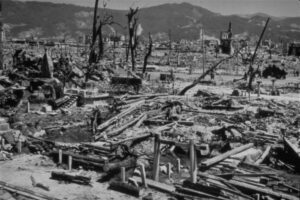
Atomic bomb dropped on Hiroshima on 6 August 1945
The unfortunate Japanese cities of Hiroshima and Nagasaki acquired unsought for historic notoriety by becoming the cataclysmic targets for atomic assaults by United States’ Air Force B-29 bombers, on the 6th and 9th of August, 1945, respectively.
The Hiroshima nuclear weapon – ‘Little Boy’ – was a uranium bomb; the device dropped on Nagasaki – ‘Fat Man’ – was a plutonium bomb, a replica of the test weapon that had been detonated in the New Mexico desert less than a month earlier.
As is generally accepted, the first U.S. atomic bombing of the city of Hiroshima killed a staggering 140, 000 people; the second atomic bomb attack on Nagasaki slaughtered another 70,000. An untold number of others succumbed to injuries and painful radiation-related diseases, in the following decades. The vast majority of victims were civilians.
The Japanese government surrendered unconditionally to Allied forces, led by the United States in the Pacific theatre, at a ceremony aboard the U.S.S. Missouri on 2 September 1945, bringing hostilities of World War II to a close. Japanese foreign affairs minister Mamoru Shigemitsu formally affixed his signature to the Japanese Instrument of Surrender. It followed the solemn announcement of surrender by Japanese Emperor Hirohito on 15 August 1945.
Before proceeding any further, what must not be forgotten is that militarist Japan, led by Gen. Hideki Tojo, had, in course of a carefully planned campaign of conquest in East and Southeast Asia, initiated the conflict in the Pacific with its sudden, massive and viscous aerial attack on 7 December 1941 on the U. S. naval base at Pearl Harbor in the Hawaiian Islands.
It had deliberately done so, without even the customary declaration of war – obviously to gain the strategic advantage of surprise. That aim, admittedly, it achieved.
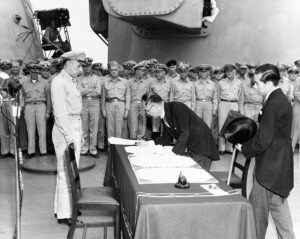
Surrender of Japan
Tokyo’s strategic objective goal was to cripple U.S. naval power in the Pacific. In the event, the bombings killed 2,335 American servicemen and 68 civilians, while wounding 1,178. The other and even more significant consequence was that it triggered America’s entry into World War II that had been raging in Europe and the Pacific and from which she had, till then, studiously stayed out of.
A less known, but important, fact is that the America’s atomic bombing of Nagasaki coincided with the Soviet Union’s declaration of war against Japan, in keeping with Soviet leader Joseph Stalin’s commitment to his American and British allies that Moscow would rescind its neutrality in the Pacific front three months after victory in Europe. Nazi Germany’s unconditional surrender, which formally ended World War II in Europe, took place of 8 May 1945.
Relatively unknown, too, is the nexus between Adolf Hitler’s decision to declare war against the United States – on 11 December 1941 – and the Japanese attack on Pearl Harbor, which caused the United States to declare war against Japan. It is well brought out by British historian Alan Bulloch in his definitive opus Hitler: A Study in Tyranny, (Smith Mark Publishers, New York, 1962), thus:
“When (his foreign minister Joachim von) Rippentrop pointed out that the Tripartite Pact (between Nazi Germany, Fascist Italy and Militarist Japan) only bound Germany to assist Japan in the event of an attack on her by some other Power, and that to declare war on the U.S.A. would be to add to Germany’s opponents, Hitler dismissed these as unimportant considerations.
“He seems never to have weighed the possible advantages of deferring an open breach with America as long as possible and allowing the U.S. A. to become involved in a war in the Pacific which would reduce the support she would be able to Great Britain.”
CONTINUING DEBATE
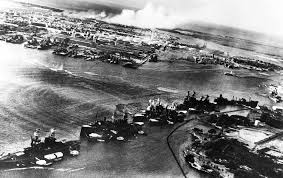
Pearl Harbor bombing
American President Harry Truman’s decision to attack Japan with atomic weapons to precipitate Japan’s surrender and bring about the end of World War II in the Pacific has been controversial right from the start. Opinion has been mainly divided between two schools of thought: one, holding that it was the correct decision; the other, that Japan’s capitulation could have been achieved without unleashing the monstrous power of atomic weaponry.
William R. Keylor provides a useful perspective in his The Twentieth Century World: An International History (Oxford University Press, New York, 1996), thus:
“Truman had been solemnly warned by his military advisers that an amphibious invasion of the Japanese islands would cause almost fifty thousand American casualties and prolong the war for another six months. The temptation to terminate the conflict immediately in a manner that would sacrifice not a single American life outweighed whatever moral qualms American policymakers may have entertained about the particular type of weapon used.
“In any case, the indiscriminate slaughter of civilian populations by conventional aerial bombardment had become an acceptable form of warfare during the Second World War, confirming the Doulter school’s hair-raising prophecies of terror rained upon defenseless civilians from the skies. More people perished in the conventional bombing raids on Dresden and Tokyo than at Hiroshima or Nagasaki.”
Another theoretical argument against the use of atomic weapons against Japan is encapsulated thus: “The capitulation of Japan could have been assured by the imposition of a total naval blockade coupled with the precision bombing of her internal transportation network. This would most likely have starved her into submission within a few months by depriving the people of the food and fuel she needed to survive.”
The counter-argument went as follows: “But in two or three months’ time, the United States might have been compelled, as it had been in Europe, to share the prerogative of filling the power vacuum created by the collapse of the defeated enemy with the Soviet Union.
“By the end of the war, the Red Army had swept into Manchuria and into Korea down to the 38th parallel and had occupied the Kurile Islands and half of the Sakhalin Island. Stalin’s conditions for Russian entry in the war against Japan, which had been earnestly sought by the United States before the development of the atomic bomb, included the recovery of all of the territory and privileges that had been lost by Russia after its defeat by Japan in 1905.”
For the sake of a more rounded picture, note, as Mahir Ali, a columnist in Dawn, recently reminded: “On the day after the Trinity test (in the New Mexico desert), a petition signed by 70 scientists had been sent to President Harry Truman imploring him to give Japan another chance to surrender instead of immediately authorizing the use of atomic weapons.” The statement cautioned:
“A nation which sets the precedence of using these newly released forces of nature for purposes of destruction may have to bear the responsibility of opening the door to an era of devastation on an unimaginable scale.”
In Ali’s opinion, “In the event, the U.S. not only used the weapons but has worn the responsibility lightly, insisting, ever since, despite evidence to the contrary, that the nuclear carnage was necessary for the conclusion of World War II. In fact, Japan was ready to surrender; the only condition was that Emperor Hirohito, potentially culpable as a criminal, should remain on the Chrysanthemum Throne.”
Claiming that many to this day believe that America’s atomic bomb attack on Japan was to deter any overreach by Moscow – that is to say, before the Soviet Red Army could step on Japanese soil – Ali, tongue-in-cheek, adds: “And one must be grateful to the Western ‘traitors’ – including several associated with the Manhattan Project – who shared atomic knowledge with the Soviets. It’s dreadful imagining the possible consequences of an American monopoly over nuclear weaponry.”
As it happened, the Soviet Union conducted its first successful atomic bomb test on 29 August 1949 at Semipalatinsk. According to the Atomic Heritage Foundation, the Soviets had begun research during World War II. Following Hiroshima and Nagasaki, Stalin called for an all-out crash programme on atomic research and development in 1946.
While the United States continued to refine and develop even more destructive forms of atomic power – followed closely by the Soviet Union – many others have since joined in the deadly game though on a much smaller scale. In our region, the first entrant into the ‘Club’ was China, whose maiden successful nuclear test was at the Lop Nor testing grounds, Xinjiang, in October 1964.
As of the present, nuclear weapon states are: the United States, Russia (successor of the USSR), the United Kingdom, France, China, India, Pakistan, and North Korea. It is generally believed that Israel, too, possesses nuclear weapons.
RAMIFICATIONS
Between ‘Hiroshima’ and the present day, virtually endless theories – simple and complex – have been spawned and bandied about nuclear weapons and foreign/security policy, including those touching upon deterrence, massive response, flexible response, limited nuclear war, non-proliferation, horizontal and vertical proliferation and so on – not to mention an ever-increasing reservoir of knowledge/data in the allied lethal field of missile technology.
As far as this exposition is concerned, our focus should be on issues most relevant to Nepal’s inherently dangerous or dire location smack between China and India, and in proximity to Pakistan. As I have expounded quite frequently – but apparently without any effect – our policy makers seem to believe that doing nothing is the best policy.
But what about our Universities: are none even mildly interested in the area of building a programme of Nepal-relevant nuclear studies, situated as we are? And what about the ever-proliferating so-called ‘think tanks’: are they so, only in name, or are they capable of independent research and creative thinking, without backing or funding from external sources?
Attention, at the very least, I believe needs to dwell, among other things, on recognizing that while both China and India have publicly subscribed the ‘no-first-use’ doctrine, Pakistan, clearly because it is inherently inferior to India in terms of conventional forces, has repeatedly declared that, if deemed necessary, she will use nuclear weapons for safeguarding her sovereignty and territorial integrity.
Similarly useful would be encouraging academic studies in the possible effect and mitigation of radioactive fallout in Nepal, whether it is as a result of a nuclear exchange between India and China, or between India and Pakistan – or even in case of an accident.
Those considerations apart, there are some issues that should be carefully noted, including those that touch upon the current regional/international scene, including the ostensible ganging up against China by the United States, Japan, India and Australia.
I find it most absorbing that this grouping – the so-called ‘Quad’ – includes the United States and Japan: the former that unleashed the maelstrom of horror against Japan in Hiroshima and Nagasaki. Similarly, it is quite weird that while Japan, which deliberately set upon the conquest and invasion of East and Southeast Asia – and was responsible for ‘Pearl Harbor’ – should be projected as a paragon of peace and democracy, and lauded, while China which does not have such a history should be demonized.
Australia itself was threatened by militarist Japan; today, Canberra is eager to not just associate with Tokyo, but to join in the anti-China gang-up, at the behest of the United States.
And India seems to have completely forgotten recent history, particularly Japan’s military incursions into Manipur, Japanese bombs being dropped at the Calcutta docks and occupation of much of Southeast Asia – not to talk of the fact that Japan also occupied India’s Andaman and Nicobar Islands. Pray, how does that all that compare with China’s record in the region?
The manifold ramifications of ‘Hiroshima’ and ‘Pearl Harbor’ are indeed worth mulling over.
The writer can be reached at: manajosse@gmail.com
People’s Review Print Edition

Login to add a comment