







By Shreeya Pokharel
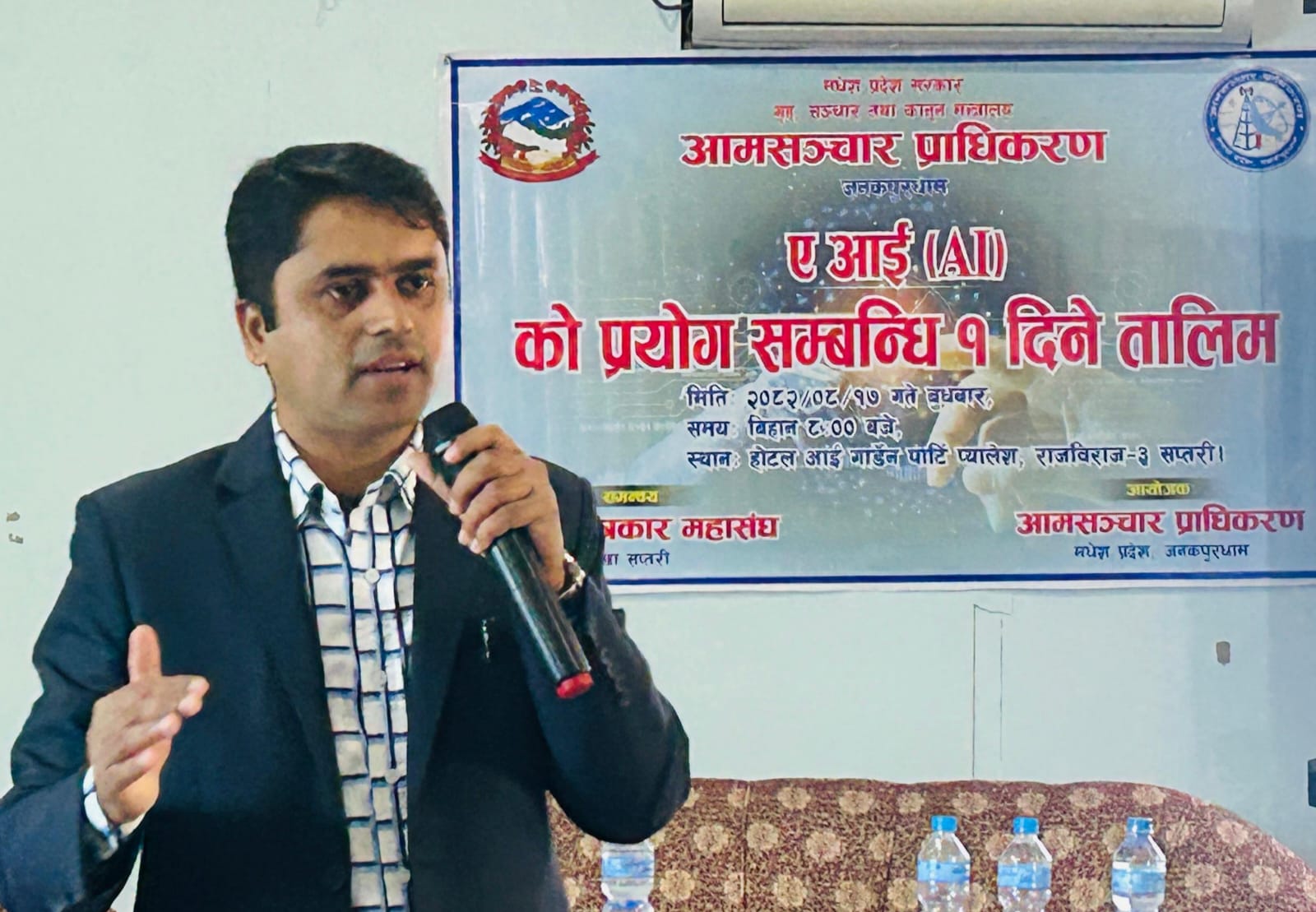
As artificial intelligence continues to find its way into newsrooms, journalists in Nepal are also learning how to understand and use the technology in their work. One of those involved in this effort is journalist and AI practitioner Jeevan Bhandari, who has been travelling across the country conducting AI training programmes for journalists and professionals from other fields.
His journey as an AI trainer began on January 28, 2025 (15 Poush 2081 B.S.), in Rajbiraj, Saptari, with a programme focused on introducing journalists to artificial intelligence and its potential applications in journalism. Since then, he has conducted more than 45 AI training programmes in nearly 40 districts across the country.
According to Bhandari, more than 2,300 people have participated in the programmes he has conducted so far. More than 2,000 of them are journalists, while the others include police personnel, teachers, students and local government officials.
For two consecutive years, Bhandari served as an AI trainer in programmes organised by the Madhesh Province Media Authority in collaboration with district chapters of the Federation of Nepali Journalists. As part of these programmes, he travelled to all eight districts of Madhesh Province, training journalists on the use of AI, its potential in journalism, and the challenges associated with the technology.
Many of his training programmes have been organised by district chapters of the Federation of Nepali Journalists. He has also spoken on AI at an interaction programme for editors organised by Press Council Nepal and Freedom Forum, where he addressed more than 50 editors from leading media organisations in Nepal.
The size of the training sessions has varied. One session held in Siraha was attended by 90 journalists. In Lalitpur, two programmes for journalists and another for students each attracted around 80 participants. Most other sessions have had an average of around 50 participants.
The participants have represented different generations of journalism. Young journalists who have recently entered the profession have attended the same sessions as journalists who began their careers when letterpress printing was still widely used. The training programmes have ranged from one to four days, depending on the organiser and the topics covered.
Bhandari says participants often tell him that the sessions end before they realise how much time has passed. Some have also suggested extending the duration of the programmes and have expressed interest in attending additional sessions to learn more about AI and its applications.
His work in AI education has not been limited to journalists. Through his teaching at Saraswati Campus and Shepherd College, he has also taught more than 50 students about artificial intelligence and its practical applications.
Participants often introduce him as an AI expert, AI trainer or even an AI guru. Bhandari, however, prefers to describe himself as an AI practitioner and researcher. For him, learning about AI is an ongoing process. Since the technology is evolving rapidly, he believes that anyone working with it must continue learning, experimenting and adapting.
His interest in AI began nearly a year before he started conducting training programmes. He learned through a combination of practical experimentation, participation in training sessions, self-study and regular practice. Over time, that experience inspired him to begin sharing his knowledge with others.
Bhandari’s involvement with AI in journalism extends beyond training. He has also played a role in introducing and developing AI-based practices in Nepal’s media sector.
On February 6, 2024 (24 Magh 2080 B.S.), he was involved in the use of an AI presenter to broadcast news in Nepali through Samaya Online TV, one of the earliest examples of AI being used in Nepali-language news presentation.
He later became involved in developing policies and guidelines for the use of AI in the media. On February 13, 2025 (1 Falgun 2081 B.S.), Nepal Radio Network introduced its AI Policy, with Bhandari playing a leading role in its development. On July 21, 2025 (5 Shrawan 2082 B.S.), the Online TV Journalists Association introduced its AI Code of Conduct, in the drafting of which he was also involved.
His experiments with AI in the media have included producing an AI-based radio podcast, as well as using AI to create audio jingles and advertisements. These initiatives reflect his broader interest in exploring practical applications of AI within the media industry.
As AI becomes increasingly relevant to journalism, Bhandari’s work has focused on helping media professionals understand the technology and apply it in their day-to-day work. From training journalists across the country to teaching students and contributing to discussions on AI policies and ethics, his work reflects the growing discussion about how Nepal’s media industry should respond to the rapid advancement of artificial intelligence.
For Bhandari, however, the journey remains one of continuous learning and experimentation. While others may refer to him as an AI expert, he continues to identify himself as a practitioner and researcher—someone who is constantly learning about the technology while helping others understand and use it responsibly.


Login to add a comment