







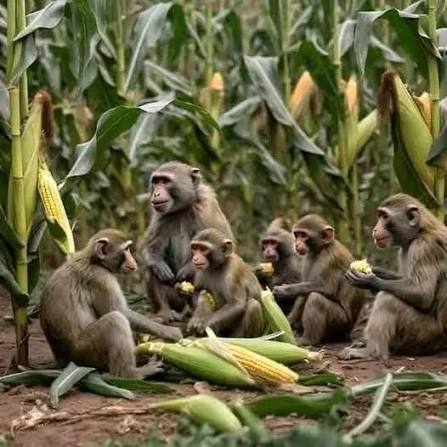
Kathmandu, July 6: For farmers in Nepal’s mid-hill region, the greatest challenge today is no longer the weather, fertilizer shortages, or market access—it is the growing menace of monkeys and wild boars. As forests have expanded closer to settlements, food sources inside the forests have diminished, and wildlife populations have increased, monkeys and wild boars have increasingly ventured into villages. As a result, farmers are often unable to harvest the crops they have cultivated through months of hard work.
Farmers across the districts of Parbat, Baglung, Syangja, Gulmi, Palpa, Arghakhanchi, Kavrepalanchok, Dhading, Gorkha, Sindhuli, Ramechhap, and the eastern hill region are facing the same problem. Monkeys and wild boars are destroying crops such as maize, rice, millet, buckwheat, potatoes, vegetables, and fruits, prompting many farmers to consider abandoning agriculture altogether.
Although farmers have repeatedly appealed to the government for assistance, they accuse the state of remaining a mere spectator, saying that no effective policy has been introduced to address the crisis.
In the past, the forests were thinner, and wild animals could find plenty of natural food there. Now the forests have become denser, but their natural food sources have declined. As a result, monkeys and wild boars come directly into farmlands. Even if farmers guard the fields from morning until evening, they are unable to protect the crops. Sometimes, they wipe out an entire maize harvest in a single day, just when it is ready to be harvested.
Wildlife and monkey expert Dr. Mukesh Chalise says monkeys should not be viewed merely as a nuisance but managed through scientific approaches. According to him, the growing monkey population is only one part of the problem. Changes in forest composition, declining natural food sources, expansion of human settlements, and the availability of food provided by humans have also attracted monkeys toward villages.
The increasing conflict between humans and wildlife is not caused by a single factor; it is the result of multiple interconnected causes, he said.
Dr. Chalise recommends that when monkey populations become excessively dense in a particular area, scientific studies should be conducted, followed by measures such as relocation, population control through reproductive management, restoration of natural food sources, and community-based conservation programs. Simply chasing away or scaring the animals, he said, cannot provide a long-term solution.
The issue of controlling monkeys has been raised repeatedly in both the federal Parliament and provincial assemblies. Although opposition lawmakers have repeatedly drawn the government’s attention to the hardships faced by farmers, a concrete policy has yet to be formulated.
Under the current legal framework, monkeys are protected wildlife and cannot be killed. On the other hand, although wild boars—which cause extensive damage to agricultural land—may be controlled under certain prescribed conditions, the relevant provisions have not been effectively implemented.
People’s News Monitoring Service.

Login to add a comment