







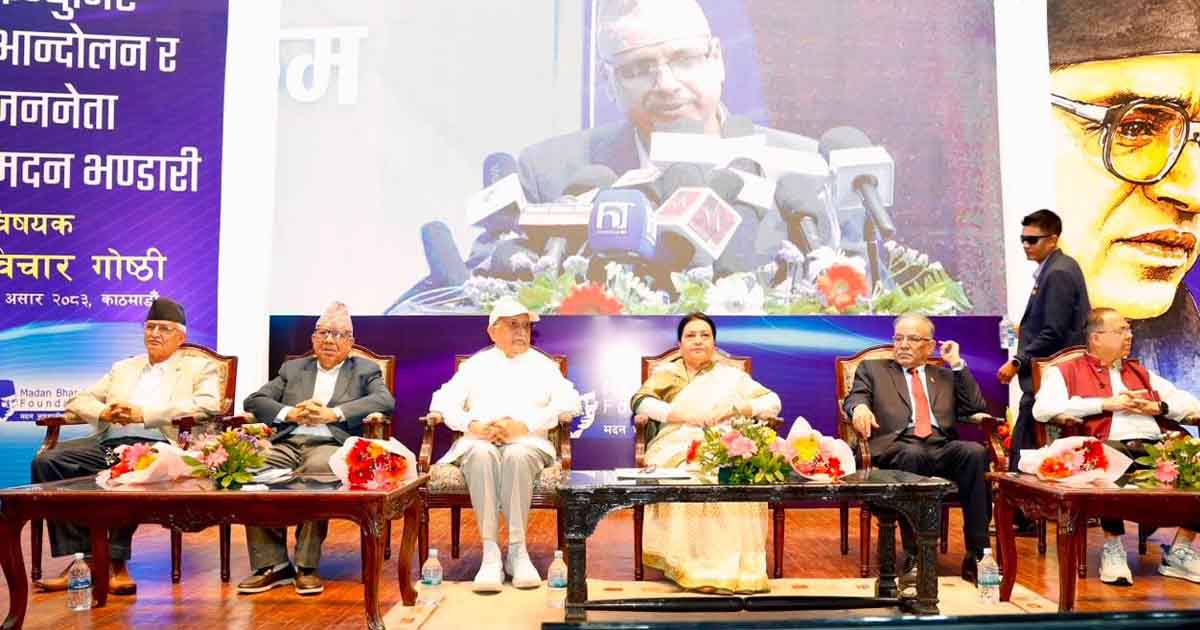
Kathmandu, June 29: Four former prime ministers and a former president shared the same stage on Sunday, delivering a broad message that Nepal’s communist forces need greater unity, even as they exchanged pointed remarks over how such unity should take shape.
The occasion was the 75th birth anniversary of Madan Bhandari, organised by the Madan Bhandari Foundation. Former prime ministers KP Sharma Oli, Pushpa Kamal Dahal “Prachanda”, Madhav Kumar Nepal and Jhala Nath Khanal appeared together with former President Bidya Devi Bhandari, who attended as the chief guest.
It marked one of the rare occasions that the leaders have shared a platform since the breakup of the Nepal Communist Party (NCP), after which they frequently criticised one another.
Despite their differences, the leaders argued that the country faces growing threats to nationalism and democracy. They called for greater cooperation among leftist and democratic forces to counter what they described as regressive politics, while disagreeing on the process and conditions for any future party unity.
Opening the discussion, senior Nepal Communist Party (NCP) leader Jhala Nath Khanal said the event itself should become the starting point for rebuilding left unity. He recalled how relations among communist leaders had deteriorated over the years and argued that unity is now unavoidable.
Khanal said the communist movement had needed unity for years, but personal rivalries repeatedly stood in the way. He urged leaders to transform Sunday’s gathering into a long-term effort toward reunification. He also claimed that communist parties could have secured around 100 parliamentary seats had they contested the February 21, 2026, election together.
NCP Co-chair Madhav Kumar Nepal stressed that unity should come only after serious self-reflection. He said every communist party must review its own weaknesses rather than rush into merger talks driven by emotion or public pressure. According to him, durable unity requires a common ideology, trust, and shared commitment, not merely an organisational merger. He warned against repeating the cycle of unification followed by another split.
Prachanda, who also co-chairs the NCP, argued that left and patriotic forces should unite without delay to defend national sovereignty and resist authoritarianism, fascism and foreign interference. He claimed reactionary forces are trying to weaken communist parties and alleged that recent political developments show increasing attacks on constitutional principles. While acknowledging the need for self-criticism, he insisted the left should move quickly toward cooperation.
Responding to Madhav Nepal, Prachanda clarified that he had never demanded immediate party unification. Instead, he proposed beginning practical cooperation at once, whether in Parliament, on the streets or during elections, leaving formal merger for later.
Oli rejected suggestions that CPN-UML should revisit its policies before discussing unification. He insisted UML’s political, economic, social and cultural policies remain correct and require no negotiation. He said the party continues to follow the principles of people’s multiparty democracy while adapting them to changing times.
Oli agreed that democratic and left forces should work together, though he framed the immediate challenge as defeating regression rather than pursuing socialism. He claimed conspiracies against democracy had intensified after September 23 last year and even alleged that the Nepali Congress had been deliberately weakened.
Aiming for parties that chose different electoral strategies, Oli argued that UML had warned against elections held after Parliament’s dissolution, claiming they legitimised regressive politics. He said other parties dismissed UML’s position at the time but have now reached the same conclusion.
He also alleged that Prime Minister Balen Shah made remarks undermining Nepal’s national interest by claiming the country had encroached on Indian territory. Oli further criticised the Prime Minister for failing to challenge statements made during the Rastriya Swatantra Party’s Chitwan convention.
Former President Bidya Devi Bhandari urged communist leaders not to judge the future of the movement based solely on one election result. She said the latest parliamentary election should serve as an opportunity to strengthen organisational practices, public engagement and political priorities.
Bhandari added that the public’s message must be taken seriously but cautioned against concluding that the people’s multiparty democracy or the communist movement has lost relevance because of a single electoral setback. She called on communist parties to update their policies and programmes to match changing national realities.

Login to add a comment