







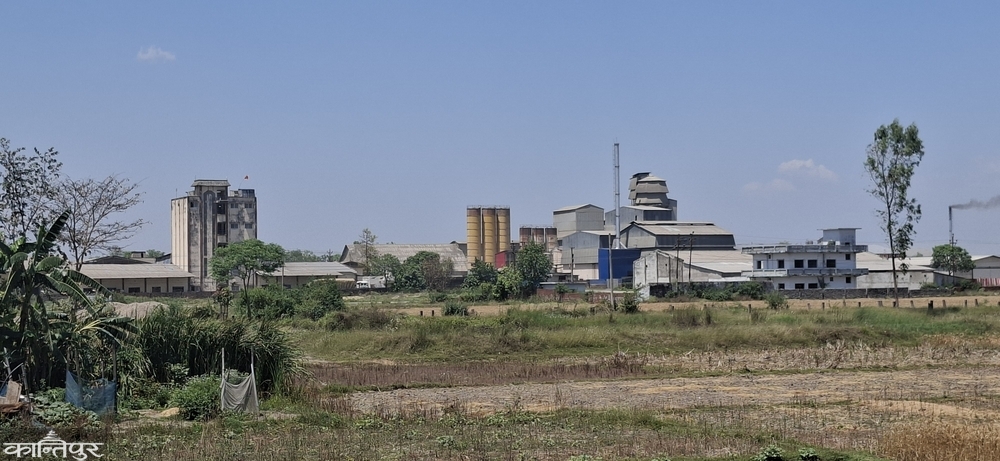
Kathmandu, April 28: The Supreme Court has ordered the government to clear all polluting industries within a 15-kilometer radius of Lumbini, the birthplace of Buddha, tightening a long-delayed push to protect the heritage site.
The Court’s Judgment Implementation Directorate has issued instructions to the Office of the Prime Minister and Council of Ministers, the Home Ministry, the Industry Ministry, and the Lumbini Development Trust to enforce the ruling. The directive follows a full verdict delivered on Bhadra 1 by a joint bench of Justices Kumar Regmi and Sunil Kumar Pokharel.
The order applies to industries emitting dust, smoke, or carbon within 15 kilometres east, west, and north of Lumbini, and up to the Indian border in the south. At least 12 cement factories fall inside this zone.
The Court said the decision aims to safeguard Lumbini’s fragile environment and ensure long-term conservation of the Greater Lumbini Area. The case stems from a public interest petition filed by senior advocate Dr. Prakash Mani Sharma, who argued that unchecked industrial expansion had sharply increased pollution in the UNESCO World Heritage Site.
The petition warned that pollution was harming both public health and key monuments, including the Ashoka Pillar, the Mayadevi Temple, and nearby monasteries and stupas.
In June 2019, the Court had issued an interim order banning new industries within the 15-kilometre zone and directing existing ones to relocate. That order saw little compliance. The latest ruling now makes relocation or closure mandatory within two years.
The Court has barred approval of any new polluting industries in the area. Existing units must either shut down or move elsewhere within the deadline. Industries registered before Mangsir 12, 2067 BS will be given priority in relocation.
The order also covers the Lumbini–Bhairahawa corridor, where the same restrictions apply within 800 meters on both sides of the road. In addition, vehicles carrying more than 19 tons are barred from operating within the Lumbini Development Trust area.
Describing Lumbini as more than an archaeological site, the Court called it a core part of Nepal’s identity and a global spiritual centre. It stressed that protecting the site holds both national and international significance.
A committee formed by the Court earlier had inspected 12 industries in the corridor and found that none had adopted effective pollution control measures. The finding strengthened the case for stricter enforcement.
The ruling directly affects around two dozen large industries in the Lumbini–Bhairahawa corridor. Nineteen firms, including major cement and steel producers, were named as defendants in the case.
Industrialists have pushed back, calling the timeline unrealistic and the policy impractical. Rajesh Agrawal of the Federation of Nepalese Chambers of Commerce and Industry said relocation requires land that is both scarce and costly. He added that rising global costs have already strained the sector, making large-scale relocation within two years difficult.
According to him, the affected industries represent investments exceeding Rs 50 billion and provide direct jobs to about 10,000 workers. He urged the government to create a supportive framework and ensure compensation.
Thakur Prasad Shrestha, president of FNCCI Lumbini Province, said relocation within the deadline is unlikely without state support for land acquisition and environmental approvals. He noted that completing environmental impact assessments alone can take years.
Business leaders also questioned the focus on industries alone, pointing out that vehicles and aircraft contribute to emissions but are not covered by the order. Some suggested that industries meeting strict pollution standards should be allowed to operate, while others should be compensated and relocated.
They warned that forced relocation could trigger job losses if worker transition plans are not in place. They also called for policies to promote tourism-based enterprises in areas vacated by industries.
Critics say the situation reflects policy inconsistency. Industries were approved by the state in the past, only to face removal now. They argue the government should bear relocation costs due to its earlier decisions.
Environmental studies back the Court’s concerns. Research by international and regional bodies has identified industry as the main source of pollution in Lumbini. One study recorded PM2.5 levels at 270 micrograms per cubic meter, far exceeding national and World Health Organization standards.
Despite earlier directives from the Prime Minister’s Office, enforcement has remained weak. More than 40 industries still operate in areas now targeted by the Court.
UNESCO has repeatedly warned Nepal about risks to Lumbini, even considering placing it on the endangered list. While that outcome has been avoided so far, concerns remain.
Monitoring reports also show that although some factories have installed pollution control equipment, many fail to operate them effectively.
Environmentalists say continued inaction will further damage both public health and Lumbini’s heritage. The Court has now set a clear deadline. The challenge lies in whether the government can enforce the order while managing economic fallout.
People’s News Monitoring Service

Login to add a comment