








By Deepak Joshi Pokhrel
Remember the bad days when the country was under the grip of a decade-long armed conflict! There were grave violations of human rights, and forceful disappearances on the pretext of spying. Life of the people across the country was a double-edged sword. Just to recall, in December 2001, Sushila Chadhary with her father, residents of Kailli district, were basking in the sun as it was a holiday. Both father and daughter were cracking jokes and were having a good time. But a ninth-grade student, Sushila Chaudhary, never realized that it would be the worst day of her life. A dozen security personnel in combat fatigues with faces covered by bandanas came to their house and accused her father of making explosives and supplying them to rebels. They barged inside our home, and pinned my father on the floor with his face down. They furiously hit him on his back and dragged him outside the house. When I heard gunshots, I thought they had killed my father but they had only fired in the air. After he was injured, they took him along with them. The Tharu, Dalit and other downtrodden communities were branded Maoist cadres and subjected to torture, intimidation and disappearance. Twenty-two years have passed since the horrifying incident. His whereabouts are still unknown. The victim’s family are impatiently waiting with the hope that he will return home. This is just a representative of such cases. There are several others.
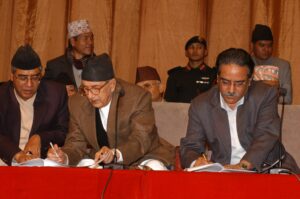 Fortunately, the dance of death came to an end with the signing of the Comprehensive Peace Accord on 21 November 2006. The then government led by Girja Prasad Koirala and former rebels under the leadership of Prachanda, among others, agreed to form the transitional justice mechanism to settle the war-era crimes within two years. However, even as the country marks the 17 anniversary of the deal the other day, not a single victim has got justice.
Why the peace process has been marred by broken promises and political manoeuvring. What has really gone wrong? When the victims of decade-long armed conflict will get justice? These key questions deserve convincing explanations.
Building peace after armed conflict is a multifaceted process which, according to Hanggi (2005), encompasses activities around three major dimensions: security, political, and socio-economic. Smith (2000) suggests that post-conflict peace-building initiatives should focus on four major dimensions: creating a socio-economic foundation, improving and maintaining security, building and strengthening institutional and political framework, and promoting post-conflict reconciliation. But all these aspects have been disregarded at its core.
Transitional justice bodies were formed with a noble intention in 2015. They agreed to resolve the war-era crimes considering the victims. Reparation for victims, truth-seeking and institutional reform were its entrusted tasks. However, the transitional justice bodies remained an entity without any essence as it did not deliver any substantial result even within eight years of its establishment.
Many blamed the politicians for making it a body without any essence. They hold the view that politicians have not collaborated and supported the transitional justice bodies and rendered them dysfunctional. The reason is simple. A vibrant and functioning transitional justice body could drag them to court and put them behind bars for their involvement in grave violation of human rights during the decade-long armed conflict.
Likewise, the executive members of the commissions are not appointed based on meritocracy and personal experience. Their academic and professional experience is not taken into consideration. What generally matters is their political affiliation and commitment to dance to their tunes after being selected. Logically speaking, the politicians appoint the executive members who pledge loyalty to them negating the selection process. It is stupidity to expect that such select crooks will work in the true spirit of service.
The victims are also not satisfied with the way the transitional justice bodies are functioning. The conflict victims are not consulted while drafting the laws and policies that matter to them. This contravenes the accord which clearly states that there should be consultation with the victims when laws and policies are drafted. But this has remained only within the papers. This is where the peace accord has faltered and faltered miserably.
Even the international communities have been expressing dissatisfaction over the progress of the peace process in Nepal. United Nations Secretary-General Antonio Guterres, was recently in Nepal to assess the peace process and other challenges Nepal has been facing. In his address to the joint meeting of federal parliament on October 21, Guterres said the transitional justice process can only succeed if it is inclusive, comprehensive and has victims at its heart and it centres on truth and reparations but also justice. The United Nations stands ready to support to development of a process that meets international standards, Supreme Court’s rulings, and the needs of victims—and to put it into practice. With these remarks, he has clearly sent the message that the United Nations want to see the peace process come to a logical conclusion very shortly
Nepal’s peace process is currently in deep crisis. The future of peace in Nepal largely hinges on the transitional justice bodies. Further delay in the logical conclusion of the peace process could sow the seed of yet another bout of civil unrest in an already conflict-torn country. Peacebuilding is not just writing a peace agreement or a new constitution. It is about rebuilding healthy relationships between civilians as well as between citizens and the state. It is also about creating a harmonious society with people enjoying peaceful livelihoods and a sense of safety and security.
The views expressed in this article are the author’s own and do not necessarily reflect People’s Review’s editorial stance.

Login to add a comment